Primary source Research Square: A Mechanistic Digital Twin for Dual-AAV Bioprocessing and Multi-Gene Base-Editing Payload Delivery
A single-author preprint posted on Research Square describes a computational digital twin for dual-AAV bioprocessing. The page states that the work “has not been peer reviewed by a journal”. The abstract is the only text this piece draws on, and it says all analyses are computational and that no experimental validation is claimed.
What the authors built
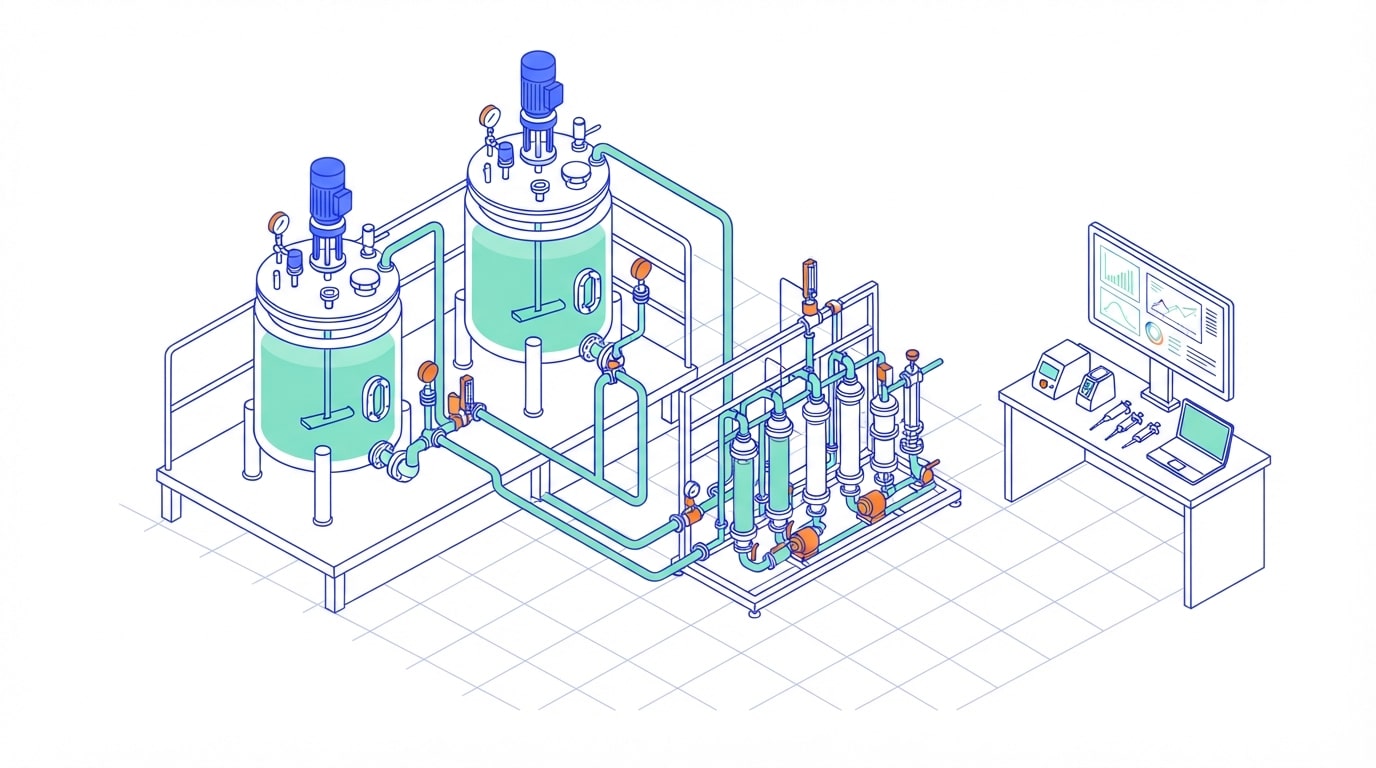
Dual-AAV delivery splits an oversized editor across two adeno-associated virus vectors. The preprint says this couples vector manufacturing, product quality, co-delivery and gene correction, and that process models rarely carry this coupling or state what their data can identify. Their answer is a modular twin spanning manufacturing, dual-vector reconstitution and gene-specific correction.
What the abstract reports
- An independent reconstruction of a published 21-state production model agreed across three stiff solvers (numerical integration methods) to within 0.14%.
- The same reconstruction still differed from the published source observations by 21.8% on average (mean absolute gap) at 46 h.
- Its 14-parameter space was rank-deficient (12/14), so the data cannot separate all 14 parameters. The condition number, a measure of how ill-determined the fit is, was 6.4×10²¹ and improved to 6.0×10³ after the model was reduced.
- Across fourteen scenario studies, variance-based sensitivity analysis assigned 52% of functional variance to the A:B ratio. A correlation screen assigned it 2%. The abstract does not define the ratio further, and the result holds within the assumed surrogate equations and input distributions.
- Titre-only release classified function at chance (AUC 0.49), against 0.98 for a functional assay. AUC is a score for how well a test separates functional from non-functional product.
Limits
These numbers come from simulations built on assumed equations and input distributions. The abstract does not report any lab or plant data from the authors, and it does not name a site, a company or a scale. The full text was not available on the page we opened, so methods are not covered here.