AAV vectors made by transfection of HEK293 cells are released by lysing the cells, and the lysis also releases host cell DNA. The usual answer is an endonuclease step before clarification. Garima Thakur, Sheldon Mink, Hanne Bak and Andrew Tustian reported clarifying AAV lysate with a single-use chromatographic clarifier without that step. The work is published in Separation and Purification Technology (volume 354, 2025) and was presented at an American Chemical Society meeting, with an abstract dated 23 March 2025.
A note on sources: the journal’s site blocks our servers, so we could not read the full paper. This piece uses the authors’ presentation abstract and two application notes from Solventum, which sells the clarifier. Each number below says which of the three it comes from.
Why the endonuclease step exists
The authors’ abstract states the problem directly: endonuclease treatment is used before depth filtration to break down host cell DNA released after lysis, and without it, traditional depth filters show negligible clearance of host cell DNA, a key process-related impurity. Solventum’s notes add the regulatory and cost side. They say the FDA enforces stringent limits on residual host cell DNA concentration and fragment size, that complete digestion needs high nuclease concentrations which make up a substantial part of AAV cost of goods, and that the nuclease itself, plus contaminants from its production, becomes an impurity to clear downstream.
What the authors’ abstract reports
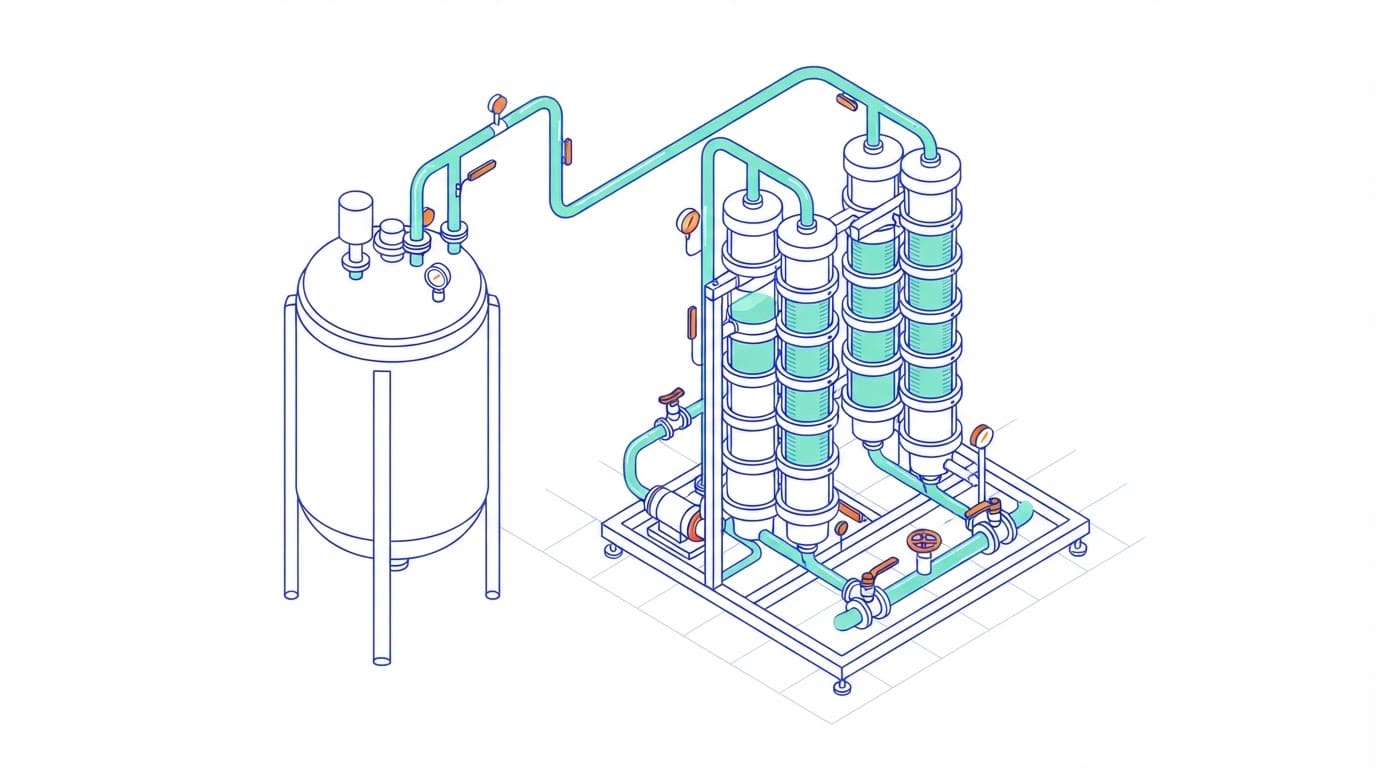
- Single-use chromatographic clarification with Harvest RC filters (Solventum) was evaluated on rAAV8 and rAAV9 HEK293 cell culture lysate, with and without endonuclease pretreatment.
- Endonuclease-free clarification worked for both serotypes, with yield above 90% and up to 3 log reduction of host cell DNA.
- A mechanistic cake-fiber fouling model was a good representation of the filtration mechanism.
- The endonuclease-free approach enables cost savings of USD 100,000 per 500 L batch, equivalent to the cost of cGMP-grade endonuclease at that scale.
- Further benefits listed: easier raw material sourcing and no need for a residual endonuclease assay.
The abstract does not give filter area or throughput, the effect on downstream chromatography, residual DNA in the final drug substance, or whether the approach is already in a GMP process. Those details may be in the paper, which we could not open.
What the vendor’s own data add
Solventum published two application notes in August 2024 on the same product, with AAV2, AAV5 and AAV6. They are vendor documents, not independent studies, but they describe the method in detail:
- AAV was produced by triple transfection of HEK293 cells in a 10 L bioreactor and lysed with Tween 20 at 0.5% w/v. Where used, DENARASE endonuclease was added at 40 U/mL. Lysate conductivity was adjusted to 25 mS/cm with 5 M NaCl before clarification.
- Clarification ran at 100 LMH and stopped when capsule inlet pressure reached 5 psi.
- For AAV5, the clarifier gave more than 90% average recovery and filtrate turbidity below 10 NTU, with similar performance with or without endonuclease. Across AAV2, AAV5 and AAV6, residual DNA after clarification was comparable with and without nuclease, by qPCR and ddPCR.
- After AAVX affinity chromatography, AAV5 from both routes showed comparable DNA contaminant profiles and was highly monomeric.
- The trade-off is throughput. Solventum’s cost modeling with BioSolve Process found up to 38% lower cost for the primary clarification stage, achieved despite the lower relative throughput when nuclease is removed. The saving comes from the nuclease raw material cost.
Solventum also cautions that AAV2 may behave differently, because it is known to have more pronounced capsid:DNA interaction. The authors’ abstract covers AAV8 and AAV9; the vendor data cover AAV2, AAV5 and AAV6. No single dataset covers every serotype.
What it means for a plant
According to the authors’ abstract, removing the endonuclease removes a costly raw material and a residual assay, and makes raw material sourcing easier. In Solventum’s data, the price is filter area: without nuclease the clarifier’s throughput drops, so the economics depend on nuclease unit price, batch size and batches per year, which is how Solventum frames its own cost model. A process team would still have to show, on its own lysate, three things the abstract does not cover: host cell DNA clearance and fragment size through the full downstream train, the effect of the salt adjustment on capture chromatography, and serotype-specific behavior. The abstract equates the USD 100,000 per 500 L batch figure with the cost of cGMP-grade endonuclease at that scale; it does not present it as a measured plant saving.
Sources
- Thakur G. (presenter), Single-use chromatographic clarification to eliminate endonuclease treatment in production of recombinant adeno-associated viral vectors, American Chemical Society presentation abstract, 23 March 2025.
- Thakur G., Mink S., Bak H., Tustian A. D., Separation and Purification Technology 354, 128557, 2025 (full text not accessed).
- Solventum, A case study for understanding impact of nuclease elimination on bioprocess cost and downstream AAV5 quality using 3M Harvest RC Chromatographic Clarifier, August 2024.
- Solventum, An investigative case study of the removal of host cell DNA from HEK detergent lysates using 3M Harvest RC Chromatographic Clarifier, August 2024.