Primary source Viruses: Lentiviral Vector Bioprocessing (Perry and Rayat, UCL and NIBSC)
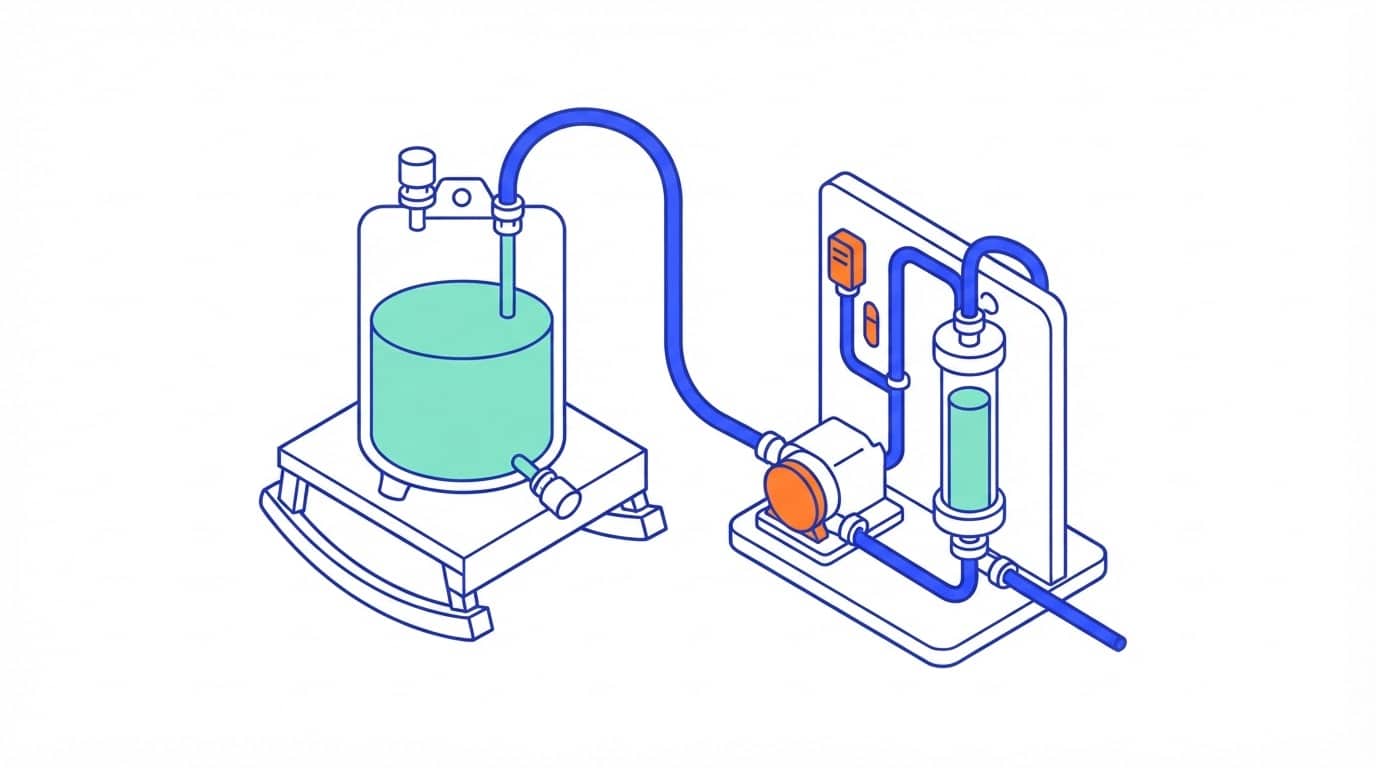
Scaling lentiviral vector (LV) production is not a volume problem. It is a race against a particle that decays in the reactor, adsorbs onto membranes and loses infectivity at every unit operation. Four open-access papers, from a 2021 review to a 2026 device study, put numbers on where the vector goes and what perfusion actually buys. What follows covers manufacturing only.
The starting constraints
A review from UCL and NIBSC sets the baseline. LV particles are 80 to 120 nm, with a half-life reported in the range of 7 to 8 hours at 37 degrees C, sensitive to freeze and thaw cycles, salt, pH, shear and buffer osmolarity. Transient transfection, still the dominant mode, gives unpurified titers of 106 to 107 transducing units (TU) per mL, with vector production peaking within 48 hours post-transfection and declining from 72 hours, a narrow harvest window. Plasmid DNA and transfection reagent are a recurring cost, typically at least 1 µg of plasmid DNA per million cells.
The losses are documented step by step. Sterile filtration through a 0.22 µm membrane has been reported to cost 30% to 50% of titer. Anion exchange chromatography recoveries in the review’s table range from 28% on one membrane adsorbent to 90% on a nanofibre prototype. Affinity approaches that looked good at small scale fell away at larger scale: one streptavidin and biotin-mimic capture method gave 60% recovery small-scale and 20% on scale-up. A 2026 paper cites vector recoveries from culture supernatant of 30% to 80% depending on the downstream strategy.
Perfusion: what it buys, measured two ways
A GSK team (funded by GSK, with several authors GSK shareholders) tested tangential flow depth filtration (TFDF), a tubular polypropylene filter with a wall around 5 mm thick and channels of 2 to 4 µm, both as a harvest filter and as the perfusion device for a stable producer cell line in 2 L bioreactors. The pore structure matters: the team reports from its own experience (data not shown) that microfiltration alternating tangential flow (ATF) membranes retain LVs, while the TFDF lets them pass into the permeate. That single difference changes the process. With ATF, vector stays with the cells and needs a separate isolation step; with TFDF, harvest is continuous.
| Process | Induction cell density (million cells/mL) | Total transducing units (x 1011) | Versus batch |
|---|---|---|---|
| Batch | 4.41 | 4.82 | reference |
| ATF perfusion, single harvest at 48 h | 45.5 | 64.0 | 13.3-fold |
| TFDF perfusion, continuous harvest to 96 h | 37.1 | 122 | 25.4-fold |
Two details keep this honest. Infectivity per particle fell from the onset of induction: of total TU collected, 42.5%, 37.4% and 17.2% came from days 1 to 2, 2 to 3 and 3 to 4 post-induction, so the last fraction is the one to question in a cost-benefit analysis. And continuous harvest produces volume: around 3 vessel volumes per day, which then needs single-pass filtration or multi-column chromatography to be practical. With a set of stated assumptions (including 20% downstream yield, 200 L scale, 2 x 10⁹ TU per dose), the team estimates 900 doses for batch, 12,000 for ATF perfusion and 24,000 for TFDF perfusion per batch.
Adherent processes: where scale-up actually broke
A UCL group, part-funded by the UCL-Cytiva Centre of Excellence and with a Cytiva co-author, took the opposite route, an adherent continuous producer line in quasi-perfusion, and reported the scale-up failure point precisely. Seeding at 3 x 10⁴ cells/cm2 with 1 vessel volume per day, infectious titers were comparable from 25 cm2 up to 1,264 cm2 flasks at (2.24 ± 0.25) x 105 TU/cm2. In a 6,320 cm2 multilayer flask, titer dropped about 1.6-fold, which the authors attribute to fewer cells, likely from suboptimal gas exchange between layers, and the higher culture pH that followed. Batch-to-batch variability stayed low across all sizes, with coefficients of variation of 7.7% ± 2.6% for infectious and 11.9% ± 3.0% for physical titer.
Their perfusion rate result is counterintuitive and worth keeping. Going below 1 vessel volume per day lowered infectious titer, consistent with the measured half-life of 16.6 ± 1.2 hours at 37 degrees C for this RDpro-pseudotyped vector. Going above 1 did not help either: at 2 and 3 vessel volumes per day the culture pH mostly stayed above 7.0, which the authors suggest may have lowered infectious yield. Physical particle productivity was comparable at every rate, so the differences were in infectious output.
Membrane-free retention
An MIT group replaced the filter altogether with a spiral inertial microfluidic device as the cell retention step, on the argument that membranes foul and retain product. Across four perfusion runs at 15 to 25 million cells/mL in a 350 mL bioreactor, cell retention efficiency averaged above 97%, continuous harvest ran up to seven days, and unconcentrated functional titers reached the order of 108 TU/mL. Titers in the bioreactor and in the harvest line were similar, which is the evidence for a lossless harvest. The top three bioreactor runs gave cell-specific yields of 17.6 to 30.1 TU per cell; splitting the culture into a shake flask with daily media replacement gave over 80 TU per cell, which the authors attribute in part to cell line selection and to a GFP transgene simpler than a therapeutic one.
What it means for a plant
- Choose the retention device by what it does to the product, not by perfusion performance. A membrane that retains LVs forces a separate isolation step; one that passes them turns perfusion into harvest.
- Total transducing units and infectivity per particle move in opposite directions. Extending the harvest window adds particles of lower quality, and the authors suggest a cost-benefit check on collecting past day 3.
- Residence time at 37 degrees C is a process parameter. With a half-life of hours, the harvest rate is set by vector stability, not only by cell metabolism.
- In adherent scale-up, watch gas exchange. In this study titer dropped between 1,264 and 6,320 cm2, possibly from suboptimal gas exchange between layers.
- Budget for the volume that perfusion creates. Three vessel volumes a day of permeate needs a concentration step designed in from the start.
Sources
- Perry C, Rayat ACME, Lentiviral Vector Bioprocessing, Viruses 13(2):268, 9 February 2021.
- Tona RM et al. (GSK), Process intensification for lentiviral vector manufacturing using tangential flow depth filtration, Molecular Therapy Methods and Clinical Development 29:93-107, 3 March 2023.
- Stibbs DJ et al. (UCL), Quasi-perfusion studies for intensified lentiviral vector production using a continuous stable producer cell line, Molecular Therapy Methods and Clinical Development 32:101264, 7 May 2024.
- Bevacqua A, Liu F, Chen J, Han J (MIT), Intensified lentiviral vector perfusion bioprocessing with a spiral inertial microfluidic cell retention device, Lab on a Chip 26:2368-2379, March 2026.