Primary source Sartorius: Sartorius collaborates with Sanofi to commercialize end-to-end platform for downstream process intensification
On 13 May 2024, Sartorius announced that it is collaborating with Sanofi to develop an end-to-end platform for integrated and continuous downstream bioprocessing, abbreviated in the release as ICB. The announcement is more than two years old, so this piece treats it as context, not news. It sets out who holds what in the deal, what the release does and does not say, and what the regulatory guideline on continuous manufacturing, ICH Q13, asks a plant to demonstrate before it runs a downstream train of this kind.
What the release says
- Who built what. The prototypes were developed by Sanofi. Sartorius, selected as a preferred supplier, contributes its engineering and manufacturing expertise to commercialize ICB platforms based on those prototypes.
- What Sanofi gives. In return, Sanofi grants Sartorius exclusive access to its know-how and patents related to the ICB platform.
- What Sartorius commits to. Rapid development of hardware, consumables and process automation for diverse applications and volumes, from development to commercial scale.
- Who sells it. Under the collaboration and license agreement, Sartorius will exclusively commercialize the ICB platform to customers worldwide.
- Design intent. A modular platform that combines flexibility with standardization.
The release does not give a launch date, column or skid sizes, the list of unit operations, financial terms or any performance data from the Sanofi prototypes. Lower raw material and energy consumption, higher productivity and less waste are described as properties of integrated continuous biomanufacturing in general, not as measured results of this platform.
What “integrated and continuous” means in downstream
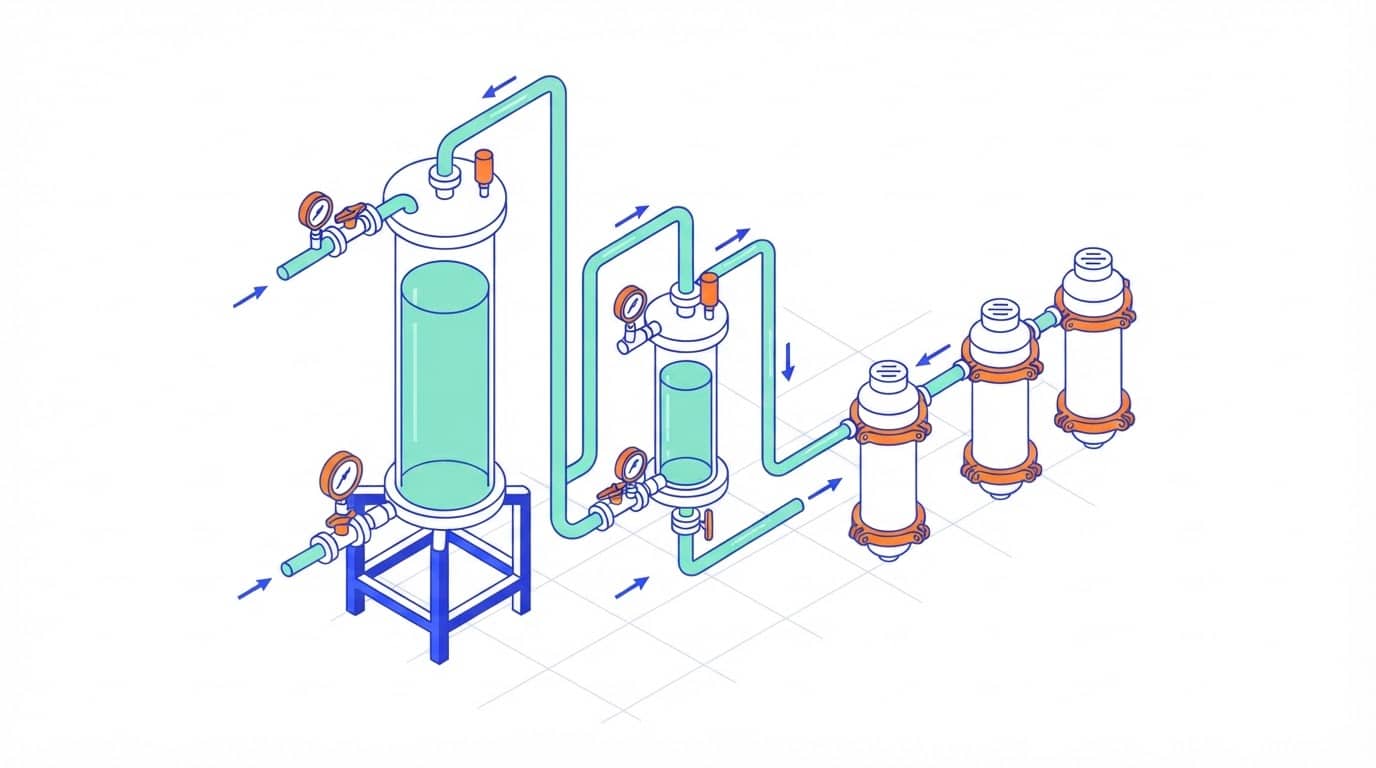
The release defines the concept as maximizing efficiency by enabling uninterrupted and steady materials flow, as opposed to traditional batch methods, and by integrating multiple unit operations into a lean process setup. The formal reference is ICH Q13, adopted by the ICH Assembly on 16 November 2022. It describes continuous manufacturing as the continuous feeding of input materials into, the transformation of in-process materials within, and the concomitant removal of output materials from a process.
Q13 focuses on integrated systems in which two or more unit operations are directly connected. That is the point that changes plant behavior: a change made in one unit operation can affect the upstream and downstream ones and the quality of the output. Q13 also accepts hybrid layouts where some unit operations run in batch mode and others are integrated and continuous, with surge lines or tanks to keep flows constant.
Annex III of Q13 sketches an example drug substance process for therapeutic proteins: a bioreactor compatible with perfusion culture, continuous capture chromatography, virus inactivation, polishing chromatography, virus filtration, and buffer exchange and concentration by tangential flow filtration. The Sartorius release covers the downstream part only and does not say whether the platform is meant to be fed by a perfusion bioreactor or by batch harvests.
What Q13 asks a plant to demonstrate
- Batch definition. The ICH Q7 definition of a batch still applies. Batch size can be defined by quantity of output material, quantity of input material, or run time at a defined mass flow rate, and can be set as a range, for example a minimum and maximum run time.
- State of control and drift. Parameters may change within specified ranges without the process being in steady state, and the root cause of drift must be identified. Q13’s own downstream example: a change in the elution profile may be due to resin aging.
- Process dynamics. Residence time distribution (RTD) has to be characterized. It supports material tracking and the design of sampling and diversion strategies.
- Surge tanks. When used, their RTD, uniformity and microbial risks to the product should be evaluated and defined in advance.
- Filtration. Filters in continuous operation may see longer filtration periods or more changes than in batch, so the plant needs a scheme for filter changes and integrity testing without interrupting the process, and a defined strategy for material diversion and refiltration if a filter fails.
- Single-use connections. Tube welds and connectors that stay in service for long durations, or are changed often, should be evaluated as potential contamination risks.
- Run time. Resin and membrane lifetimes and the control of adventitious agents must be considered. ICH Q5A viral clearance recommendations remain applicable, with scientifically justified alternatives where they do not fit.
- Monitoring and release. Q13 cites in-line UV flow cells to monitor protein concentration, and in-line or online release tests for attributes such as pH, osmolality, protein concentration, purity, charge heterogeneity and aggregation. Potency still needs conventional offline testing.
What it means for a plant
For a site weighing continuous downstream, the 2024 deal is mainly a supply signal: an equipment supplier took exclusive commercial rights to a biopharma company’s prototype and patents and committed to build hardware, consumables and automation around it. It does not remove any of the validation work. Whichever ICB platform a plant evaluates, the Q13 list above turns into concrete questions for the vendor: how batch size is defined, where diversion points and PAT sit, how RTD was characterized and with which tracer or step test, how filters and single-use assemblies are changed without stopping the train, and what resin and membrane lifetime data exist for the proposed run length. The May 2024 release answers none of these. They have to come from the vendor’s technical documentation and from the plant’s own studies.