Primary source Food Standards Agency: Review: Technical Production Methods of Precision-Fermented Foods
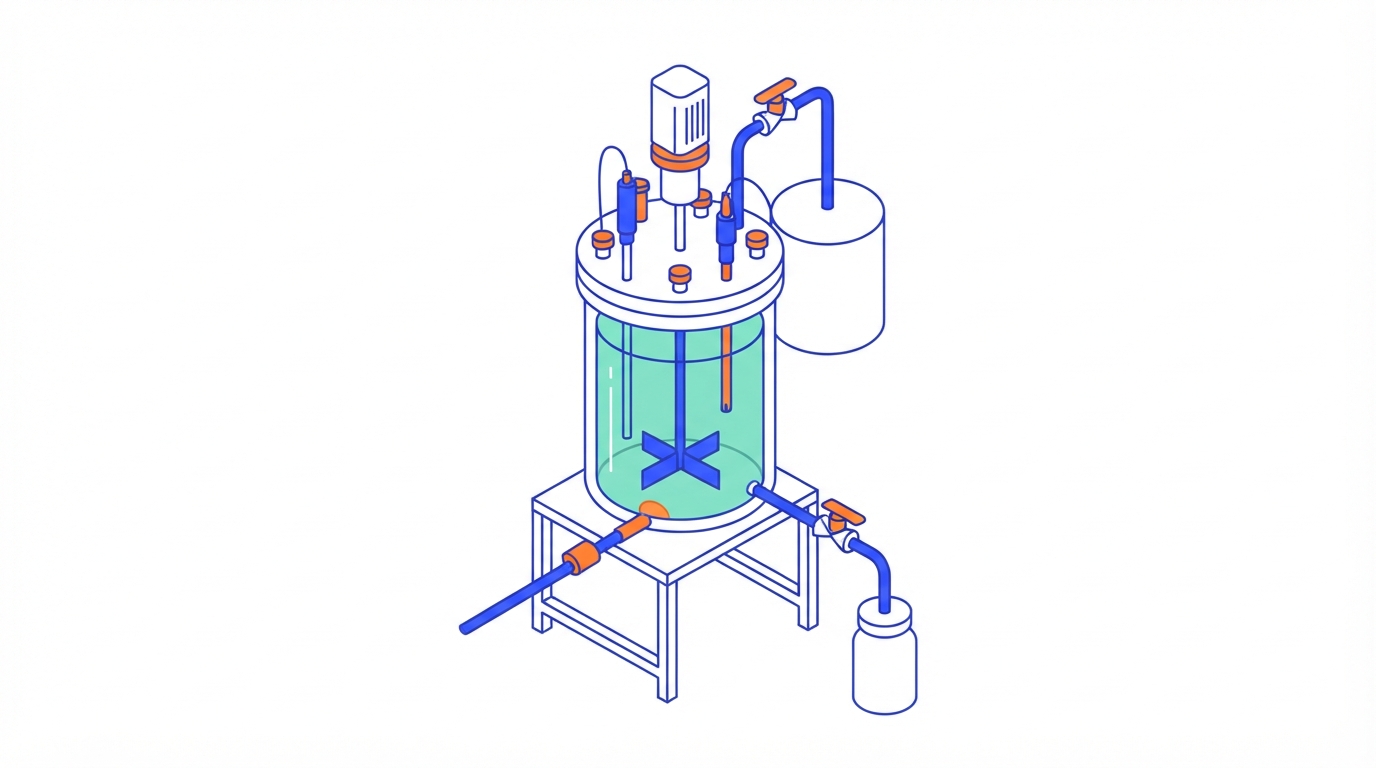
Industrial fermentation means growing living cells in a bioreactor (a closed, controlled tank) so that they make a product you want. Microbes such as yeast and bacteria grow fast, while animal cells grow slowly on costly media but can modify proteins in ways microbes often cannot.
What goes in and what comes out
Into the tank go the production cells (a microbe engineered for the job) and a growth medium that supplies a carbon source. The economics depend on cheap carbon sources such as agricultural residues or waste glycerol (a by-product of biodiesel), and glucose is also used. The operator holds temperature, pH, stirring and dissolved oxygen at set values while the cells grow.
What comes out is the product, either held inside the cells or secreted into the surrounding liquid. Secretion is useful because it simplifies downstream processing, the purification steps after the tank (harvesting, extraction, membranes, chromatography).
Microbes versus animal cells
Microbes: yeasts and bacteria grow quickly and have extensive genetic tools. Yeasts grow roughly ten times faster than mammalian cell lines, according to a 2014 review in Frontiers in Microbiology. Their limits are that some give low yields and that bacteria cannot add the complex modifications (such as glycosylation, the attachment of sugar chains) that many animal proteins need. Yeasts and filamentous fungi can add them.
Animal cells: mammalian cells do glycosylation authentically, which the same review calls an important advantage over all other hosts. Against that, their yield per cell is often low, and the FSA review calls animal cell culture impractical for food proteins because of slow growth and costly media. For biopharmaceutical proteins approved by the US FDA (more than 150 by 2014), about 50% are made in mammalian cell lines and hybridomas, 30% in E. coli and 20% in yeasts.
What it makes
Products include proteins, enzymes, lipids, pigments and other metabolites. Examples are the amino acid L-valine, the flavour vanillin, natural colorants, and, from yeast, insulin, human growth hormone, vaccine antigens and human serum albumin. Moulds account for over 50% of industrial enzyme production.
Sources
- Food Standards Agency, Review: Technical Production Methods of Precision-Fermented Foods Identification and Characterisation of Hazards, 12 March 2026.
- Bill RM, Playing catch-up with Escherichia coli: using yeast to increase success rates in recombinant protein production experiments, Frontiers in Microbiology, 5 March 2014.