Researchers at Tohoku University, Godo Shusei and partners report a filamentous fungus strain that sticks less to bioreactor surfaces. They deleted the hydrophobin gene rolA from an Aspergillus oryzae strain that already lacked two adhesion factors (cell wall alpha-1,3-glucan and galactosaminogalactan). The paper is peer reviewed and was listed on 12 November 2026.
What was measured
Wall growth is the crust of mycelium that builds up on vessel surfaces. It impairs mixing and lowers recovery. The authors used recombinant xylanase as the model product and compared the new strain with its parent at each scale.
- Flasks, 72 h: wall growth dry weight was 42% lower, and xylanase activity in the broth rose 14% (916.2 versus 805.4 U per mL). Total enzyme per flask, which accounts for the larger recovered volume, was 21% higher.
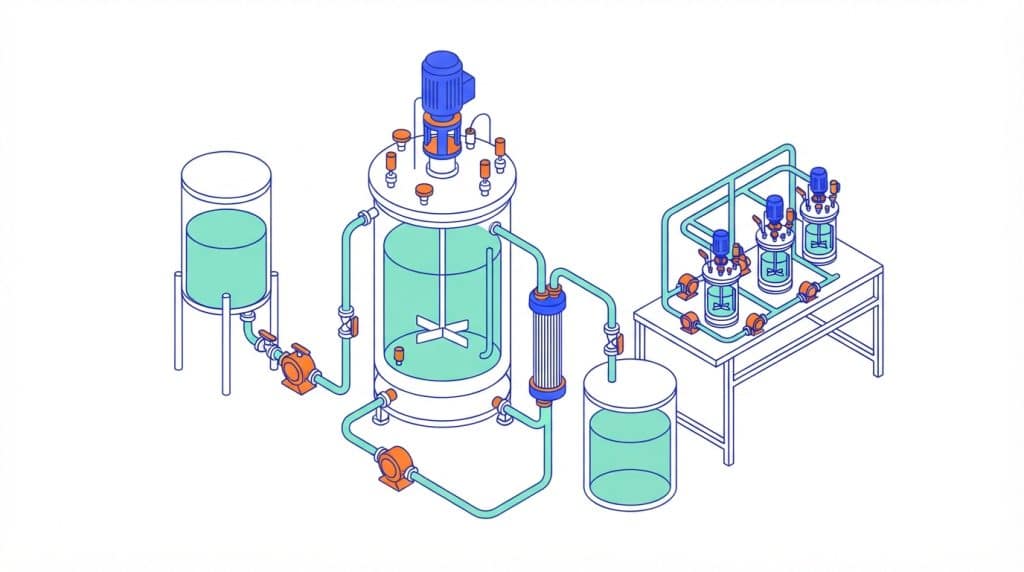
- 4 L bioreactor, 120 h: wall growth dry weight was 33% lower, and the recovered culture volume was about 5% higher. Xylanase activity was 10,111 versus 7,090 U per mL, a 1.43-fold increase.
- 200 L single-use bioreactor, 160 h: xylanase activity was 9,799 versus 8,302 U per mL, a 1.18-fold increase.
Scale-up basis
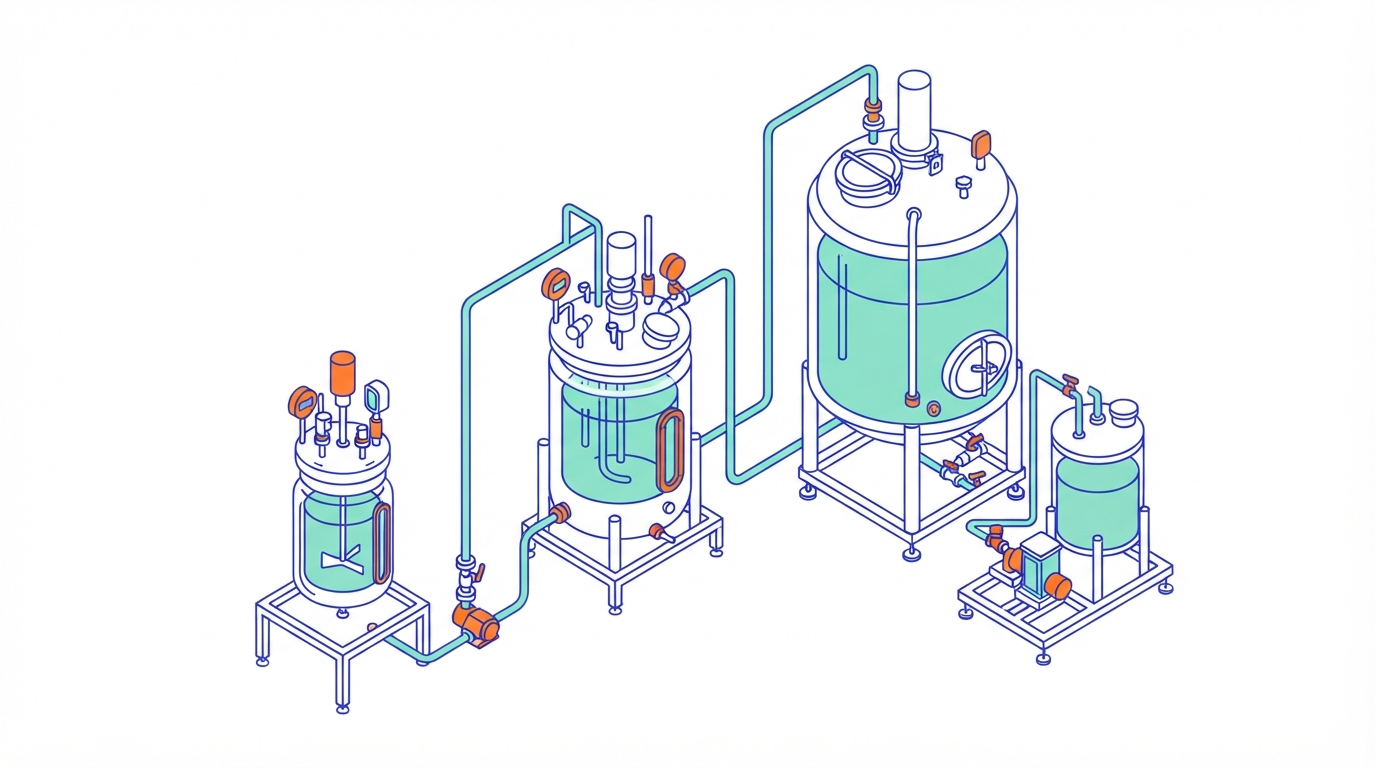
Scale-up held volumetric power input under aeration constant at about 3 kW per m3, the power drawn per cubic metre of broth. Computational fluid dynamics (CFD) simulations, using measured broth viscosity, gave the agitation speed: 390 rpm at 200 L for the new strain and 263 rpm at 3,000 L. The 3,000 L run, at Green Earth Institute in Chiba, started with 1,800 L of working volume. The authors report that the strain was scaled up successfully, and that its xylanase activity profile was similar at 200 L and 3,000 L. The CFD analysis predicted improved hydrodynamics for the new strain at equivalent power.
Limits stated in the paper
Each pilot-scale condition was a single fermentation, so the paper reports no statistical comparison at 200 L or 3,000 L. The 3,000 L run used only the new strain, with no parent strain run at that scale. Xylanase is one model enzyme, and the source does not report other products.