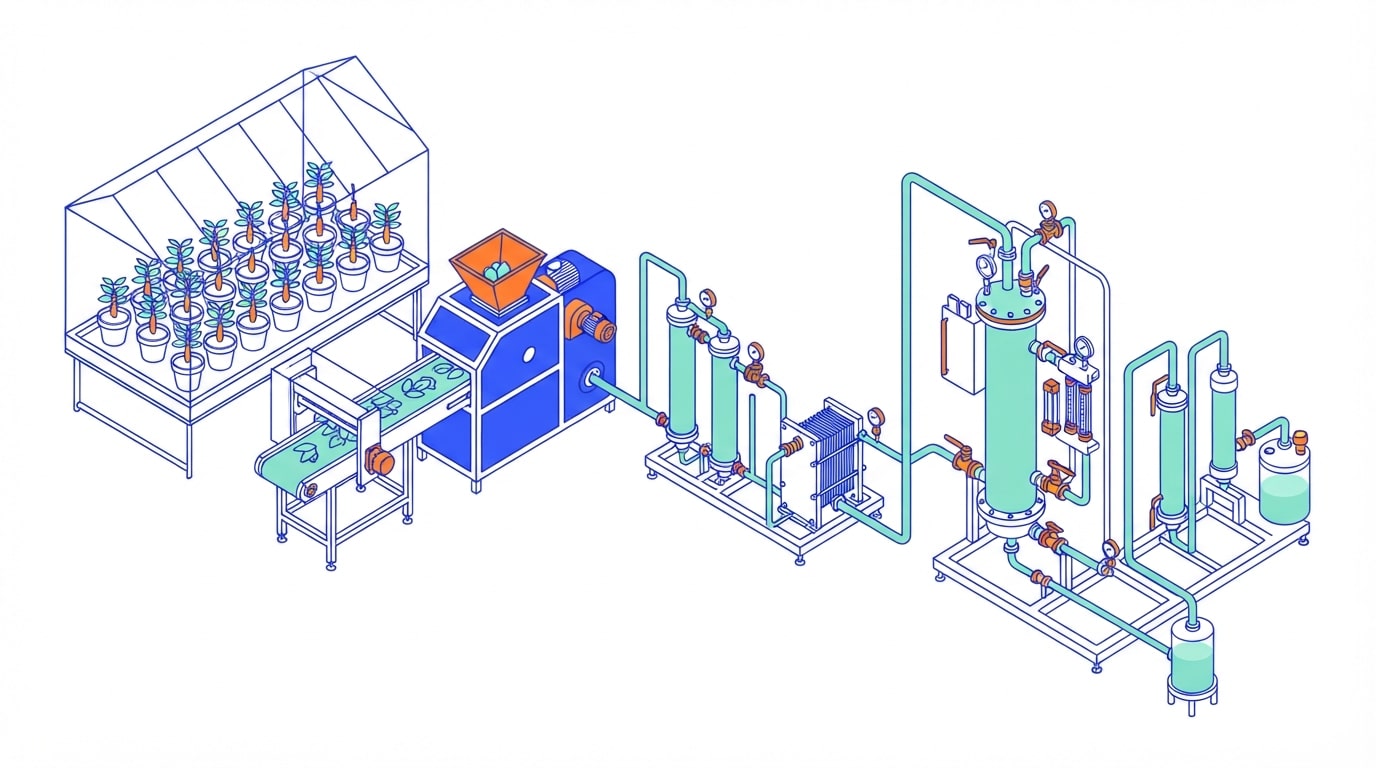
Tobacco is used to make recombinant proteins, but its alkaloids, mainly nicotine, complicate downstream processing. A short communication in Planta, published open access on 24 November 2026, tests an old agricultural fix: growing antibody-expressing tobacco on tomato roots, where little alkaloid is made.
What was done
The authors grafted transgenic Nicotiana tabacum (cv. Petit Havana SR1) expressing a human IgG1 monoclonal antibody (VRC01) onto Solanum lycopersicum (Ailsa Craig) rootstocks. Of 30 grafted plants, 27 healthy plants were recovered. Grafted plants developed about 10 days later than controls, with no other phenotypic differences observed. Extracts from grafted plants were lighter in colour and less affected by enzymatic browning.
What was measured
- Nicotine in leaf extracts was 3 to 43 mg/kg in grafted plants, against 396 to 483 mg/kg in non-grafted plants. In the upper leaves of grafted plants, nicotine was under 1% of the level in non-grafted plants. In the more mature lower leaves it was 11%.
- Nornicotine, anatabine, anabasine and pseudoxynicotine were also lower: 2 to 4% of the non-grafted level in upper leaves and 2 to 22% in lower leaves.
- Antibody expression showed no difference between grafted and non-grafted plants (one-way ANOVA, three pooled samples each, nine plants per pool).
- Protein A binding capacity was tested on a Biacore chip over 42 cycles of extract injection, elution and regeneration. With non-grafted extract, capacity fell to 80% after 25 cycles and to 70% after 40 cycles. With grafted extract, no loss was observed.
Limits stated or implied by the source
The Protein A test is a small surface plasmon resonance chip model, not a packed column at process scale. Alkaloid results are shown for one set of pooled samples, and the authors report that the assay was repeated with similar results. The authors say fouling of Protein A by plant host compounds has not been studied in detail and that the role of alkaloids rests partly on anecdotal experience. They did not test extraction buffer additives such as antioxidants or PVPP, which they note add cost and would not physically remove alkaloids. The source gives no cost or yield figures for grafting at production scale.