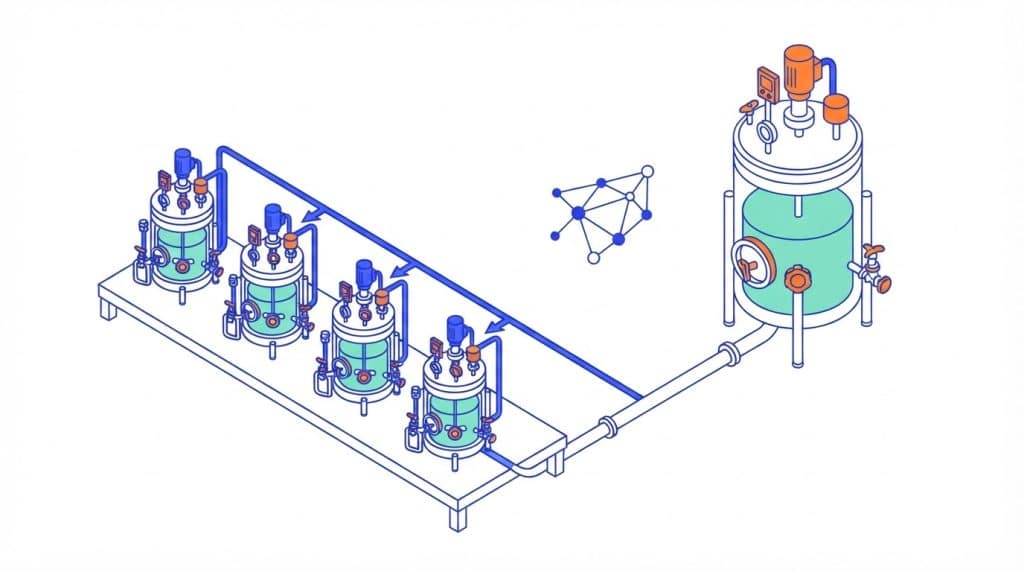
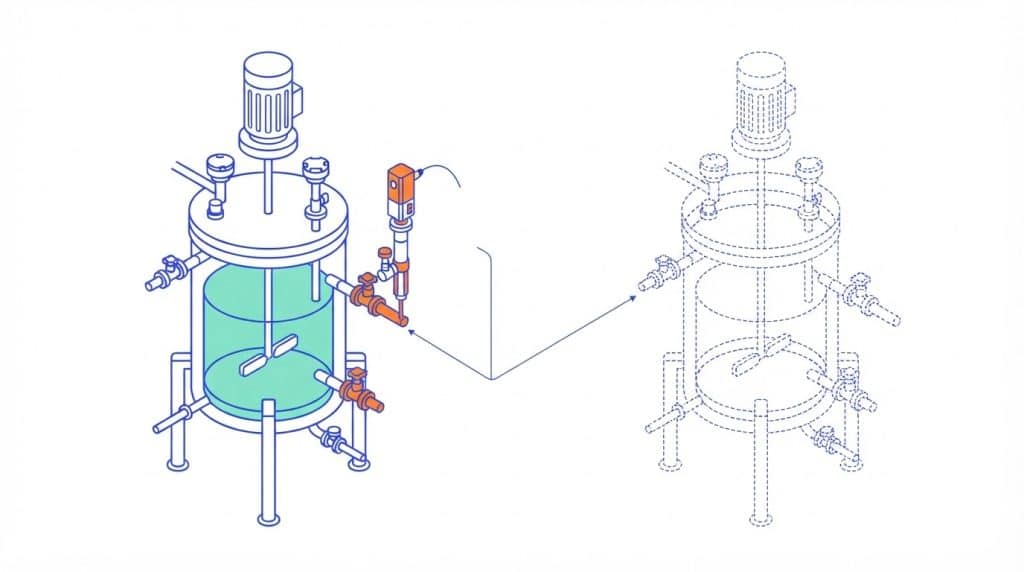
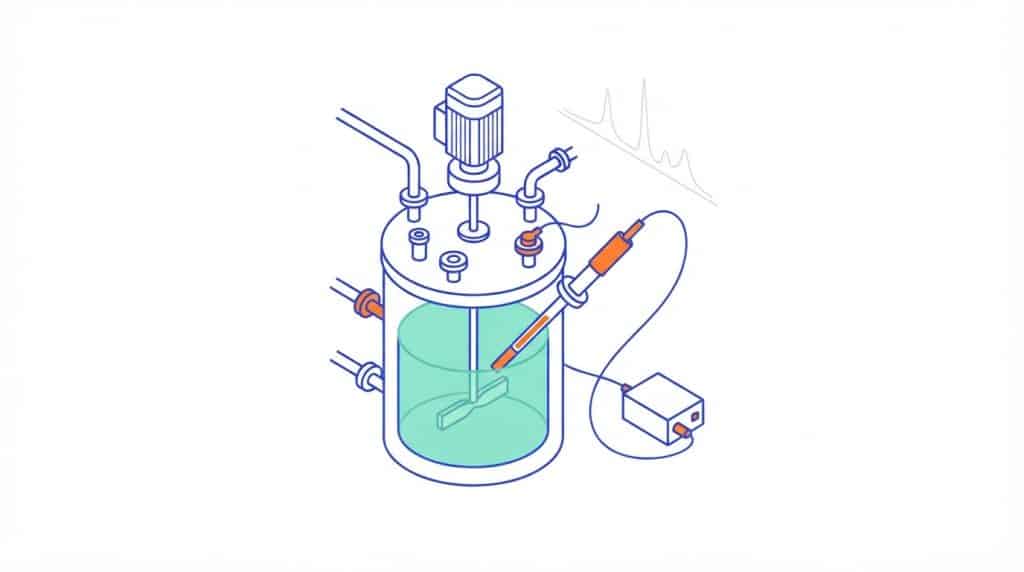
Primary source Biotechnology Progress: Artificial intelligence and machine learning-assisted digital applications for biopharmaceutical manufacturing
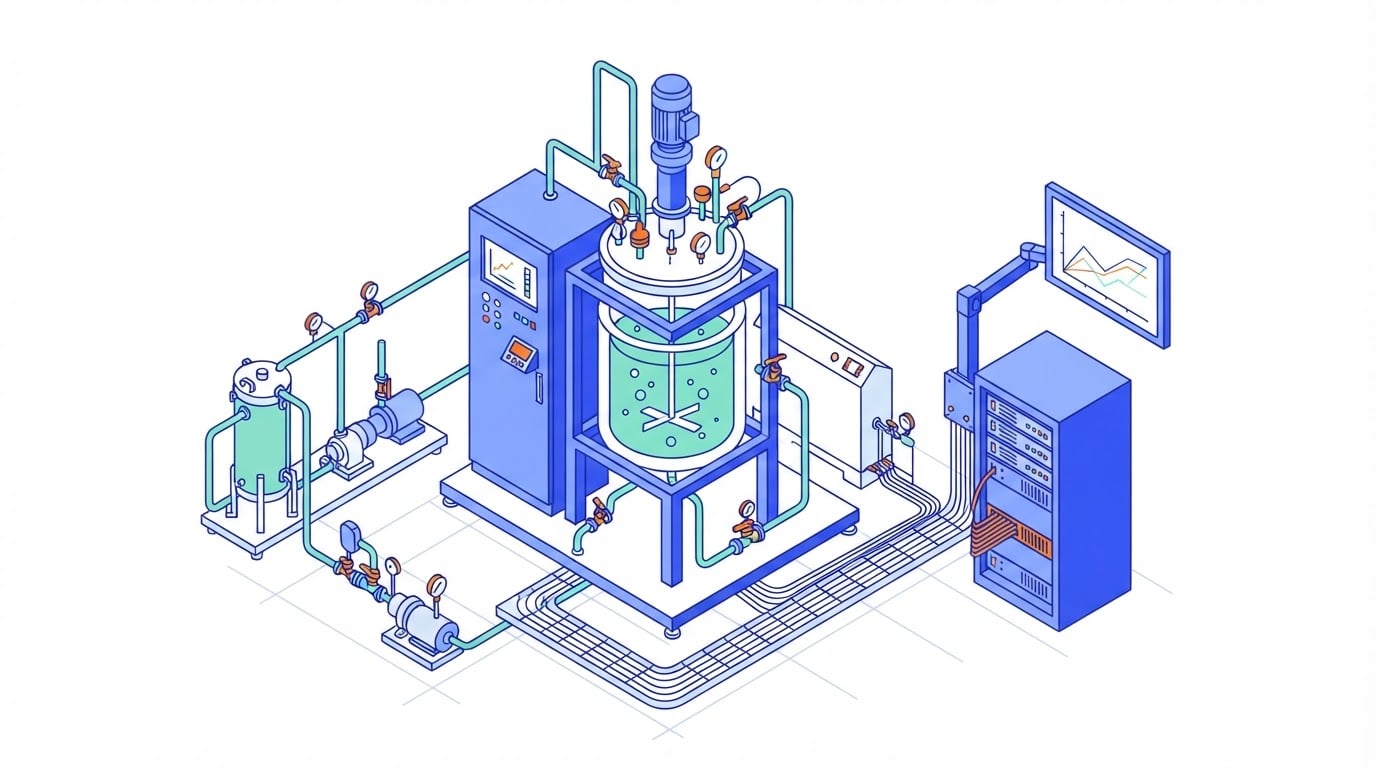
Primary source Engineering in Life Sciences: Digitalization concepts in academic bioprocess development
“Bioprocess automation” means different things on a GMP production floor and in a development lab. This explainer is built only from two open-access reviews that cover both ends. The first, by Shyam Panjwani, Hao Wei and John Mason of CMC and Technology at Bayer Pharmaceuticals in Berkeley, was published in Biotechnology Progress on 10 November 2025 and looks at data systems and AI/ML in biopharmaceutical manufacturing. The second, by Tessa Habich and Sascha Beutel of the Institute of Technical Chemistry at Leibniz University Hannover, was published in Engineering in Life Sciences on 9 February 2024 and looks at how bioprocess development labs connect devices and data. Neither is a plant survey, so what follows is what the reviews describe, not a measured adoption rate.
Layer 1: the manufacturing data backbone
The Bayer review starts from paper. Traditionally, manufacturing data were captured in paper batch records signed by several people to ensure data integrity, which works in the short term but makes retrieval and analysis hard as data volumes grow. To comply with FDA 21 CFR Part 11 and EU GMP Annex 11, many large pharmaceutical companies started building on-premises IT infrastructure and moving to electronic batch records (EBR) in the early 2000s.
- MES supports EBR and acts as the bridge between Enterprise Resource Planning (ERP) and the Distributed Control System (DCS) on the production floor. Its limitation, per the review, is data access for scientists without programming experience.
- Data integrators such as BIOVIA Discoverant give lab and process scientists graphical access to at-line and offline results and map data across unit operations, but are not intended for real-time collection from the DCS.
- Historians: the PI system is widely used in the industry to collect and historise real-time data from inline sensors and equipment, upstream and downstream.
- Cloud: biologics manufacturers have started deploying digital applications on cloud platforms. The review stresses that it remains the company’s responsibility to ensure providers follow regulations such as 21 CFR Part 11.
Layer 2: device connectivity in the development lab
The Hannover review describes the lab side, where many device vendors still ship proprietary control software, and researchers agree the future lies in standardised device communication protocols. Two currently coexist in bioprocess development labs: SiLA2 (Standardization in Lab Automation 2) and LADS (Laboratory and Analytical Device Standard), which is based on OPC UA and was developed by a working group of the industry association Spectaris. OPC UA is already a standard for vendor-independent data exchange in multiple industries, which the review notes also connects research labs to industrial infrastructure.
Devices fall into three groups. Legacy devices with only USB or serial ports (such as RS232) need a physical gateway module to reach the network. Devices with a network port need a software device controller. Devices with native SiLA2 or OPC UA drivers can be controlled directly by a central device control server.
A definition worth keeping: model, shadow, twin
The Hannover review separates three terms that are often used interchangeably, by the direction of automated data flow:
| Term | Physical to digital | Digital to physical |
|---|---|---|
| Digital model | Manual | Manual |
| Digital shadow | Automated | Manual |
| Digital twin | Automated | Automated |
By that definition, a model that reads plant data automatically but whose recommendations are applied by an operator is a digital shadow, not a twin.
Where AI and ML already appear
The Bayer review cites published studies. Examples include random forest regression predicting quality attributes in continuous monoclonal antibody manufacturing from pH, UV absorbance and conductivity sensors, with prediction errors below 5%, and machine learning for viral clearance studies through low-pH inactivation, where random forest reached 94% overall cross-validation accuracy. On algorithm choice, the review notes that process scientists still prefer classical algorithms when the performance gap to advanced ones is not practically significant, in line with regulatory emphasis on interpretability, and that advanced algorithms typically need large amounts of data that early development rarely has.
For generative AI, the review sees use in finding and summarising SOPs and in deviation investigations, with a caveat: large language models may hallucinate, so expert oversight is necessary before any document is finalised for regulatory submission.
What is still manual, according to the reviews
- Because AI/ML is not mandatory to produce quality drugs, many pharmaceutical companies are still operating in traditional settings (Bayer review).
- In cell therapy, automated gating for flow cytometry exists in commercial software, but adoption in the bioindustry, especially in clinical settings, remains slow due to biological complexity, lack of standardisation and regulatory requirements (Bayer review).
- Handwritten paper notebooks are still used in many bioprocess development labs, although electronic lab notebooks are spreading fast, and data are sometimes moved on flash drives, which raises the risk of manipulation or loss (Hannover review).
- In academic labs, automation and high throughput are not possible for most experimental settings because of the need for flexibility, and robots are not yet common; long development times, maintenance, investment and even lab reconstruction hold them back (Hannover review).
The regulatory frame, as the Bayer review summarises it
According to the review’s account of FDA discussion with industry, non-time-critical applications can be hosted on cloud servers, while software that executes direct control actions should run on-premises, close to the manufacturing unit. The manufacturer is responsible for defining model validation standards, and near-real-time model updates are hard to reconcile with change control, so AI model lifecycle management has to be clear. The review also reports that the EMA highlights the need for interpretable and explainable models rather than black boxes. These points are the review’s summary; we have not read the underlying agency documents for this piece.
What it means for a plant
Both reviews put the same step first. The Bayer authors write that the first requirement for any AI/ML application is good quality data in an easily accessible digital format; the Hannover authors write that automated, secure data capture is the first step to unlock AI or ML in the lab. For a site planning automation, that sets the order: paper records and flash drives out, historian and batch records connected, then models.
Three practical choices follow. When buying lab or process equipment, ask whether it speaks SiLA2 or OPC UA/LADS, because legacy devices need a physical gateway module to join the network. When placing a model, keep anything that acts directly on the process on-premises, as the review reports from FDA discussion, while, per the same account, non-time-critical applications can be hosted in the cloud. And plan for people: the Hannover review makes collaboration between IT specialists and lab staff the key aspect, and the Bayer review adds that hiring data science profiles or training the existing workforce is critical.
Sources
- Panjwani S, Wei H, Mason J (Bayer Pharmaceuticals). Artificial intelligence and machine learning-assisted digital applications for biopharmaceutical manufacturing. Biotechnology Progress, 10 Nov 2025 (issue Mar-Apr 2026).
- Habich T, Beutel S (Leibniz University Hannover). Digitalization concepts in academic bioprocess development. Engineering in Life Sciences, 9 Feb 2024.