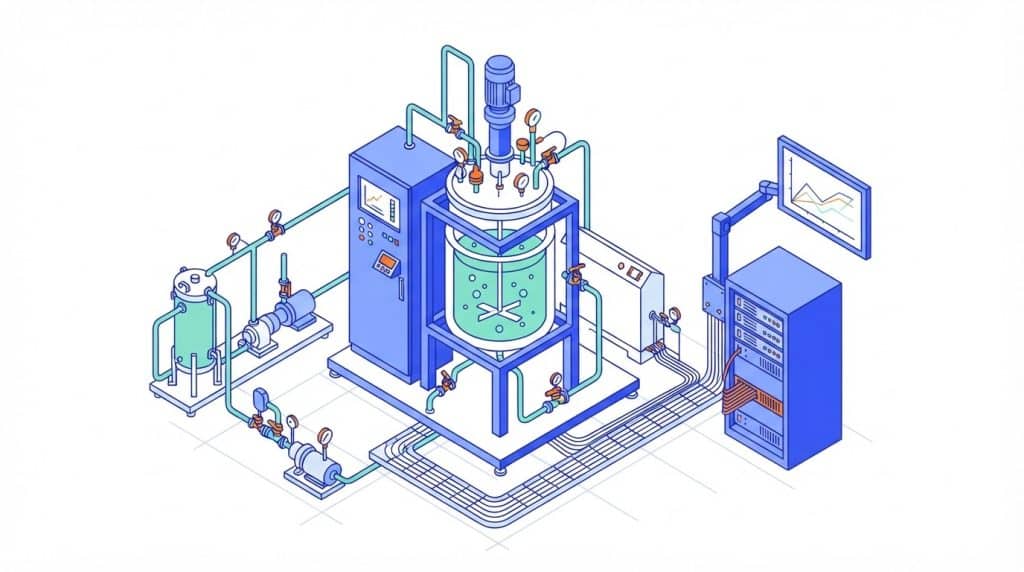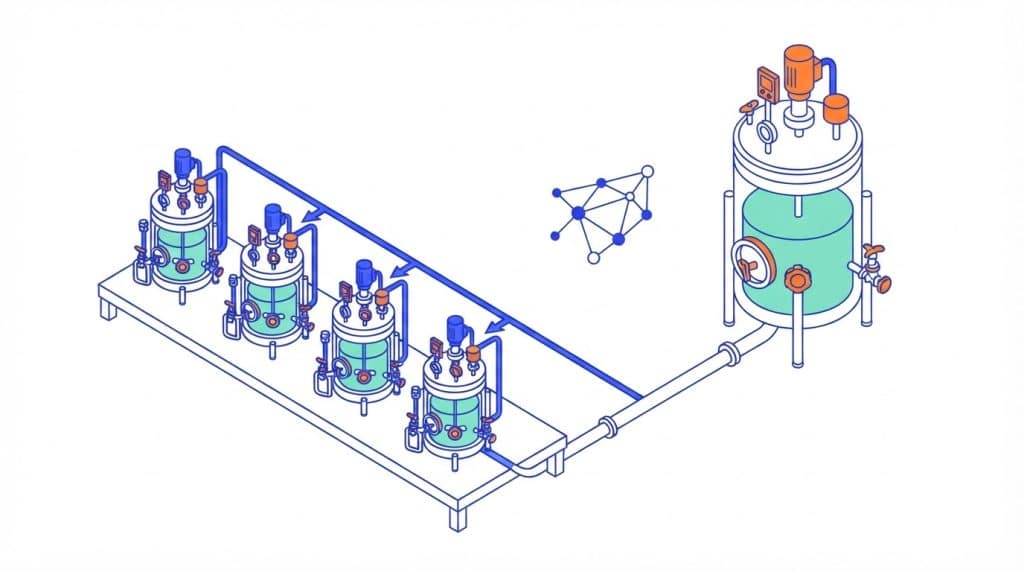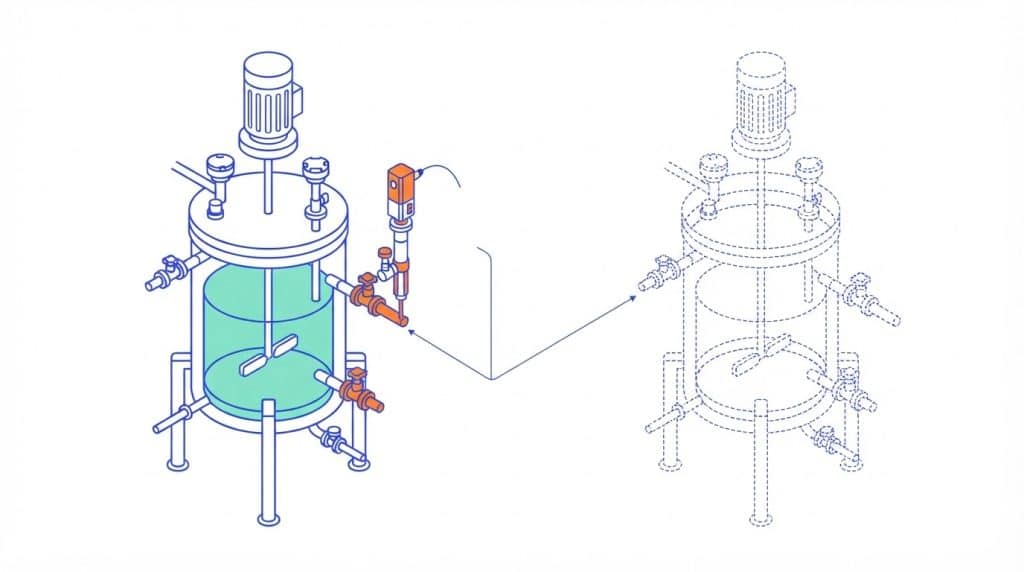
Scale-down models are only useful if the cells in them behave like the cells in the large vessel, and whether they do is still debated. A paper published on 30 August 2026 in Biotechnology and Bioengineering by the Department of Bioprocess Engineering at Technische Universität Berlin with Wacker Biotech and Wacker Chemie AG tests one answer: fit the same mechanistic model at every scale and compare the fitted physiological parameters. The process is an Escherichia coli fed-batch producing an extracellular Fab antibody fragment, studied across five scales.
This case is based on the abstract only. The full text is open access under the publisher’s licence but could not be retrieved from our servers. The abstract names three of the five scales (30 L pilot, 150 mL and 15 mL mini-bioreactors) and gives no process curves, so we do not reconstruct any.
The method: parameters as the comparison metric
The authors extended a macro-kinetic model of aerobic growth and overflow metabolism with equations for product formation and product release. The abstract notes that calibrating physiological parameters in mechanistic models across scales has been proposed as a scale-down strategy, but that few studies have critically evaluated it. This paper is one such evaluation.
What the cross-scale comparison showed
- Batch phase aligns. Growth-related parameters during the batch phase were comparable between 30 L and 15 mL, which the authors read as evidence that scale-down to 15 mL was feasible.
- Feeding mode breaks alignment. The 15 mL system could only feed in pulses, while continuous feeding was used at the reference scales and could also be applied at the remaining scales. Pulse-based feeding was identified as the main factor preventing full alignment across scales.
- The effect of pulses was positive. Pulse feeding induced physiological changes that reduced cell lysis and improved productivity. These effects were confirmed at 150 mL.
- Inducer dosing mattered. Adapting millilitre-scale conditions, in particular reducing IPTG concentration to keep a constant IPTG-to-biomass ratio, substantially changed production: the specific product yield doubled and product formation was more sustained.
Why this matters for scale-down validation
Comparing fitted parameters phase by phase separates two different questions: do the cells grow the same way (here, yes in the batch phase), and does the process around them behave the same way (here, not while feeding differs). The abstract’s own conclusion is that consistent scale transfer also requires a detailed understanding of how process input parameters affect performance, and that model-based evaluation supports identification of process variables critical for knowledge-driven scale-down.
The IPTG result is the practical warning. Adapting conditions for the small vessel, in particular keeping the inducer ratio to biomass constant, came with a doubling of specific yield. If a scale-down model uses different inducer dosing or a different feeding mode from the large scale, its productivity numbers answer a different question from the one the plant is asking.
What the abstract does not say
It does not name the other two scales or state which scales were the reference scales. It gives no titres, no feed rates, no induction times, no lysis figures and no parameter values. The two Wacker affiliations show industry participation, but the abstract does not say whether the process is a Wacker production process. Those details need the full paper.
What it means for a plant
For a site or CDMO that relies on mini-bioreactors to qualify changes to a microbial process, three checks follow from the abstract. First, compare fitted model parameters by phase between scales. Second, treat feeding mode as a process variable, not a hardware detail: pulse feeding at 15 mL changed cell physiology here. Third, document inducer dosing per unit biomass when moving between scales, since the millilitre-scale adaptations, led by IPTG dosed to a constant ratio to biomass, doubled specific product yield in this study. A scale-down model that passes on batch-phase growth can still mislead on production if feeding and induction are not matched.