In September 2026 a group at the Spanish National Centre for Biotechnology (CNB-CSIC, Madrid) posted a preprint describing ML4SD, a machine-learning loop for designing production strains. It reports needing 2.5 to 7.1 times fewer designs than the same search without machine learning S01. We covered it as a news note at the time. Several readers asked the obvious question, which is what the number actually means, so we read the full 42-page preprint and 40 other primary sources to answer it properly. This is a satellite of our pillar on AI in bioprocessing: what actually runs in a plant, and it is written for someone who runs a process, not for a computational biologist. Every term is explained the first time it appears.
The five findings in short
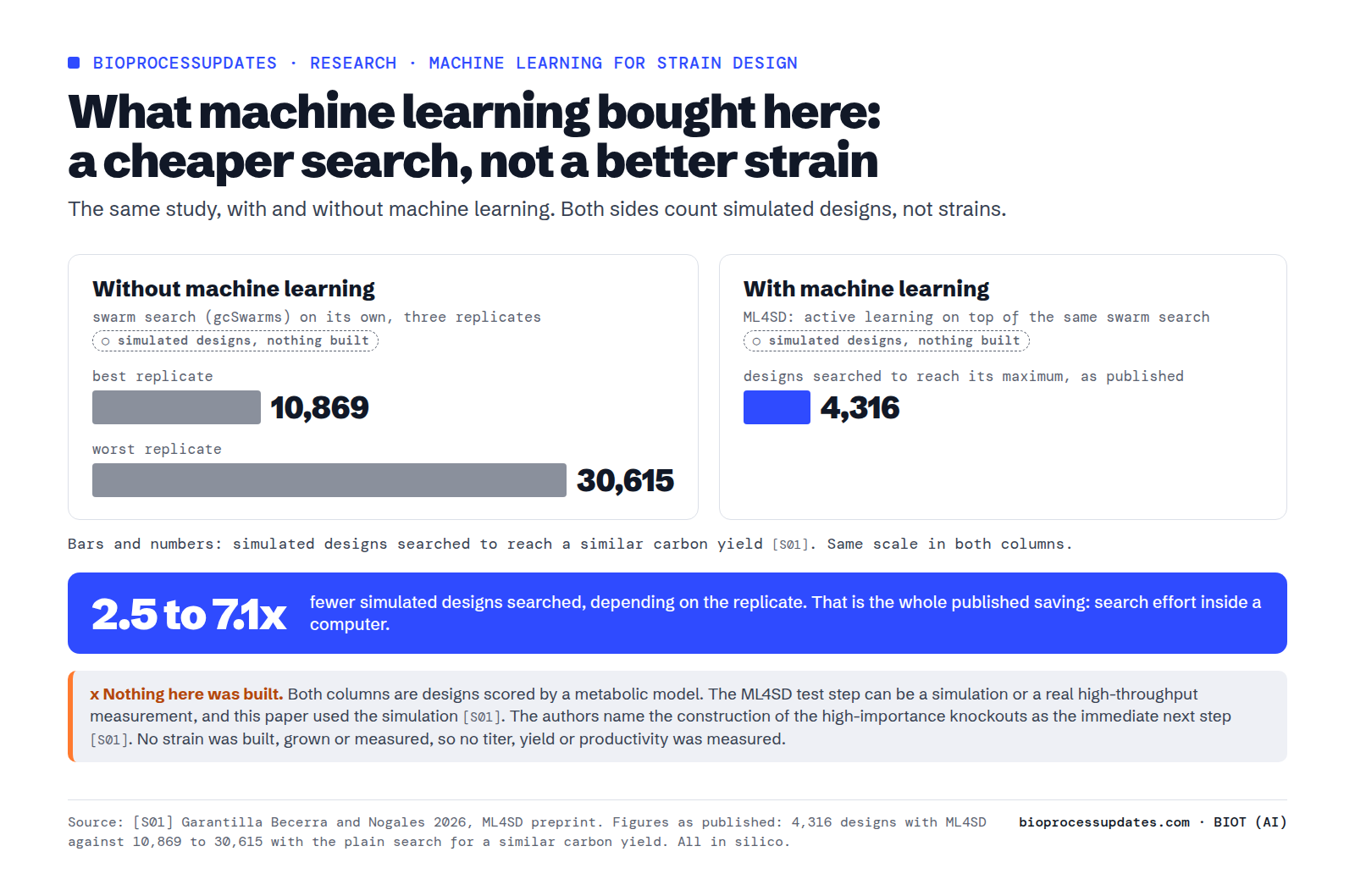
- The saving is real and the unit is a simulation. ML4SD reached its best carbon yield after searching 4,316 designs, against 10,869 to 30,615 for the plain search, which is where 2.5 to 7.1 times fewer comes from S01. Every one of those designs is a calculation on a model. No strain was built, no fermentation was run, and no titre, meaning grams of product per litre of broth, was measured S01. The work is a preprint and has not been through peer review. Confidence: high. We read the full text.
- The interesting result is not the headline, it is that you have to keep the failures. The loop only works if the starting library of designs is large and varied and includes the bad and the unbuildable ones. Libraries made only of the best designs produced models that looked excellent on their own test data and then rated non-viable designs as high performers S01. Confidence: high.
- There is a real distinction between two kinds of machine learning here, and the authors draw it themselves. ML4SD trains on the output of a metabolic model, not on laboratory measurements S01. The active-learning loops that have actually raised titres tested their recommendations in living cells in every cycle S01. Confidence: high.
- With real laboratory data the approach has a track record, and the gains spread wide. Published wet-lab campaigns run from 21% more product S31 through five times more S22 to 46 times for the best designs of one biofoundry round S24, and one industrial report is a win on one product and a loss on the other S37. The comparator decides the headline: the same yeast campaign is 74% or 106% better depending on what it is measured against S21 S20. Confidence: high.
- A model-computed design failing in a living cell is not hypothetical. In the same organism and the same class of feedstock as the ML4SD case study, a complete model-computed set of deletions was built and the strain would not grow on the target substrate, so it made nothing. Three months of serial passaging did not rescue it S14. Confidence: high.
How we built this
We read 41 primary sources, 31 of them in full and 10 as abstracts only, and cite 35. The ML4SD preprint itself was read in full, including Materials and Methods. Every number in this article is quoted from the source it came from, and for each source we say who is speaking: the group that wrote the algorithm, an academic laboratory, a public biofoundry, or a company reporting on its own process. Where we did arithmetic on published figures we label it as our own calculation. Our verifier checked every sentence with a number against the stored source text. What we could not read is listed at the end.
What a growth-coupled strain is, in plain terms
A production strain is a microbe that has been modified to make something you want. The modification is often a knockout, which means switching a gene off so its reaction no longer runs, closing a route the cell would otherwise use.
Growth-coupled design is a particular trick: wire the cell so that it cannot grow without making the product S01. The point is not chemistry, it is evolution. If a mutant that stops producing no longer has any advantage, production survives repeated passaging and continuous culture instead of drifting away S01. That is an argument the field makes, not a measured result. There are two strengths of it: weak coupling, where the cell only has to produce when it is growing as fast as it can, and strong or obligatory coupling, where it has to produce at any growth rate S01.
Finding which genes to switch off is a search problem, and the map it searches is a genome-scale metabolic model, usually shortened to GEM: a list of every chemical reaction a cell is known to be able to run, with the genes responsible for each one. The reference model of Escherichia coli covers 1,515 genes, 2,719 reactions and 1,192 metabolites S04. The model of Pseudomonas putida that ML4SD runs on covers 1,462 gene products, 2,929 reactions and 2,155 metabolites, and those 1,462 genes are only 38% of the proteins annotated in the genome S05.
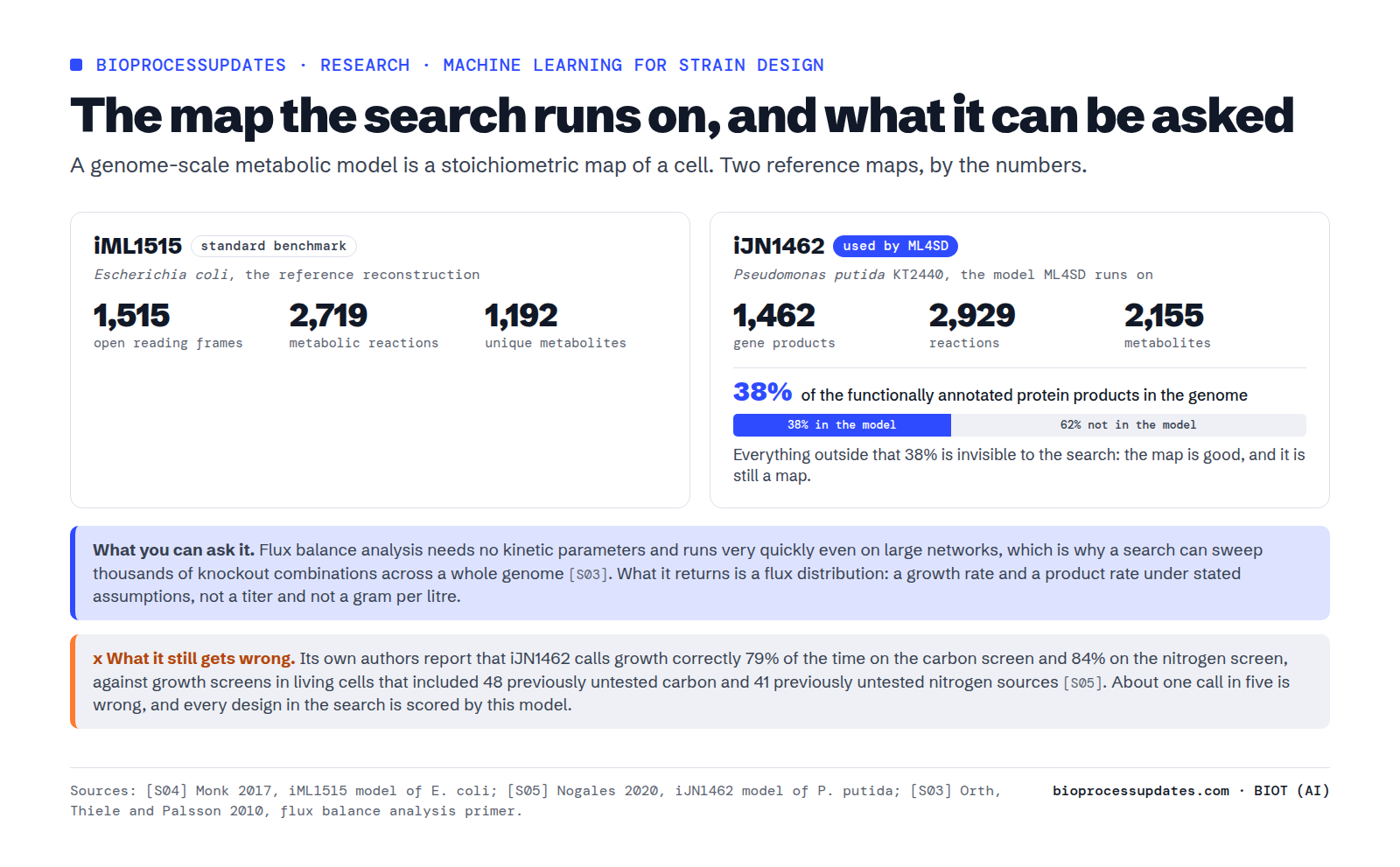
On top of that map runs flux balance analysis (FBA), which calculates how material could flow through the network under a stated assumption about what the cell is trying to do. FBA needs no kinetic parameters, which is exactly why it can be run across a whole genome quickly S03. The classical design algorithms sit on top of FBA: OptKnock, published in 2003, searches for knockouts that make growth impossible without product formation, and its authors already noted that this gives you a growth selection for the overproducer S02. RobustKnock followed because the earlier method ignored competing pathways and was therefore over-optimistic about what the strain would really make S17.
All of this sits inside a loop the field calls design-build-test-learn, or DBTL: pick the modifications, build them into a host, measure what comes out, learn, and go round again S01.
Without machine learning: a huge search and a very small number of strains
The search space is the first problem. A ten-knockout search over 150 candidate reactions is more than a quadrillion combinations, and one 2010 study had to cap each run at a week of computing S07. Even in a small model, five deletions out of 250 reactions is already more than 7.8 billion combinations S12. The exact methods are slow by construction, as the ML4SD authors put it plainly about the whole family S01.
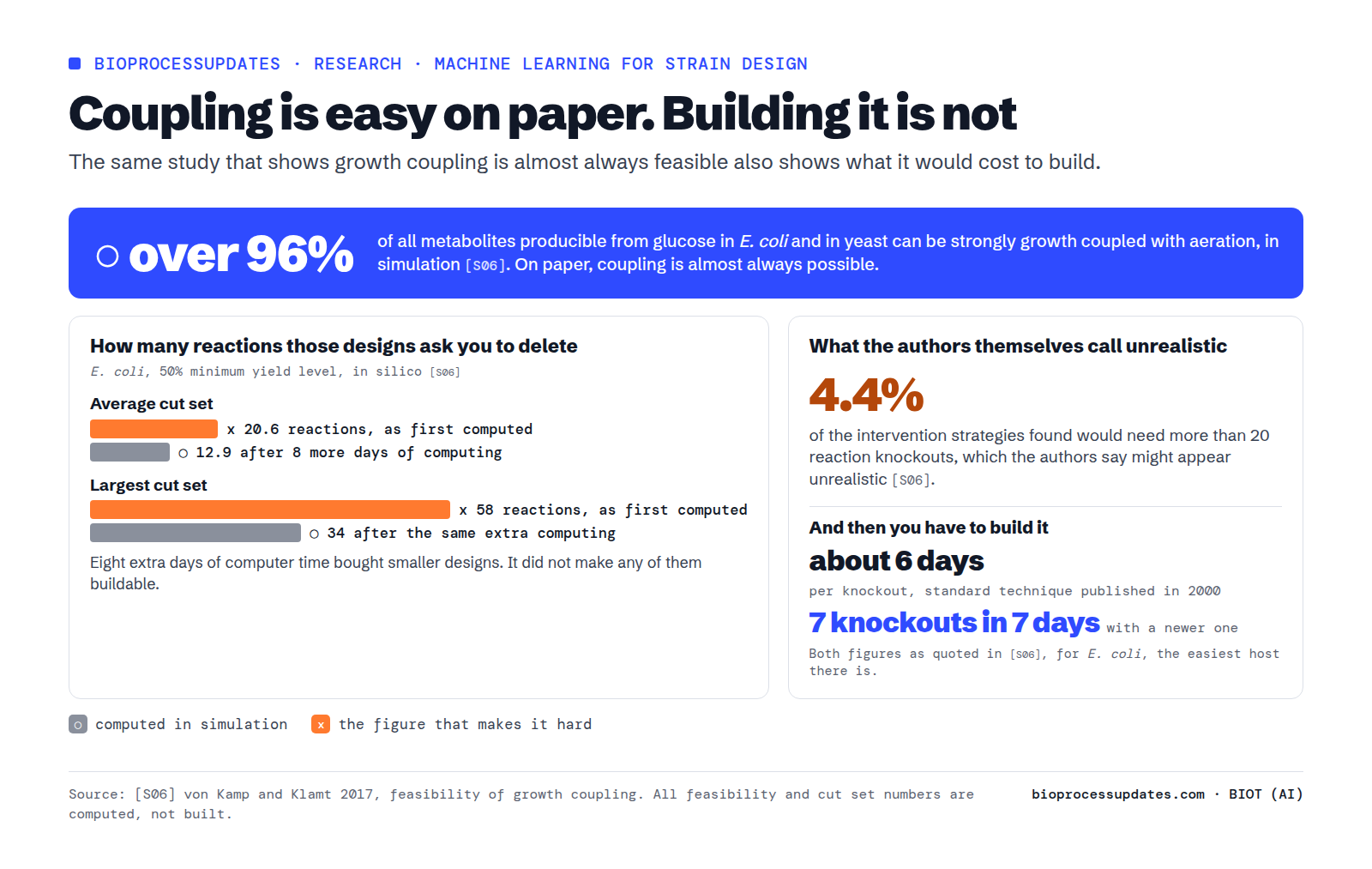
What is counter-intuitive is that feasibility is almost never the obstacle. For more than 96% of the metabolites that E. coli and yeast can make from glucose, strong growth coupling is feasible with aeration S06. The obstacle is the number of knockouts it takes. In that same study the average set of cuts was 20.6 reactions, and eight extra days of computing only brought the average down to 12.9 and the largest from 58 to 34 S06. The authors themselves call strategies needing more than 20 reaction knockouts possibly unrealistic, and 4.4% of theirs did S06. The OptCouple group states the objection without hedging: almost everything can be coupled on paper, but often only by deleting an infeasible number of genes S11.
Then you have to build it. A standard technique for deleting a gene in E. coli, published in 2000, takes about six days per knockout; a newer one managed seven knockouts in seven days S06. That is in the easiest host there is.
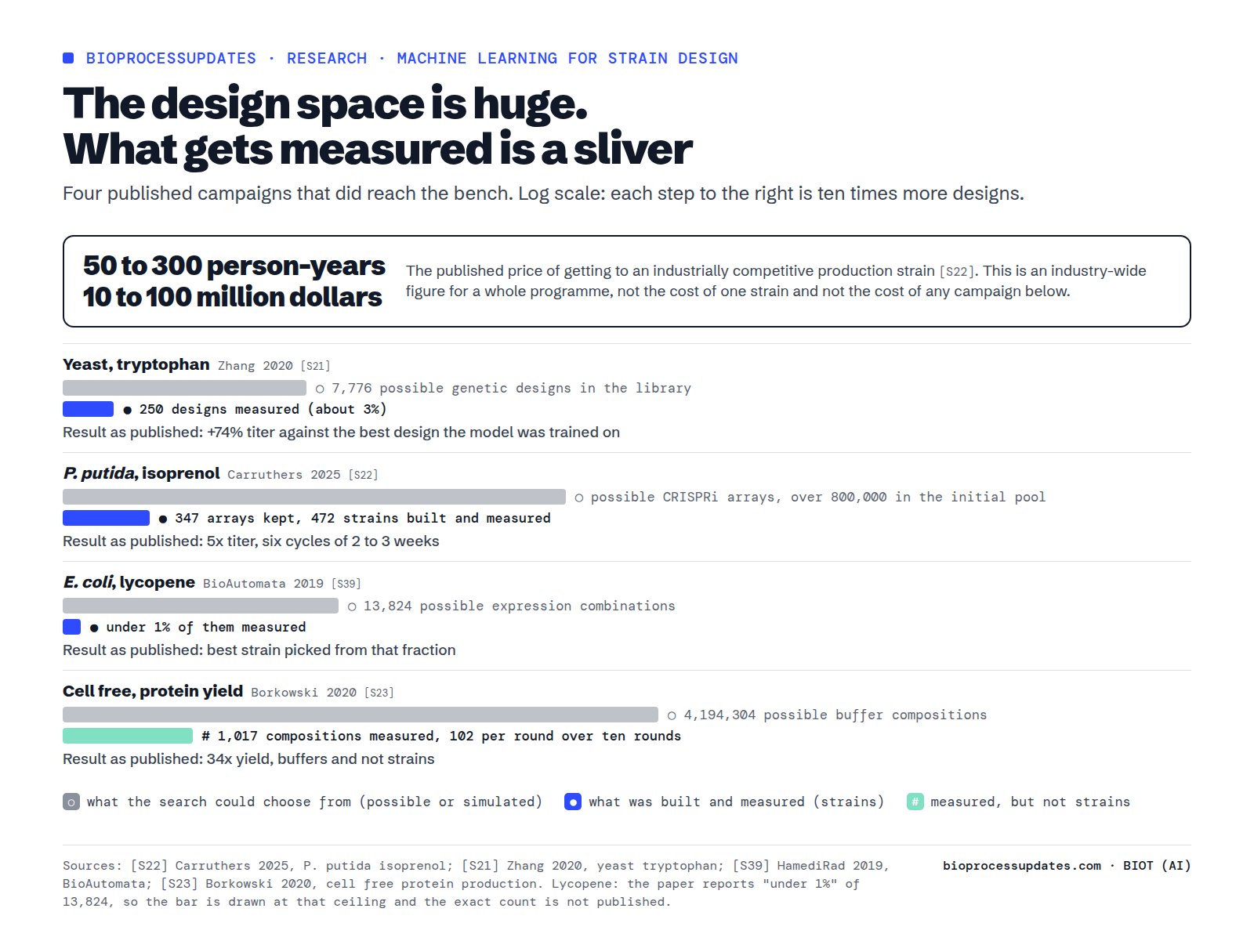
The money figure usually quoted for this work is 50 to 300 person-years and 10 to 100 million dollars for an industrially competitive production strain S22. Read it as the price of a whole programme, not of one strain: it is a figure the authors cite from three earlier sources, and we found no published cost or schedule for building one specific knockout strain. Do not divide one by the other.
The useful contrast is how few designs ever get measured. In the real laboratory, a yeast campaign explored about 3% of its design space, 250 designs out of 7,776 S21. A robotic platform faced 13,824 possible expression combinations and measured under 1% of them S39. A cell-free study had more than four million possible buffer compositions to choose from S23. The gap between what a computer can propose and what a bench can build is the whole reason anyone wants machine learning here.
What machine learning adds, and the distinction that matters most
Machine learning changes the learn step. Instead of reading results by hand, a model maps design choices to outcomes and says what to build next, so fewer constructs are made per round S01. Active learning is the stronger version, where the algorithm chooses the next experiment itself S23, and it is chosen in this field precisely because it needs less data than ordinary machine learning S01. ML4SD picks its next designs by mixing two signals: predicted performance, which exploits what the model already believes, and predicted error, which explores where it is unsure S01.
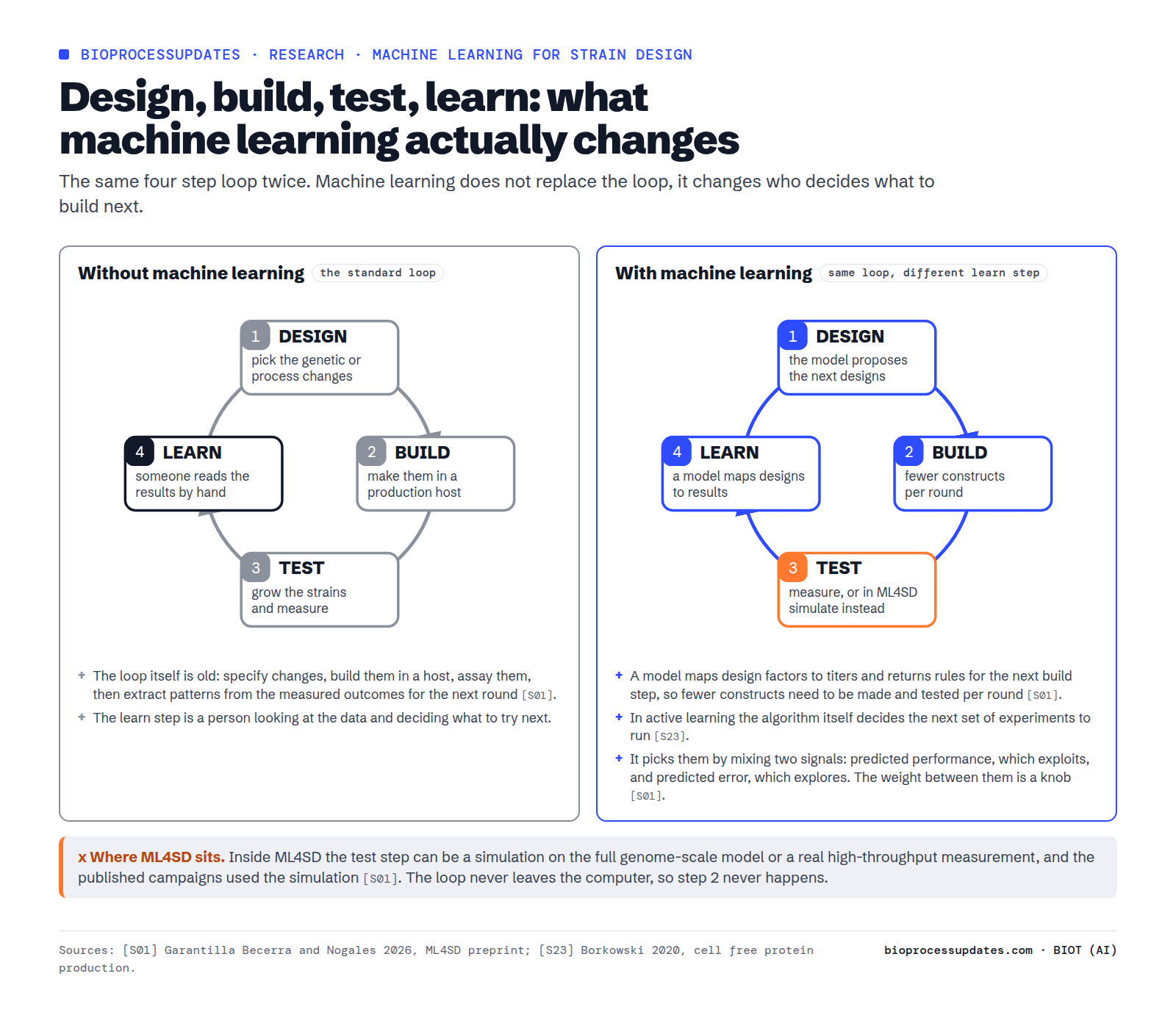
Here is the distinction that this whole article turns on, and it is not our framing. There are two different things both called machine learning for strain design:
- Models trained on laboratory measurements. Real strains were built, grown and measured, and the model learns from those numbers. The yeast campaign below rested on more than 124,000 measured data points from over 500 real designs S21.
- Models trained on the output of a metabolic model. No cells involved. In the words of the ML4SD preprint, in the absence of experimental data it uses the GEM as a generator of synthetic data S01.
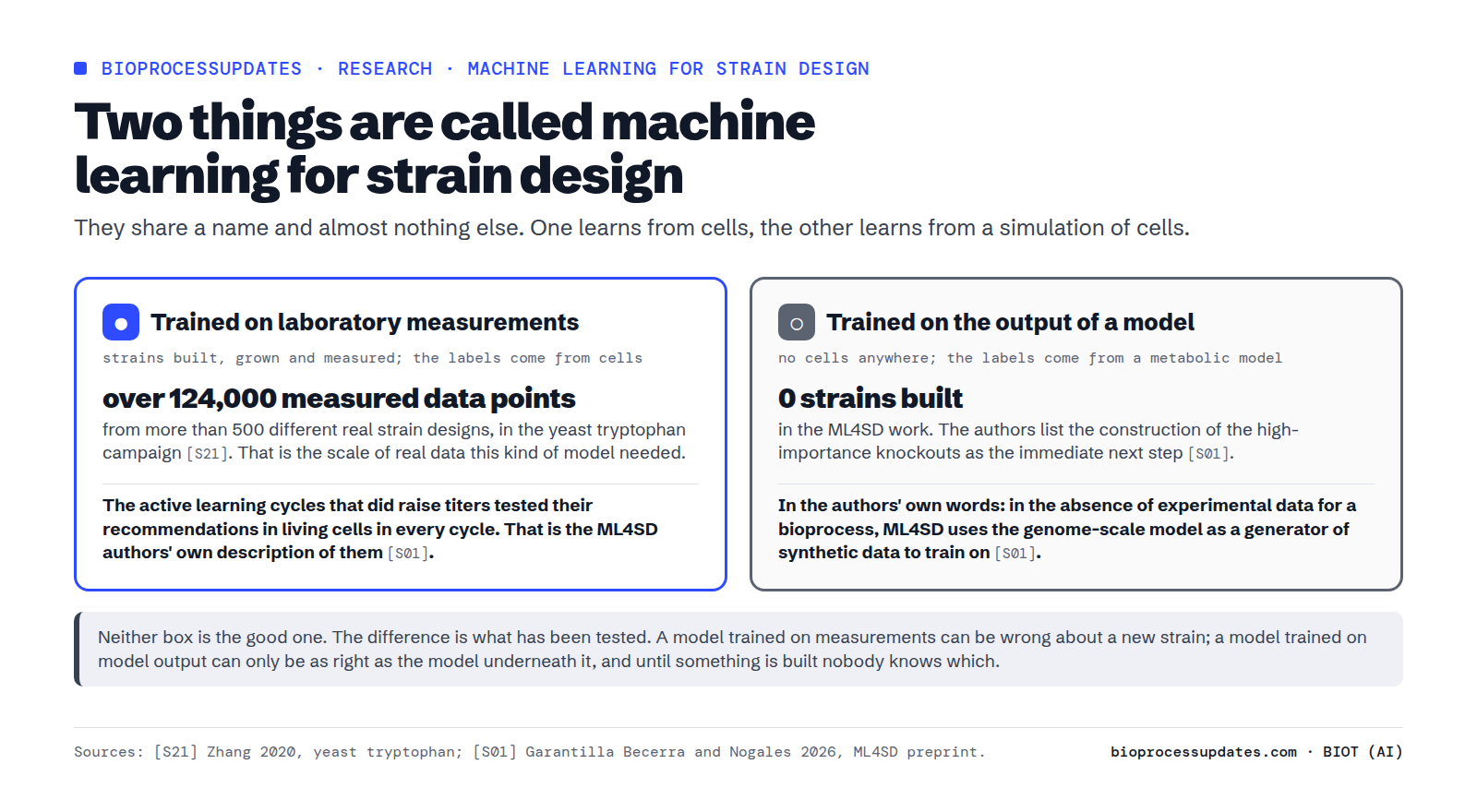
ML4SD is the second kind. Its test step could in principle be either a simulation on the full model or a real high-throughput measurement S01, and in this paper it is the simulation. The authors say why they went that way: there are very few designs ever tested in living cells per bioprocess, and that scarcity is what blocks ordinary machine learning S01. The ceiling is well known in the field: datasets in synthetic biology are typically under 100 instances, too small for deep learning S20.
And the authors draw the line themselves. The other active-learning DBTL cycles that did raise titres, they write, recommend promoter combinations, promoters being the switches that set how hard a gene is read, or CRISPRi constructs, which dial a gene down instead of deleting it, from sparse data measured in living cells, and test those recommendations in living cells within each cycle S01. Theirs does not.
What ML4SD actually is
ML4SD is an active-learning DBTL cycle whose model ensembles, meaning groups of models whose predictions are pooled, are trained on scores that a genome-scale metabolic model gives to knockout designs, and which samples the next designs from predicted performance and predicted error S01.
Its real methodological finding is about the starting library. The cycle generalises only if that library is large and varied and includes suboptimal and non-viable designs; libraries restricted to the minimal or best designs produced models that overfitted S01. That failure is specific, not rhetorical. Trained on a library of only the best designs, the ensembles had a median error of 58% of the target range on fresh designs S01, and rated designs as high as 0.89 carbon yield, which is the fraction of the carbon fed that ends up in the product, when validation on the full model showed those designs were not viable at all S01. In the authors’ summary, the lack of negative examples, the designs that produce nothing, is what caused the overfitting S01.
So they wrote a new search algorithm, gcSwarms, to supply those negatives: a particle swarm search that keeps its entire search history rather than only the winner S01. Its libraries averaged 59,000 unique qualifying designs, which the authors say is more than any strain design algorithm they know of S01, and the same ensembles trained on them dropped from 58% to a median error of 4.4% of the target range S01. Note what that comparison is: model against model. Nothing here is measured against a cell.
The case study is 4-hydroxybenzoate, an aromatic compound obtainable from lignin, converted to 6-caprolactam, the monomer of nylon-6 S01. The campaign started from a deliberately small library of 1,200 designs, which the authors chose partly because it is what a wet laboratory could afford S01. The interpretable output is a motif of three deletions that redirects flux out of the TCA cycle, the central loop the cell burns carbon in, toward the product through acetyl-CoA S01. It was recovered from the model and never built.
One resource claim deserves reading twice. ML4SD ran on a laptop with 6 cores in about 74 minutes, against 32 cores of a computing cluster for 44 minutes for the plain search S01. That is cheaper hardware, but it is more wall-clock time, not less.
The authors’ own label for the work is a computational proof of concept S01, and their own warning is blunt: without measured production, the recommendations stay ranked lists on a digital twin, a computer copy of the cell, rather than designs shown to yield a product in the host S01.
The 164 per cent, and the sibling campaign that gained 1.6 per cent
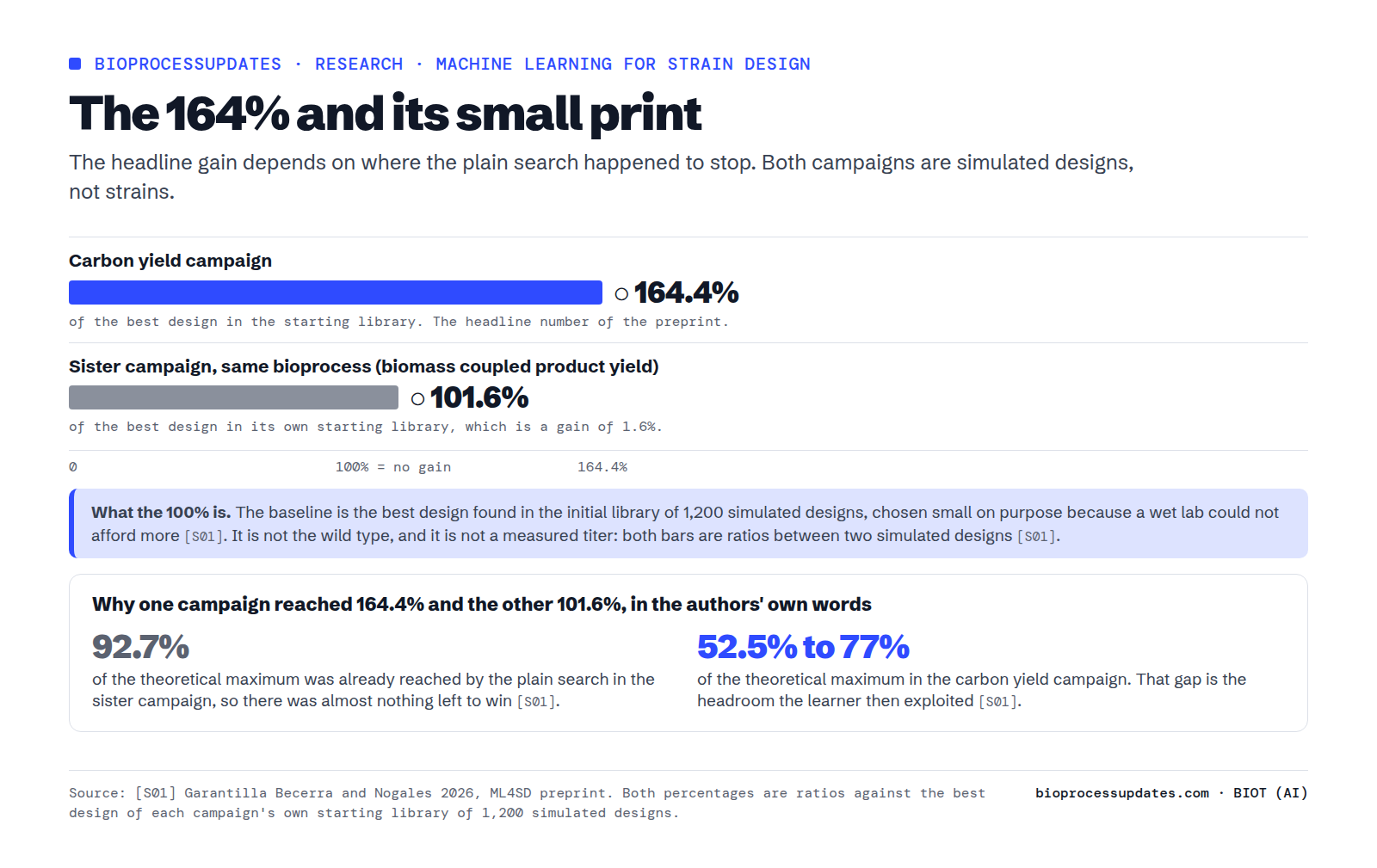
The preprint’s other headline number is a carbon yield reaching 164.4%, and it is worth seeing what the denominator is. It is 164.4% of the best design in the starting library of 1,200 S01. Not of the wild type, meaning the unmodified organism, not of the best published result, and not of any measured titre.
The reason to trust the authors on this is that they published the number that undercuts it. The second campaign, on the same bioprocess but scoring a different objective, gained 101.6% of the best starting design, which is to say 1.6% S01. Their explanation is the honest one: for that objective the plain search had already found a design at 92.7% of the theoretical maximum, so there was nothing left to win S01. For carbon yield it had only reached between 52.5% and 77% of the maximum, and that gap is what the learner exploited S01. Their own conclusion scopes the claim accordingly: the method is more advantageous when the search algorithm hands you designs far enough from the global maximum S01.
That is a useful thing to know before anyone sells you a loop like this. The size of the improvement is mostly a statement about how bad the baseline was.
What machine learning has actually done with real laboratory data
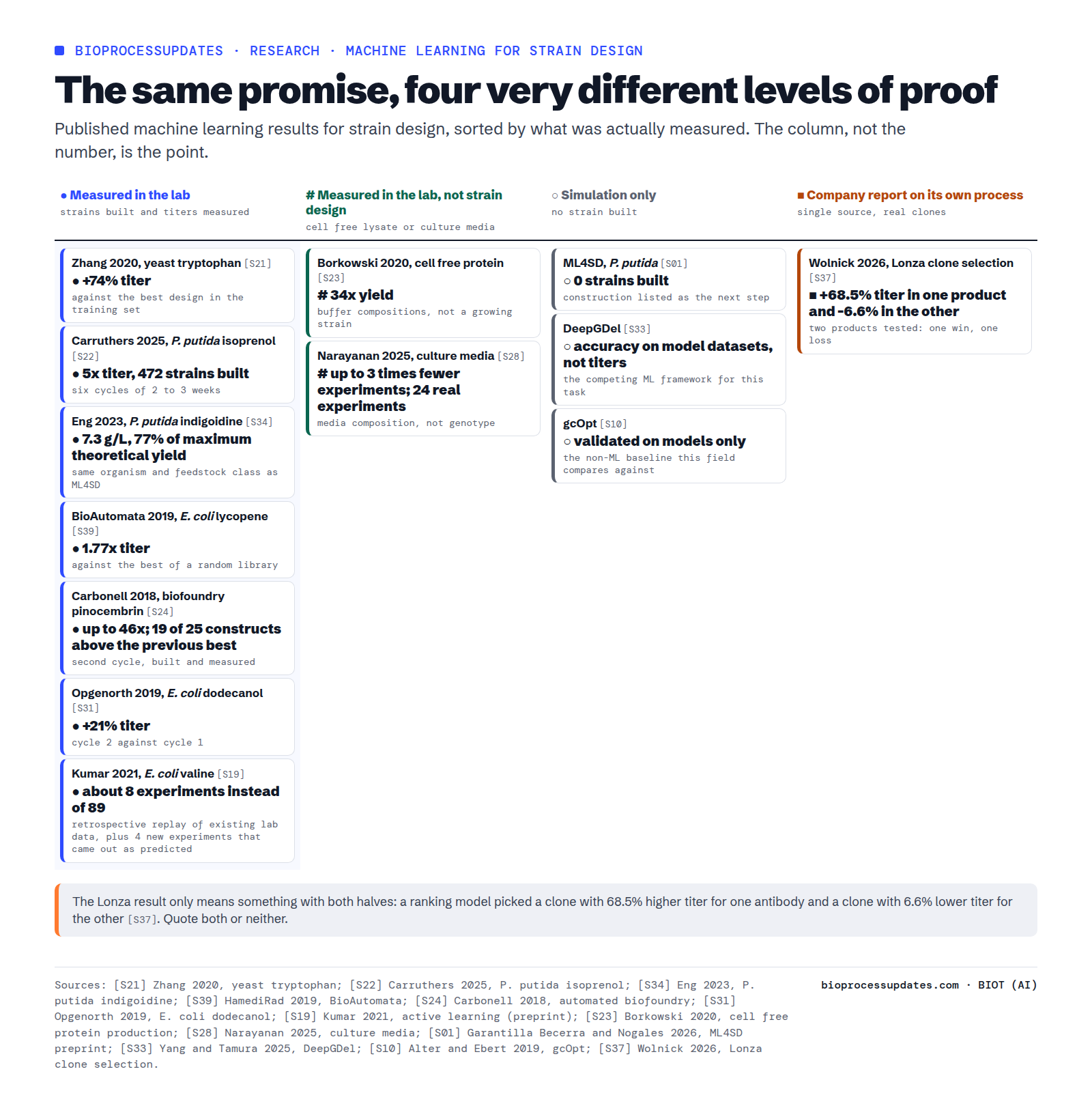
Outside this preprint there is a genuine track record, and it is worth separating by how it was measured.
In yeast, models trained on real strains found promoter combinations giving up to 74% higher tryptophan titres than the best design they were trained on S21, resting on more than 124,000 measured time points from over 500 designs S21. In Pseudomonas putida, active learning plus laboratory automation raised isoprenol titres five-fold across six DBTL cycles of two to three weeks, narrowing the design space to 347 arrays out of more than 800,000, and building and measuring 472 unique strains in triplicate S22. At the Agile BioFoundry, two design-build-test-learn cycles on 60 E. coli strains, with machine learning trained on the first cycle to pick the second, bought a 21% titre increase in that second cycle S31, which is the most sobering published number and probably the most representative. A biofoundry run on pinocembrin had 19 of 25 constructs beat the previous best, ten of them by up to 46 times S24. A Bayesian-optimisation robot found a lycopene strain 1.77 times better than the best of a random library it had also built and measured S39. In cell-free protein production, which is real measurement but not a growing cell, active learning over a four-million-point space raised yield 34 times against the starting buffer, measuring 1,017 compositions in ten rounds of 102 to get there S23.
The closest wet-lab precedent to the ML4SD case study is worth naming, because it shows what the finished article looks like. In the same organism and from the same lignin-derived class of feedstock, a group explored 4,114 growth-coupling solutions and ended with a strain producing 7.3 g/L of indigoidine at 77% of maximum theoretical yield S34. That is a number with a unit of mass in it.
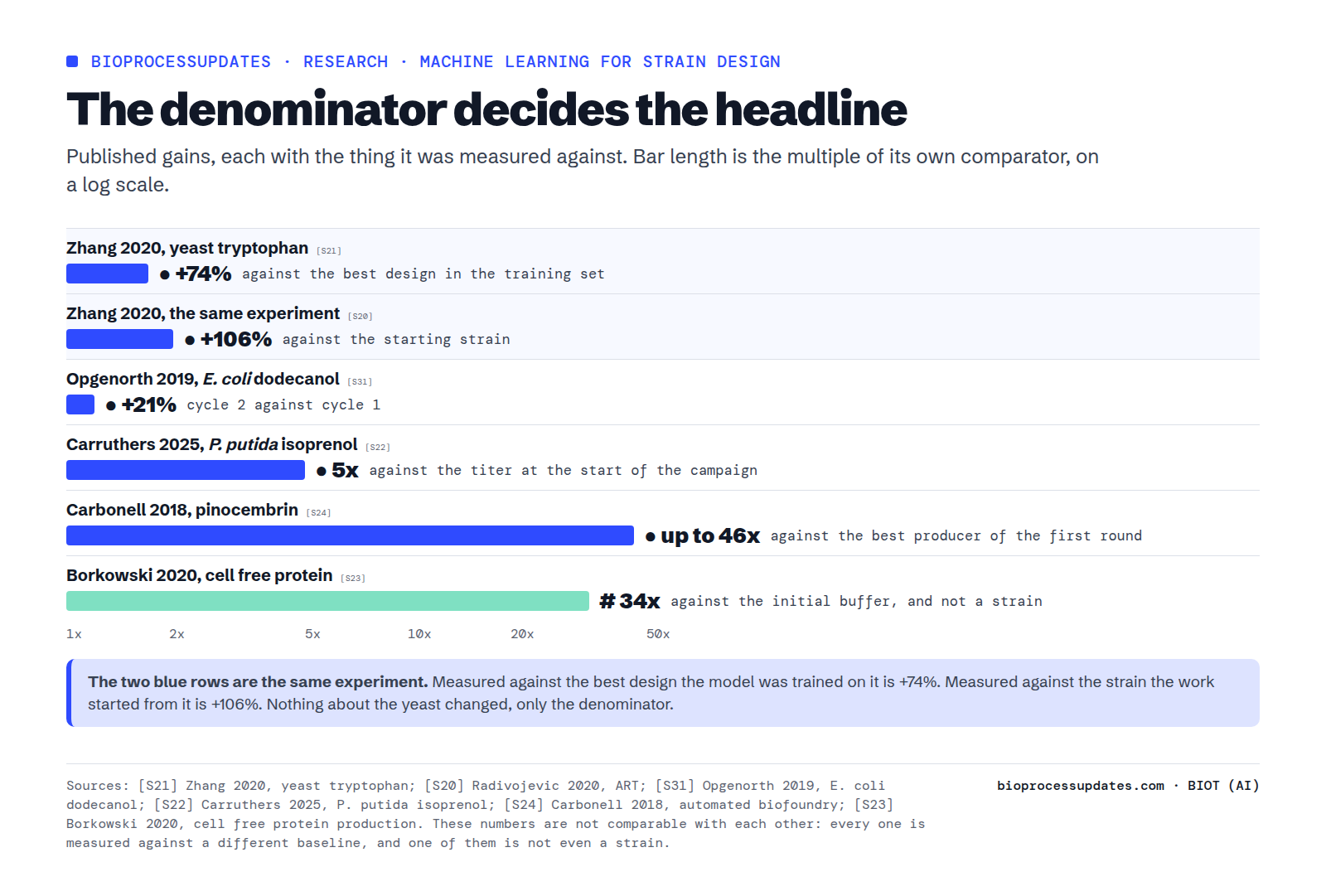
Two cautions on reading any of this. First, the comparator decides the headline. The yeast campaign above is 74% better than the best training design S21 and 106% better than the base strain S20: same experiment, two denominators. Second, some results are less prospective than they look. A frequently cited result, active learning finding a good E. coli valine strain in about eight experiments rather than the 89 originally run S19, is largely a replay over data the same group had already generated; they did go back to the bench, and all four newly suggested experiments came out as predicted, with one at 53.4% of maximum theoretical yield against a best measured 54.7% S19. That is a real but small prospective validation.
Adjacent work is more mature than strain design itself. Bayesian optimisation of culture media cut the experimental burden up to three-fold against classical design of experiments, and 10 to 30-fold with nine factors in play, reaching its result with 24 real experiments S28. An autonomous software agent drove 20 days of a 27-day perfusion cultivation, as reported by the company and university team that built it S36. In cell line development, a company ranking model picked a clone with 68.5% higher titre than the legacy choice for one antibody, and one with 6.6% lower titre for the other S37. We quote both halves of that one on principle: it is the only industrial head-to-head we found, and it is one win and one loss.
Where the models break
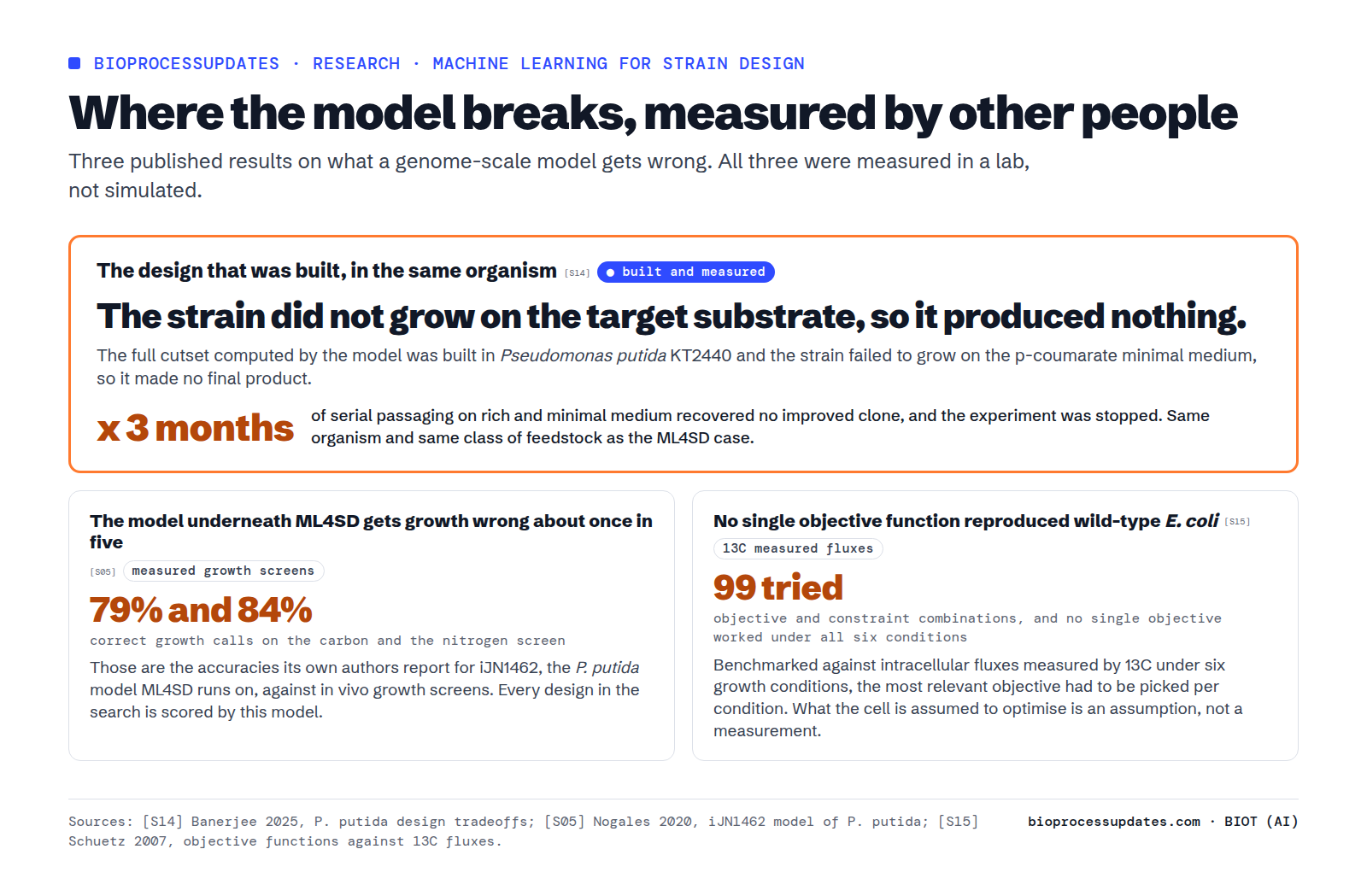
The sharpest counter-example available is in the same organism as the ML4SD case study. A group completed a model-computed set of cuts in P. putida KT2440, intended to couple growth to a product on a lignin-derived substrate. The finished strain grew slowly on rich medium and failed to grow at all on the target substrate, so it produced nothing S14. Three months of serial passaging recovered no improved clone, and the experiment was stopped S14. Their conclusion names what the model could not see: conditional synthetic lethality and gene dosage requirements among the deletions the design demanded S14. Even the partial version of the design produced less than predicted S14.
That is not an unlucky one-off, it is the known limit of the method. A metabolic model accounts for mass balance and thermodynamics and cannot account for kinetics, allosteric control, or regulation outside metabolism S13. The primer written by the authors of flux balance analysis says it cannot predict concentrations and, without modification, ignores regulation, so its predictions may not always be accurate S03. Benchmarked against intracellular fluxes measured with carbon-13 tracers under six conditions, no single FBA objective reproduced wild-type E. coli everywhere, across 99 combinations of objective and constraint tried S15.
And the specific model underneath ML4SD gets about one growth call in five wrong: its published accuracy on carbon and nitrogen growth screens is 79% and 84% S05. The ML4SD authors concede the general point about their own tooling, naming annotation gaps and promiscuous enzymes as reasons model predictions are sloppy S01. On top of that, metabolic burden, the cost to the cell of carrying the modification, is a known cause of designs underperforming, and reviewers of the field call it a black box, with reduced growth, impaired protein synthesis and genetic instability among the symptoms S29.
Finally, a model trained on a model can be confident and wrong. The ML4SD ensembles trained on the narrow library could not tell non-viable designs from high performers S01, and that failure mode is invisible without a validation step. Neither search algorithm in the paper found a library for every target, and the authors note that some apparent infeasibilities are false negatives from the computing time budget S01.
What would have to be published to believe the 2.5 to 7.1 times
- Strains. Nothing was built. The authors list constructing the high-importance knockouts, and especially the minimal design, as the immediate next step S01, and plan to fold real measurements in by transfer learning onto the existing ensemble, also as future work S01.
- Titres. There is not a single g/L in the preprint, because nothing was fermented. The comparator exists and is published: 7.3 g/L at 77% of maximum theoretical yield in the same organism and the same class of feedstock S34.
- Scale. Nothing above simulation, so nothing about what happens in a bioreactor.
- A comparison against the state of the art. The 2.5 to 7.1 times is against the authors’ own new search algorithm, not against OptKnock, gcOpt, minimal cut sets or gcFront on equal terms S01.
- Independence. The metabolic model, the base search algorithm and the framework are all from the same group, and the last author of the preprint is also an author of the model S05 S01. We found no external reproduction.
- Settled parameters. The authors concede that the cycle’s own settings are unsettled and that answering those questions needs extensive proofs S01, and that the design landscape is rugged, with the best designs not where the good ones are densest, which is itself a reason to expect surprises in living cells S01.
- Peer review. This is version 1 of a bioRxiv preprint, with no journal version indexed at the time of writing.
For context on how young this corner is: the framework the ML4SD authors name as the only other one published for this task reports accuracy gains on model datasets rather than titres S33 S01, and the non-machine-learning comparator family it is measured against was also validated only on models S10. Nobody in this specific niche, machine learning that picks growth-coupled knockouts, has shown a strain yet. Machine learning that picks gene targets in other ways has: one 2026 database-driven model was checked by overproducing geraniol in yeast S41.
The AI in the plant series
This piece sits inside our series on artificial intelligence in bioprocessing. The pillar, AI in bioprocessing, explained: what actually runs in a plant, sorts the uses by the evidence behind them and includes a simulator of a model that does not survive scale-up. PAT in practice: sensors, models that fail and where to start covers the probes and the soft sensors that feed any of this. The news note this research grew out of is our brief on the ML4SD preprint.
Questions
What is machine learning strain design? Using a statistical model to decide which genetic modifications to try next, instead of ranking every candidate by hand or by an optimisation algorithm alone. The model maps design choices to outcomes and recommends the next batch, so fewer constructs are built per round S01.
What is ML4SD? A framework described in a September 2026 bioRxiv preprint from CNB-CSIC in Madrid: an active-learning design-build-test-learn cycle whose model ensembles are trained on genome-scale metabolic model scores of knockout designs S01. It is in silico throughout, has not been peer reviewed, and no strain was built S01.
Does machine learning in metabolic engineering reduce the number of experiments? With real laboratory data, yes, in published campaigns, by amounts that range from 21% more product S31 to five times more S22, and in one case a satisfactory strain from about eight experiments rather than 89 S19. How much depends heavily on the comparator, and one industrial report is a win on one product and a loss on another S37.
What does growth-coupled mean? That the cell has been modified so it cannot grow without making the product, which means a mutant that stops producing gains no advantage S01. For more than 96% of metabolites that E. coli and yeast make from glucose it is feasible on paper S06, but often only with a number of knockouts that is not practical to build S11.
Is AI used in cell line development? It is being reported by companies on their own processes. One ranking model picked a clone with 68.5% higher titre than the legacy method for one antibody and 6.6% lower for another S37. That is one published comparison, not a settled practice.
What we could not verify
The preprint states that all its code is available in a free-access GitHub repository S01. We checked that URL on 4 November 2026 and it returns a not-found error, and the account’s six public repositories, four of its own plus two copies of other people’s, include none called ML4SD. The first author does publish a related strain design pipeline covering knockout analysis and flux balance analysis, but it is not ML4SD S42. So the method cannot currently be reproduced from the link the paper gives.
We read the supplementary figures of the preprint only through their captions, so the per-bioprocess numbers behind its medians were not checked one by one. We found no published cost or schedule for building one specific knockout strain in a named organism, only whole-programme figures S22 and gene-editing timings S06. We found no study comparing a metabolic model’s knockout predictions directly against carbon-13 measured fluxes in the same multi-deletion strains, so our statement that these models do not predict real flux well rests on a benchmark in wild-type cells S15 plus one implemented design that failed S14, not on a head-to-head test. Measured flux data are not a clean reference either: that field reports large discrepancies in quality and studies that cannot be reproduced from incomplete reporting S16. Several key older papers were available to us as abstracts only, including the standard review of the pre-machine-learning algorithms S08, the most candid biofoundry result S31 and the closest wet-lab precedent S34; their headline numbers are in the abstracts, their internal breakdowns are not. A search for few-shot learning applied to strain design returned nothing.
Sources
- S01 Alvaro Garantilla Becerra; Juan Nogales, ML4SD: Leveraging Machine Learning and High-Throughput Search Algorithms for an Iterative Growth-Coupled Design Innovation. bioRxiv preprint, posted 16 September 2026, version 1, CC-BY, 2026 (preprint, not peer reviewed). Affiliations: Academic (Systems Biotechnology Group, Centro Nacional de Biotecnologia, CSIC, Madrid; CNB DNA Biofoundry; SusPlast-CSIC). Not peer reviewed.
- S02 Burgard AP et al., Optknock: a bilevel programming framework for identifying gene knockout strategies for microbial strain optimization. Biotechnology and Bioengineering, 2003. Affiliations: Academic (Penn State). The original growth-coupled knockout algorithm. Abstract read. Published before 2015.
- S03 Orth JD et al., What is flux balance analysis?. Nature Biotechnology, 2010. Affiliations: Academic (UC San Diego). Primer written by the group that built the E. coli models. Published before 2015.
- S04 Monk JM et al., iML1515, a knowledgebase that computes Escherichia coli traits. Nature Biotechnology, 2017. Affiliations: Academic (UC San Diego and collaborators). The reference E. coli genome-scale model.
- S05 Nogales J et al., High-quality genome-scale metabolic modelling of Pseudomonas putida highlights its broad metabolic capabilities. Environmental Microbiology, 2020. Affiliations: Academic (CSIC Madrid and UC San Diego). Juan Nogales, last author of the ML4SD preprint, is first author here: this is the model ML4SD runs on.
- S06 von Kamp A et al., Growth-coupled overproduction is feasible for almost all metabolites in five major production organisms. Nature Communications, 2017. Affiliations: Academic (Max Planck Institute for Dynamics of Complex Technical Systems, Magdeburg).
- S07 Feist AM et al., Model-driven evaluation of the production potential for growth-coupled products of Escherichia coli. Metabolic Engineering, 2010. Affiliations: Academic (UC San Diego). Published before 2015.
- S08 Maia P et al., In Silico Constraint-Based Strain Optimization Methods: the Quest for Optimal Cell Factories. Microbiology and Molecular Biology Reviews, 2016. Affiliations: Academic (University of Minho, Portugal). Review of the pre-ML algorithm family. Abstract read.
- S10 Alter TB et al., Determination of growth-coupling strategies and their underlying principles. BMC Bioinformatics, 2019. Affiliations: Academic (RWTH Aachen). The gcOpt algorithm.
- S11 Jensen K et al., OptCouple: Joint simulation of gene knockouts, insertions and medium modifications for prediction of growth-coupled strain designs. Metabolic Engineering Communications, 2019. Affiliations: Academic (DTU Biosustain, Denmark).
- S12 Patil KR et al., Evolutionary programming as a platform for in silico metabolic engineering. BMC Bioinformatics, 2005. Affiliations: Academic (Technical University of Denmark). The OptGene algorithm. Published before 2015.
- S13 Sabzevari M et al., Strain design optimization using reinforcement learning. PLOS Computational Biology, 2022. Affiliations: Academic (Aalto University and VTT, Finland). Machine learning over model scores, no wet lab.
- S14 Banerjee D et al., Addressing genome scale design tradeoffs in Pseudomonas putida for bioconversion of an aromatic carbon source. npj Systems Biology and Applications, 2025. Affiliations: Academic and national lab (Joint BioEnergy Institute, Lawrence Berkeley National Laboratory). Wet-lab test of a model-computed growth-coupled cutset in the same organism ML4SD models.
- S15 Schuetz R et al., Systematic evaluation of objective functions for predicting intracellular fluxes in Escherichia coli. Molecular Systems Biology, 2007. Affiliations: Academic (ETH Zurich). Benchmark of FBA predictions against measured 13C fluxes. Published before 2015.
- S16 Crown SB et al., Publishing 13C metabolic flux analysis studies: a review and future perspectives. Metabolic Engineering, 2013. Affiliations: Academic (University of Delaware). Reporting standards for measured flux studies. Published before 2015.
- S17 Tepper N et al., Predicting metabolic engineering knockout strategies for chemical production: accounting for competing pathways. Bioinformatics, 2010. Affiliations: Academic (Technion, Israel). The RobustKnock algorithm. Abstract read. Published before 2015.
- S19 Kumar P et al., Active and machine learning-based approaches to rapidly enhance microbial chemical production. Metabolic Engineering (preprint version read: bioRxiv 2020.12.01.406439), 2021 (preprint, not peer reviewed). Affiliations: Academic (University of Wisconsin-Madison). Active learning scored against real E. coli lab data.
- S20 Radivojevic T et al., A machine learning Automated Recommendation Tool for synthetic biology. Nature Communications, 2020. Affiliations: National lab (Agile BioFoundry and Joint BioEnergy Institute, Lawrence Berkeley National Laboratory). The ART tool.
- S21 Zhang J et al., Combining mechanistic and machine learning models for predictive engineering and optimization of tryptophan metabolism. Nature Communications, 2020. Affiliations: Academic (DTU Biosustain) with Lawrence Berkeley National Laboratory. The wet-lab counterpart of the ART paper.
- S22 Carruthers DN et al., Automation and machine learning drive rapid optimization of isoprenol production in Pseudomonas putida. Nature Communications, 2025. Affiliations: National lab (Joint BioEnergy Institute, Lawrence Berkeley National Laboratory). Active learning plus robots, measured in vivo.
- S23 Borkowski O et al., Large scale active-learning-guided exploration for in vitro protein production optimization. Nature Communications, 2020. Affiliations: Academic (INRAE and University of Paris-Saclay). Active learning on real measurements, but cell-free, not whole cells.
- S24 Carbonell P et al., An automated Design-Build-Test-Learn pipeline for enhanced microbial production of fine chemicals. Communications Biology, 2018. Affiliations: Academic biofoundry (Manchester Synthetic Biology Research Centre, SYNBIOCHEM).
- S25 Van Lent P et al., Comparing metabolic engineering scenarios using simulated design-build-test-learn-cycles. Frontiers in Bioengineering and Biotechnology, 2026. Affiliations: Academic (Delft University of Technology) with dsm-firmenich co-authorship. In silico benchmark of DBTL design choices.
- S27 Hillson N et al., Building a global alliance of biofoundries. Nature Communications, 2019. Affiliations: Consortium comment from 16 public biofoundries (Global Biofoundry Alliance).
- S28 Narayanan H et al., Accelerating cell culture media development using Bayesian optimization-based iterative experimental design. Nature Communications, 2025. Affiliations: Academic (MIT Koch Institute). Active learning on real cell culture measurements, media rather than genotype.
- S29 Snoeck S et al., Metabolic burden explained: stress symptoms and its related responses induced by (over)expression of (heterologous) proteins in Escherichia coli. Microbial Cell Factories, 2024. Affiliations: Academic (Ghent University). Review of why engineered cells underperform their design.
- S31 Opgenorth P et al., Lessons from Two Design-Build-Test-Learn Cycles of Dodecanol Production in Escherichia coli Aided by Machine Learning. ACS Synthetic Biology, 2019. Affiliations: National lab (Agile BioFoundry, Lawrence Berkeley National Laboratory). Abstract read.
- S33 Yang Z et al., DeepGDel: Deep Learning-Based Gene Deletion Prediction Framework for Growth-Coupled Production in Genome-Scale Metabolic Models. IEEE Transactions on Computational Biology and Bioinformatics, 2025. Affiliations: Academic (Kyoto University). The only prior published ML framework for this task, per the ML4SD authors. Abstract read.
- S34 Eng T et al., Maximizing microbial bioproduction from sustainable carbon sources using iterative systems engineering. Cell Reports, 2023. Affiliations: National lab (Joint BioEnergy Institute, Lawrence Berkeley National Laboratory). The closest wet-lab precedent: growth-coupled P. putida on a lignin-derived substrate. Abstract read.
- S36 Gadiyar C et al., Self-Driving Development of Perfusion Processes for Monoclonal Antibody Production. Biotechnology and Bioengineering, 2026 (company reporting on its own process). Affiliations: Industry and academia (Merck Serono, DataHow AG, TU Berlin). Autonomous agent on real bioreactors.
- S37 Wolnick A et al., Machine learning-assisted clone selection for intensified cell culture processes. Biotechnology Progress or Journal (Lonza R&D publication), 2026 (company reporting on its own process). Affiliations: Industry (Lonza, Bend, Oregon). Company reporting on its own clone selection.
- S39 HamediRad M et al., Towards a fully automated algorithm driven platform for biosystems design. Nature Communications, 2019. Affiliations: Academic (University of Illinois Urbana-Champaign). BioAutomata: Bayesian optimization plus a robot, measured in vivo.
- S40 Morrell WC et al., The Experiment Data Depot: A Web-Based Software Tool for Biological Experimental Data Storage, Sharing, and Visualization. ACS Synthetic Biology, 2017. Affiliations: National lab (Joint BioEnergy Institute, Lawrence Berkeley National Laboratory). Abstract read.
- S41 Li X et al., Leveraging large language models for metabolic engineering design. Trends in Biotechnology, 2026. Affiliations: Academic (Chinese institutions). The D2Cell database and model. Abstract read.
- S42 extrevaro (Alvaro Garantilla Becerra), StrainDesignPipeline (README of the public repository of the ML4SD first author). GitHub repository README, last pushed 18 September 2025, 2025 (code repository). Affiliations: Code published by the first author of the ML4SD preprint.