Pfizer’s Bioprocess Research and Development group in Andover, Massachusetts, has published a paper describing how it scaled an intensified perfusion process for antibody production from 100 L pilot runs to 500 L manufacturing runs for early clinical supply. The paper was received on 27 May 2026, accepted on 10 September 2026, and published online on 27 September 2026 in Biotechnology and Bioengineering. It also reports parallel development of a next-generation version of the platform. The full text is subscription-only; this brief is based on the published abstract.
A dynamic two-stage process
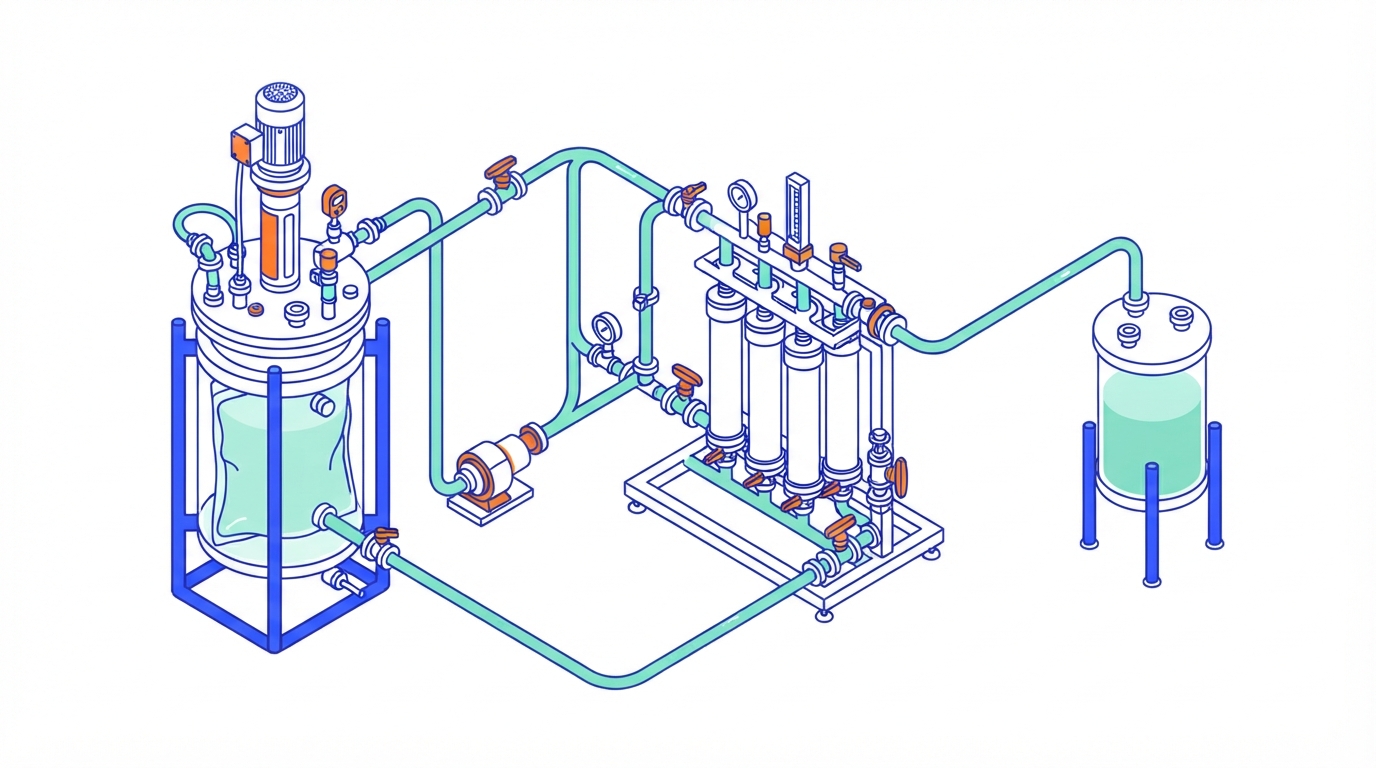
The process, which the authors call high-intensity, low-volume perfusion (HILVOP), runs in two stages. During the growth phase, the system uses cell-controlled perfusion. During the intensified production phase, product is removed from the bioreactor through tangential flow filtration (TFF). The team evaluated scale-up performance across multiple CHO cell lines, focusing on membrane robustness, product recovery and space-time yield.
Membrane fouling was a key scale-up risk
Early manufacturing-scale runs identified membrane fouling as a key risk, particularly with challenging cell lines, the authors report. To address it, the team ran a systematic optimization of TFF operating conditions: a reduced membrane wall shear rate, a larger pore size, an alternative filter membrane, and refined perfusion rate profiles. Those changes improved membrane performance, delayed the rise in transmembrane pressure (TMP), and increased cumulative product recovery while reducing media consumption.
More yield from seeding density and phase length
Additional productivity gains came from high-density seeding and from extending the productive perfusion phase, which increased permeate space-time yield, according to the abstract. The authors describe the results as evidence of the robustness and scalability of the HILVOP platform, and say they highlight design considerations for reliable perfusion operation at manufacturing scale.
What it means for a plant
The abstract identifies TFF membrane fouling as a key risk when the HILVOP process moved to manufacturing scale, particularly with challenging cell lines. The changes it lists are TFF operating conditions and filter selection: wall shear rate, membrane pore size, filter membrane and perfusion rate profile. For a facility running or planning intensified perfusion with TFF-based product removal, these are the variables the paper links to membrane performance, TMP rise and cumulative product recovery at scale. The abstract gives no numeric recovery, yield or media-consumption figures.