Primary source Bioresource Technology: Harnessing Yarrowia lipolytica as a platform for animal-free and secretory production of human lactoferrin
A team from the Department of Chemical Engineering at Guangdong Technion-Israel Institute of Technology, with coauthors from Inner Mongolia Mengniu Dairy’s R&D centers, engineered the yeast Yarrowia lipolytica to produce and secrete recombinant human lactoferrin (hLF) without extracting it from milk. The paper appeared online on 22 Sep 2026 in Bioresource Technology (volume 464).
From shake flask to fed-batch
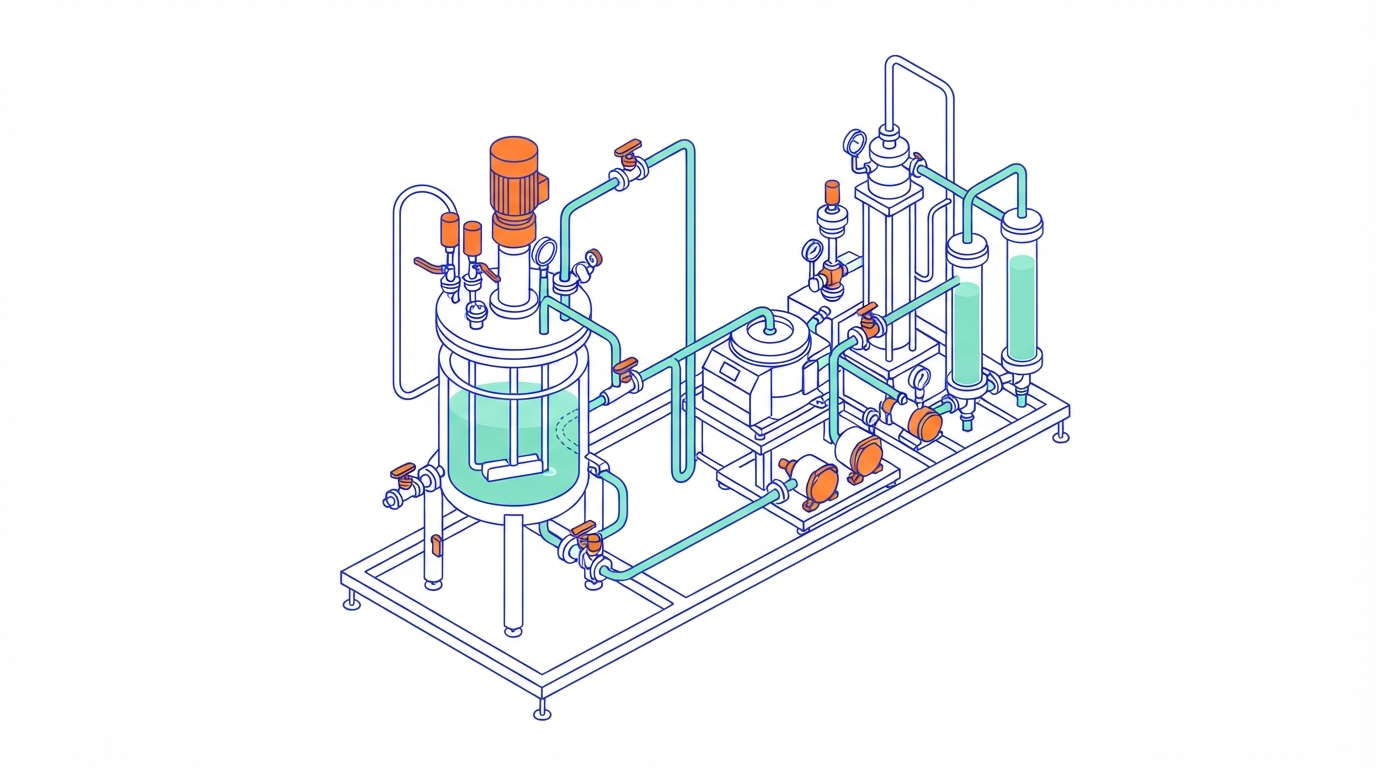
The best-performing strain secreted 409.9 mg/L of hLF in shake flasks. Further process optimization in a 5 L fed-batch fermentation raised the titer to 3.14 g/L. The abstract does not give the fed-batch conditions.
Secretion capacity, not copy number, was the limit
The authors report that simply raising the hLF gene copy number did not proportionally raise extracellular yield; instead it impaired cell growth and morphology. They instead strengthened the cell’s protein-folding and secretory machinery, which let the yeast accommodate and secrete higher levels of hLF. The abstract frames this balance between recombinant protein expression and host secretory capacity as the critical factor for producing complex proteins in this system.
Europe PMC lists the full text as subscription required, so this brief is limited to what the abstract reports; strain construction details and process data are not covered here.
What it means for a plant
For a plant evaluating animal-free lactoferrin, the result argues against copy-number scale-up as a shortcut: adding gene copies alone impaired growth and morphology and did not proportionally raise extracellular titer. The gain came instead from matching expression to the host’s folding and secretion capacity, then confirming it in a 5 L fed-batch run. Any transfer to larger fermenters should budget time for the same two checks, secretory bottleneck and process optimization, rather than assuming titer will scale with copy number or vessel size alone.