
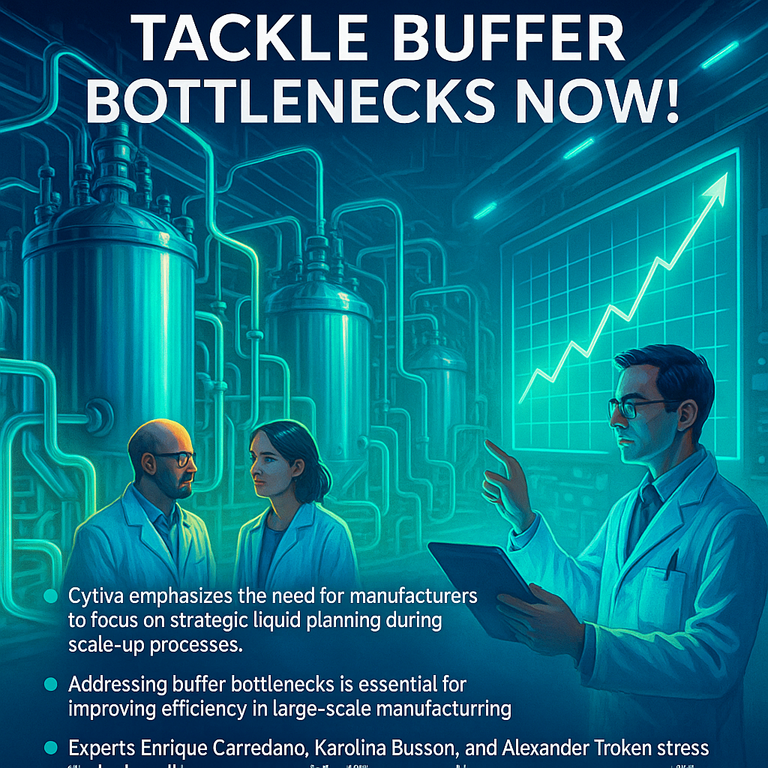
🔄 **Addressing buffer bottlenecks** is essential for improving efficiency in large-scale manufacturing.
👨🔬 **Experts Enrique Carredano, Karolina Busson,** and **Alexander Troken** stress that a broader approach will facilitate smoother operations and production flow.
🏭 **Manufacturers should adapt** to the evolving demands in the industry for better outcomes.
Introduction:
The article “Addressing Buffer Bottlenecks in Large-Scale Manufacturing” by Enrique Carredano, PhD, Karolina Busson, and Alexander Troken, PhD, explores the critical need for manufacturers to enhance their operational efficiency by incorporating strategic liquid planning in their scale-up processes. It highlights the importance of addressing buffer bottlenecks that can hinder production performance in large-scale manufacturing settings.
- Manufacturers often overlook the significance of liquid planning, which can lead to bottlenecks in production processes.
- Buffer capacity and effective management are essential for optimizing production timelines and meeting demand without delays.
- Integrating advanced technologies can mitigate bottlenecks and improve fluid dynamics in the manufacturing process.
- Collaboration across departments and with suppliers is crucial for enhancing operational flexibility and responsiveness to market changes.
- Future manufacturing strategies need to prioritize sustainability alongside efficiency to adapt to evolving industry demands.
Conclusion:
This article underlines the necessity for manufacturers to reassess their operational strategies by incorporating a systematic approach to liquid planning. Addressing buffer bottlenecks not only enhances productivity but also aligns with sustainability goals, ensuring that manufacturers are well-prepared for future challenges in an increasingly competitive market.