Primary source NIIMBL: OAGi and NIIMBL Announce Release of Biopharmaceutical Manufacturing Ontologies to Advance Interoperability and Analytics
On 12 November 2025, the National Institute for Innovation in Manufacturing Biopharmaceuticals (NIIMBL) and the Open Applications Group (OAGi) released a set of open ontologies for biopharmaceutical manufacturing data. They are free to use under an MIT-style license. On 4 September 2026, a review based on material gathered by NIIMBL’s Big Data Program was published in Frontiers in Bioengineering and Biotechnology; it lists ontologies among the data capabilities the industry says it needs. This explainer covers what an ontology is in plant terms, what was released, and where it could save engineering time.
What an ontology is, in plant terms
The NIIMBL review defines an ontology as a formal semantic model of a set of concepts and their relationships within a common reference model. Its job is semantic interoperability: making sure the meaning of data stays consistent across systems. The review lists it as a critical component of interoperability and says it is becoming a requirement for capabilities such as digital twins. It also separates the ontology from the data schema. The schema standardizes content, structure and format so machines can extract and integrate data from different sources, in alignment with an ontology.
The review uses the Levels of Conceptual Interoperability Model to show the gap. At the syntactic level, technical connections exist and agreed protocols exchange the right data, but the meaning of the data is not established. Two historians can swap a tag called “DO” every second and still disagree on whether it is percent air saturation or mg/L, measured by which probe, in which vessel, during which phase. An ontology is what pins that down. The review says the highest level of interoperability is what effective digital twins need.
What was released
According to the release, the ontologies cover process parameters, equipment, quality attributes, various types of recipes and their components, processing steps and materials. They were developed within OAGi’s Industrial Ontologies Foundry (IOF) and are meant as a common reference for systems integration, data analytics, regulatory submissions and digital transformation. The NIIMBL review adds that NIST created the IOF to harmonize data structures across manufacturing sectors, building on the Basic Formal Ontology (BFO).
The OAGi project page, where the files and documentation are published, gives the engineering detail:
- The work sits in OAGi’s Biopharmaceutical Manufacturing Industry Council (BMIC), set up in 2023 in coordination with NIIMBL and sponsored by it.
- The problem it targets: field names and concepts differ across ELN, LIMS and QMS platforms, media composition is not digitally structured or queryable, supplier data uses inconsistent naming and formats, and there is no formal connection between media lots, process parameters and CQAs.
- The ontologies are not meant to replace existing systems but to add ontological context to them.
- The suite is designed to align with ISA-88 and ISA-95, and to be instantiated in knowledge graphs and tested with sample queries across materials, process and quality data.
- Three working groups build it: Process (starting with cell culture, then downstream), Quality Management, and Materials.
- The Year 1 use case is correlating media composition with process performance and product quality.
Why technology transfer is the obvious first win
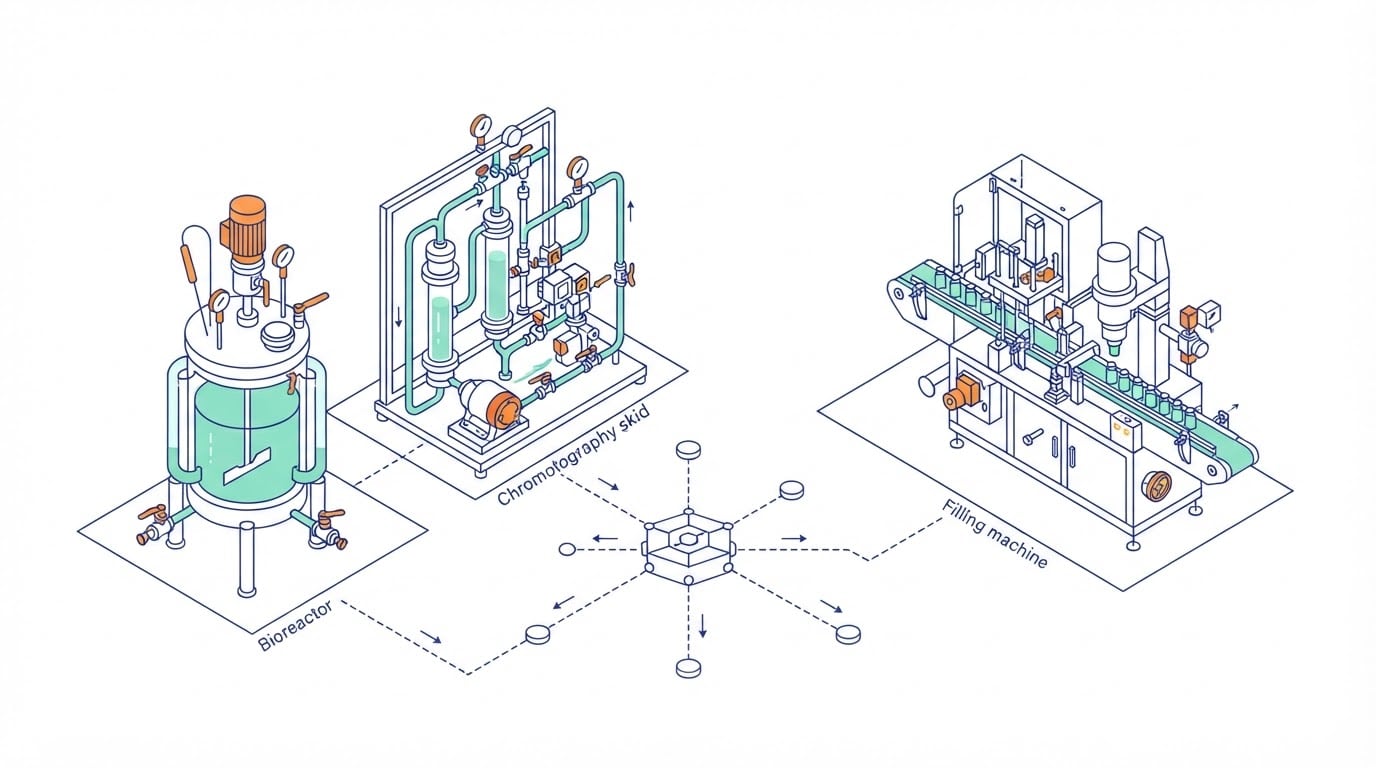
The NIIMBL review is blunt about where the missing standard costs time. The lack of standardized data formats between companies creates inefficiencies and delays during technology transfer to CMOs, and incompatible internal systems slow data transfer between a company’s own process design and manufacturing units. It also notes poor interoperability between equipment from different vendors, and that vendors have little incentive to connect their products with competitors’ products. An open, vendor-neutral vocabulary is aimed at those points, but it only helps if the sending and receiving sites both map their data to it.
What the release does not show
The release carries statements from staff at AstraZeneca and MilliporeSigma describing the expected benefits, but it gives no deployment figures and does not say any company runs the ontologies in production. It says the ontologies are expected to be adopted by technology vendors, regulatory bodies and manufacturers; it does not report that any regulator has accepted them for submissions.
What it means for a plant
For a data or automation team, the practical value is a free, documented reference model designed to align with ISA-88 and ISA-95, so it can sit on top of an existing MES, LIMS or historian rather than replace it. A sensible start is the BMIC Year 1 use case: map the media lot, component and supplier fields in the ELN and LIMS, link them to the process parameters and CQAs of a few runs, and test whether a single query can answer a deviation question that today needs laborious manual alignment of data. The license is permissive, so internal tools can use it without negotiation. What is still open, on the evidence available, is industry uptake, vendor support in commercial software and regulatory use.
Sources
- NIIMBL, OAGi and NIIMBL Announce Release of Biopharmaceutical Manufacturing Ontologies to Advance Interoperability and Analytics, 12 November 2025.
- OAGi, Biopharmaceutical Manufacturing Industry Council (BMIC) project page, accessed 26 September 2026.
- Hart R., Kedia S., Lanspa R., Lichtner S., Lee K. H., Industry-defined opportunities for advancing big data capabilities in biopharmaceutical manufacturing, Frontiers in Bioengineering and Biotechnology, 4 September 2026.