Researchers at the Korea Research Institute of Bioscience and Biotechnology (KRIBB) and Pusan National University report an E. coli production and purification workflow for GmPRR7-1, a soybean circadian clock protein. The paper was first published online on 13 November 2026 in a peer-reviewed journal. This note relies on the abstract only, because the full text is behind a subscription.
What was done
The authors compared two gene constructs: the native GmPRR7-1 coding sequence in the pET-28a(+) vector, and a codon-optimized sequence in the pBT7-C-HIS vector. Codon optimization rewrites the gene to use the codons E. coli reads most readily. Both constructs were screened in two E. coli hosts, BL21(DE3) and Rosetta(DE3), at 16, 25 and 37 °C.
The native construct was not detectably expressed in either host under any condition. The codon-optimized construct gave a band of the expected size. The authors conclude that codon optimization was a prerequisite for expressing this protein.
Scale and recovery
The target band stayed detectable in Rosetta(DE3) at 25 °C. The authors state that the whole-cell lysates were not fractionated, so the screen identifies a productive combination of construct, host and induction temperature. It does not rank the two hosts.
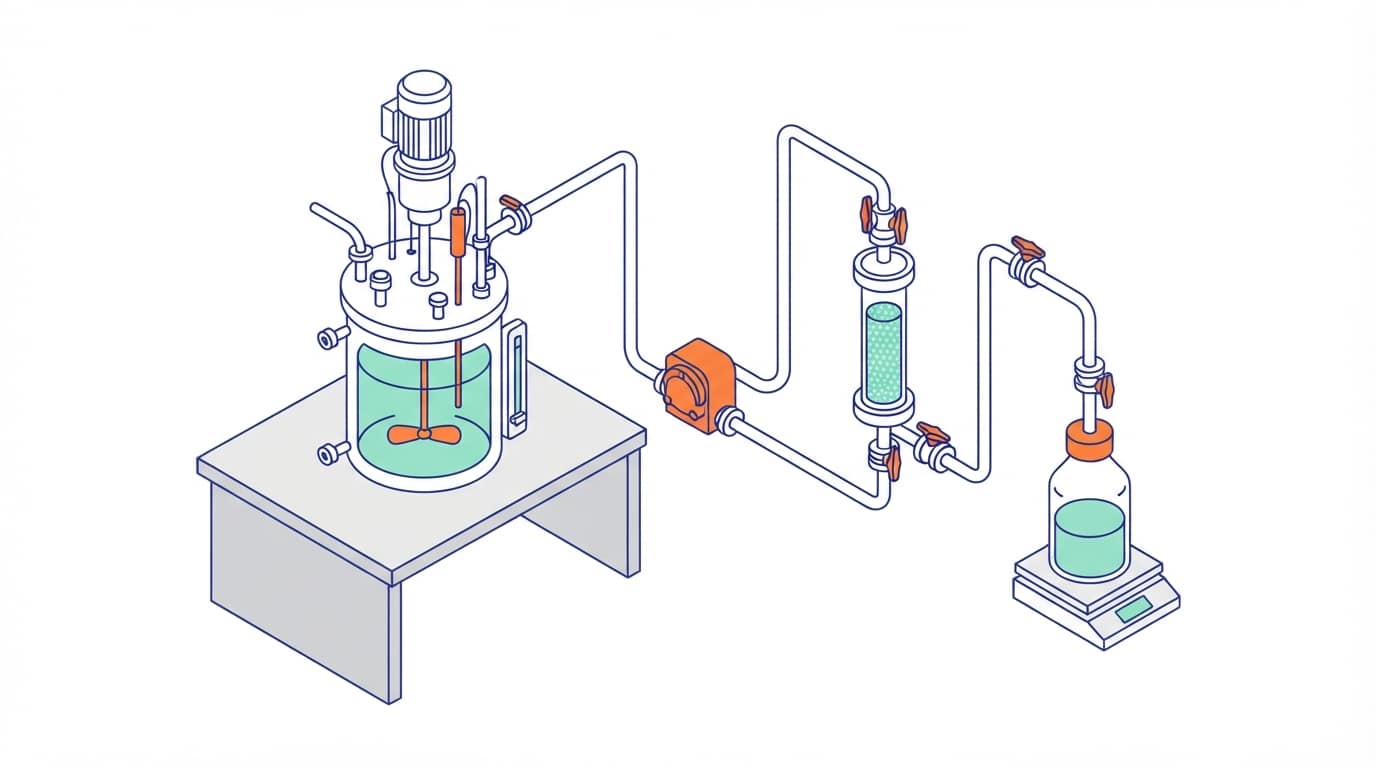
Rosetta(DE3) carrying the optimized sequence was then grown in a 5-L fed-batch bioreactor. Soluble GmPRR7-1 was recovered with a single Ni-NTA affinity chromatography step, which captures the His-tagged protein on a nickel resin. The eluted protein made up 0.83% of the protein in the soluble fraction. Small-scale cultures induced at 25 °C gave 0.77% on the same basis. The authors stress that these values describe total eluted protein, not target-specific yield. Anti-His immunoblotting confirmed the target and detected minor His-reactive degradation products.
The purified protein kept specific interactions with MBP-tagged GmFDL19 and three GmLUX homologs. The authors say this shows the workflow reproducibly delivers interaction-competent GmPRR7-1.
What the source does not say
The abstract gives no titre in grams per litre, no recovery yield and no purity figure. It does not report fed-batch feeding parameters or scale beyond 5 L.