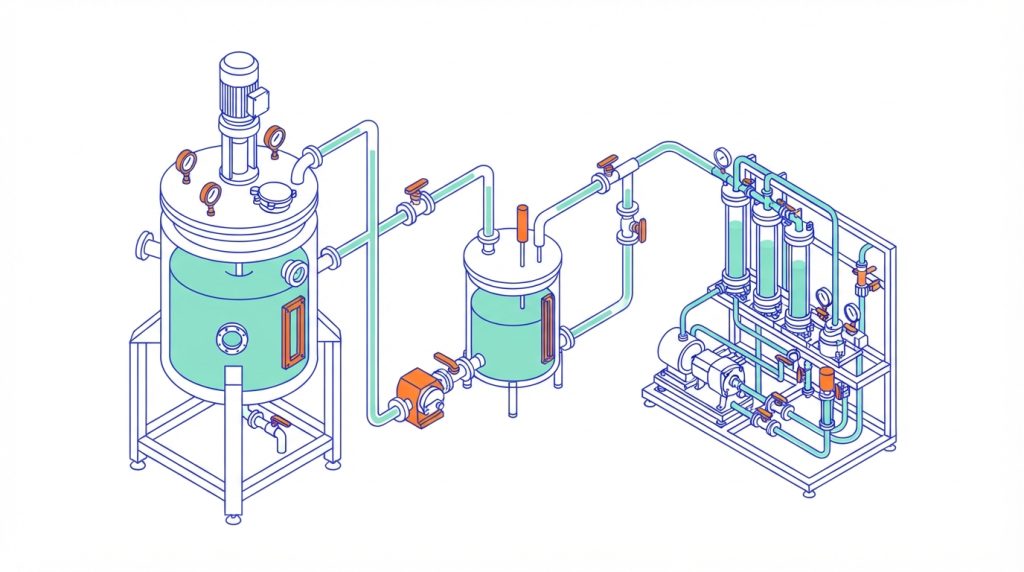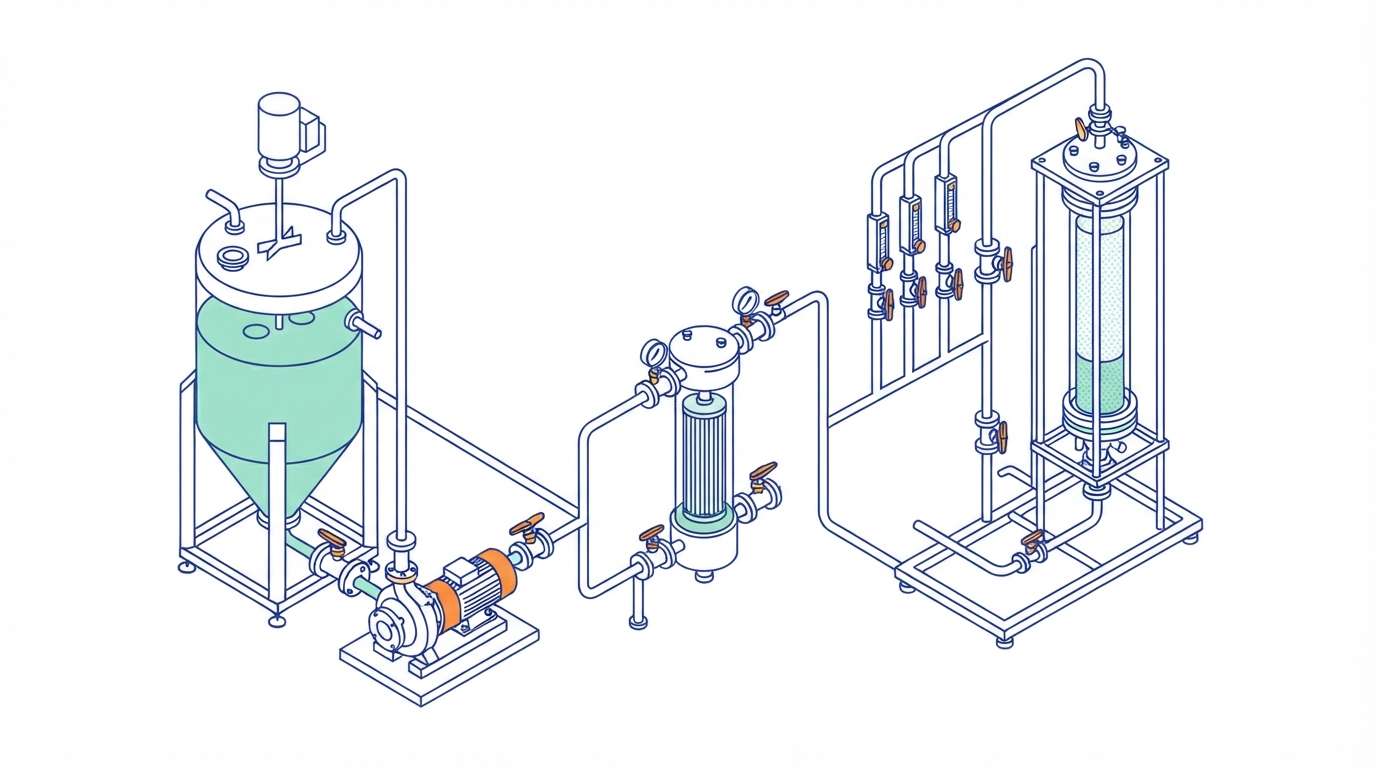
A team at AstraZeneca reports a way to get far more work out of a depth filter in an integrated continuous purification train. The paper appeared online on 29 October 2026 in Biotechnology and Bioengineering. This piece is based on the abstract only, because the full text is behind a subscription.
The problem: precipitate after neutralization
In the purification of a molecule the abstract calls bsAb1, precipitate formed when the product from the affinity capture step was neutralized. In the Integrated Dynamic Bioprocessing (IDB) platform, that precipitate was removed before the stream was loaded onto the first polishing column. The abstract says the precipitate had a dynamic particle size distribution, which caused complex scaling without proper characterization.
The approach: run the filter like a column
The authors established a protocol for characterizing downstream precipitate formation. They also operated a depth filter (Emphaze AEX) like a chromatography column to support continuous purification of bsAb1. The sequence is:
- Load the filter with precipitated material, but “underloaded”, meaning short of its maximum capacity.
- Apply a chase step.
- Apply sanitization buffers.
According to the abstract, the sanitization buffers solubilized the precipitate bound to the depth filter and controlled bioburden. That drastically increased filter capacity and helped ensure a closed system.
The result
At bench scale, the depth filter was cycled 40 times for a total capacity of 10,500 L/m2. That is litres of process fluid per square metre of filter area. The abstract calls this an order of magnitude greater than loading the filter to maximum capacity without any cycling or sanitization. The authors state that the cycling capacity eases depth filter scale-up and IDB implementation at the clinical and commercial scale.
The abstract does not give the single-load capacity figure, filter area, flow rates, buffer compositions, product recovery or impurity clearance. It does not report any run above bench scale.
Sources
- Biotechnology and Bioengineering, 10-Fold Improvement in Depth Filter Capacity During Integrated Dynamic Bioprocessing (IDB) Purification Through Depth Filter Cycling and Precipitate Control Strategy, 29 Oct 2026 (abstract read via Europe PMC record).