Primary source Sanofi: Sanofi “all in” on artificial intelligence and data science to speed breakthroughs for patients
Sanofi has said since June 2023 that it wants to be the first pharma company powered by artificial intelligence at scale. Most coverage of that ambition is about discovery. This piece stays in manufacturing and supply, and uses only what Sanofi publishes itself: the 2023 press release and three company pages describing what is deployed in its plants. Where a figure that circulates about Sanofi does not appear in those sources, that is stated.
The 2023 announcement, read as a manufacturing statement
The June 2023 release is mostly about plai, an internal app built with Aily Labs that aggregates company data and serves scenarios to decision makers. For manufacturing and supply it lists four things: moving quality assessment from paper to electronic batch records, using data to improve asset utilisation, an in-house AI-enabled yield optimisation solution that learns from past and current batch performance to enable consistently higher yield levels, and plai adoption in the biopharma supply chain, which the release says proved able to predict 80% of low inventory positions.
That is a narrow and checkable list. Note what it does not contain: no claim of autonomous process control, no model taking setpoints in a bioreactor, and no percentage figure for yield improvement.
What is named in the plants today
Sanofi’s Digital and AI page (read on 26 September 2026) puts names to the manufacturing tools:
- SimplY, described as an AI-powered yield analytics platform that learns from past and current batch performance to enable consistently higher yield. The page gives no yield figure.
- plai in manufacturing and supply, which the page says has demonstrated the ability to predict 80% of stock disruptions through probabilistic planning and to correlate 65% of risks with a root cause.
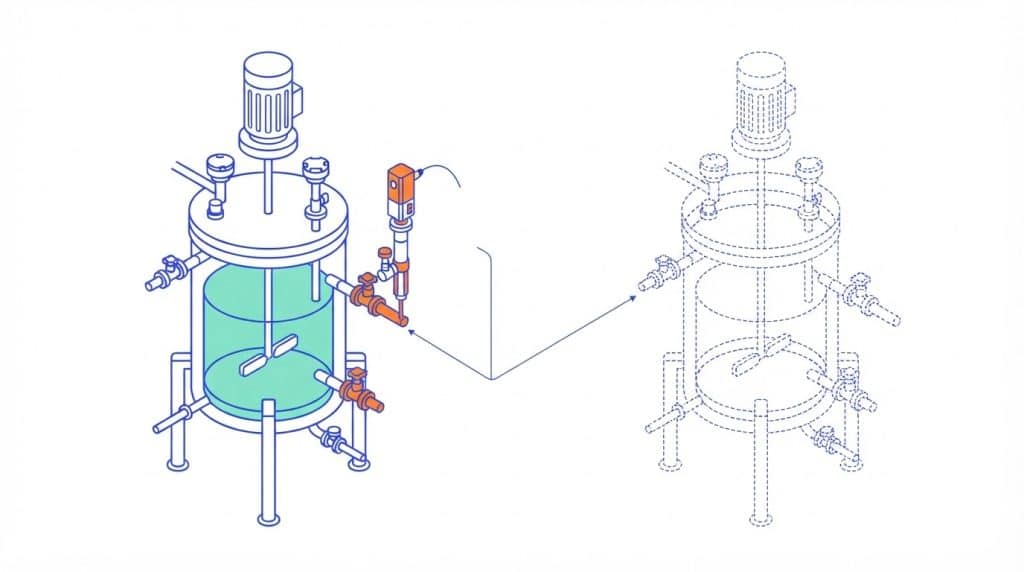
- Digital twins at factories, to reduce the number of technical, trial and qualification batches required and the time it takes to manufacture a treatment or vaccine.
- Generative AI for regulatory reporting, starting with mandatory annual Product Quality Reports and then MSAT and commissioning and qualification documentation, which the page says cuts time and effort by up to 80%.
- A Manufacturing and Supply Accelerator in Lyon, opened in May 2025 with 30 recruits, working on digital twins for virtual production simulation and AI with IoT systems.
The last two are the interesting ones for a plant. Automating the drafting of Product Quality Reports is document work, not process control, and it is where the largest time saving is claimed. Reducing qualification batches with a digital twin is a capacity gain measured in campaigns, not in titre.
Modulus: flexibility as the design goal
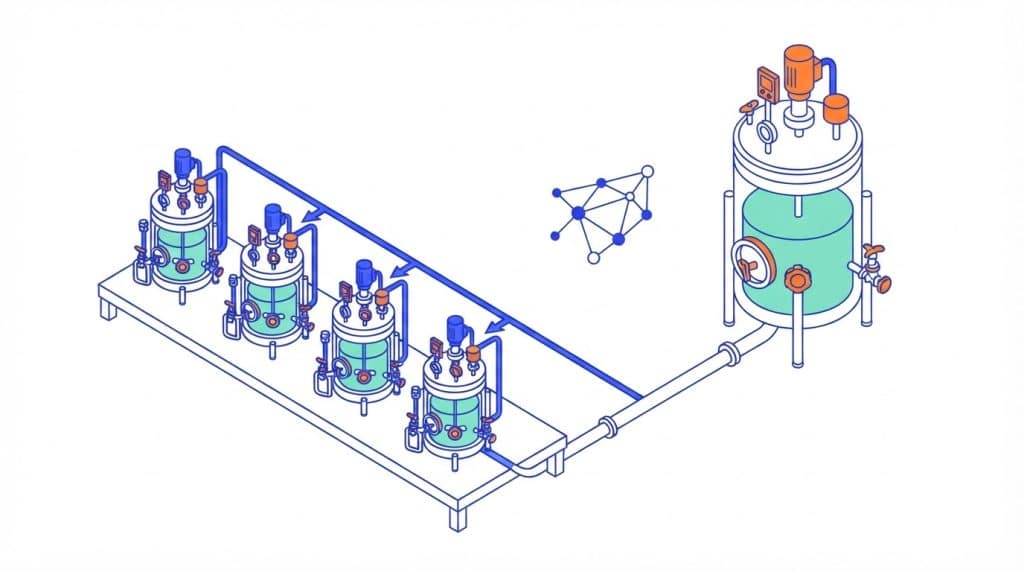
The clearest manufacturing case Sanofi publishes is Modulus, described in an article dated 8 October 2025 and running at Neuville-sur-Saone in France and in Singapore. The design idea is modular: the article describes thirty-four mini-factories that can be combined, reshuffled or upgraded.
| Attribute | What the company states |
|---|---|
| Products in parallel | Up to four different vaccines or biologics at the same time |
| Changeover time | As little as one week between pre-validated technology platforms, against an industry standard the company puts at several months |
| Sites | Neuville-sur-Saone (France) and Singapore |
| Digital layer | AI coordinating autonomous guided vehicles for internal logistics, and real-time sensor data for equipment analysis, maintenance forecasting and faster quality inspections |
| Stated direction | Towards prediction of process deviations, beyond process optimisation |
| Environmental | LEED Gold certification at Neuville-sur-Saone |
A changeover of one week instead of months is the number to watch, because it converts into campaigns per year and therefore into effective capacity, and because it is the kind of claim a plant can test against its own cleaning, changeover and requalification protocols.
Acceleration targets, and where they apply
A May 2025 company article describes the third Digital Accelerator, dedicated to manufacturing and supply, and states the aim of shortening the time to bring new medicines to market by up to one year, applying AI across the development lifecycle from early research to commercial manufacturing. On its Digital and AI page Sanofi also says its launch units are accelerating time to market by twelve months for priority pipeline molecules. Both are company targets and statements of intent, not measured process outcomes.
Two figures we could not source
An earlier version of this article reported two percentage figures, one on development timelines and one on drug substance output through SimplY. Neither figure appears in the Sanofi press release or the three company pages cited here, which name SimplY but give no percentage. Both have been removed rather than repeated.
What it means for a plant
Read as a company’s own account of its plants, Sanofi’s material suggests where AI in biomanufacturing is being deployed first, and it is not the process:
- Documentation and planning before control. The largest stated savings are in report drafting and in inventory and disruption prediction, not in manipulating process parameters.
- Yield analytics is a learning layer on batch history. SimplY is described as learning from past and current batch performance, which presupposes structured, comparable batch records. Electronic batch records are a prerequisite, not a parallel project.
- Digital twins are being justified by batch count. Fewer technical, trial and qualification batches is a capital and schedule argument that a plant can quantify before committing.
- Flexibility competes with scale. Modulus targets short changeovers and four parallel products rather than larger single trains, which is the opposite trade-off to a dedicated large-scale facility.
- Company targets are not process data. Twelve-month acceleration and up-to-one-year figures are ambitions; the more concrete numbers here are the 80% and 65% planning figures and the changeover time, and they are company figures too.
Sources
- Sanofi, Press release: Sanofi “all in” on artificial intelligence and data science to speed breakthroughs for patients, 13 June 2023.
- Sanofi, Digital and Artificial Intelligence (corporate page), read 26 September 2026.
- Sanofi, Modulus: redefining the future of biopharma manufacturing, 8 October 2025.
- Sanofi, A new era of biopharma production with AI, 28 May 2025.