A perfusion bioreactor needs a device that keeps the cells in and lets the spent medium out, with the product in it. In the antibody processes covered here, that device is a cartridge of hollow fibres, run in one of two ways: alternating tangential flow (ATF) or tangential flow filtration (TFF). Which one fouls less, and which one holds back less product, is argued by vendors and users alike. We read 46 primary sources, from 2011 to 2026, to see what has actually been measured. This is the third piece of our perfusion series: how a perfusion culture works is in Perfusion, explained, and how it compares with fed-batch is in Fed-batch vs perfusion.
The seven findings in short
- ATF and TFF use the same filter. What differs is the pump. An ATF moves the culture back and forth with a diaphragm pump through one connection. A TFF circulates it one way around a loop. Confidence: high.
- Both hold back product, and more as the filter ages. In two studies antibody transmission fell to 50% or less within 10 to 23 days, and an industry consortium writes that it can typically reach 50 to 60% after 20 days. Confidence: high.
- Whether a well-built TFF matches an ATF is not settled. With a peristaltic pump the TFF did worse in two studies. With a low-shear pump one study found them equal, 73% and 71% recovery, and another found the TFF retaining up to 50% of the antibody against about 10%. Confidence: medium at best. Three laboratories, bench scale.
- Product held back is delayed, not lost, unless cells are bled. Without a bleed, 86 to 92% of the antibody was harvested although transmission had fallen to 50% or less. With a daily bleed it was 54 to 71% with ATF and 46 to 56% with TFF. Confidence: medium, one study, but the mechanism is a mass balance.
- What fouls the fibre is particles about the size of the pores, not whole cells. Roughly 20 to 200 nm. Two sources tie them to cells breaking, a third points to antifoam, and what they are made of is disputed. Confidence: high for the size, medium for the link with cell lysis, low for the identity.
- Membrane structure matters more than the pore rating, and more crossflow is not a cure. One 0.2 µm membrane with wide surface pores kept transmission above 85% for 40 days. A larger rating, 0.65 µm, did worse in three of the four comparisons we read. Confidence: medium; the membrane structure result comes from one company.
- Scale and cost are the thin part. Past 500 to 1,000 L an ATF setup needs several units, and a TFF needs longer fibres that retain more. No source gives a filter price or a measured filter life at production scale. Confidence: low.
How we built this
We read 25 sources in full and 21 from the abstract only, and we say so where it matters. The full-text set includes papers, one doctoral thesis and six documents published by vendors; several of the papers also have vendor co-authors. Who is talking matters here. Repligen makes the ATF and the tangential flow depth filter and is the author of five documents S20 S21 S22 S23 S24 and a co-author of two papers S16 S17. Levitronix makes the low-shear pump used in most recent TFF work; it co-authored a pump report S25 and two papers we read as abstracts S38 S39, and the copy of the Boehringer Ingelheim paper we read S04 is hosted on its website, although the authors are all from Boehringer Ingelheim. Cytiva, Artemis Biosystems and MilliporeSigma have co-authors in S09 and S43, in S14 and in S40. The 2013 KTH study was financed by GE Healthcare, which has co-authors on it and makes the bioreactor and the fibre that were used S01 S02. Two papers are an industry consortium’s design assumptions, not measurements S12 S13. For the ETH Zurich comparison we read the author’s doctoral thesis S03, not the journal article, which was behind a paywall. The three head-to-head comparisons of ATF and TFF that we read in full were run at 1.5 to 4 L, with the two systems side by side for 30 days or less; a fourth, at 200 mL, we read only as an abstract S42.
What tangential flow filtration is
In ordinary filtration the liquid is pushed straight at the filter, and whatever does not pass stays on it. In tangential flow filtration the cell suspension flows along the membrane, which may prevent fouling S01: the flow creates shear that clears the layer forming on the surface S04. The same paper states the price. More shear cleans better, but it can also harm the cells S04.
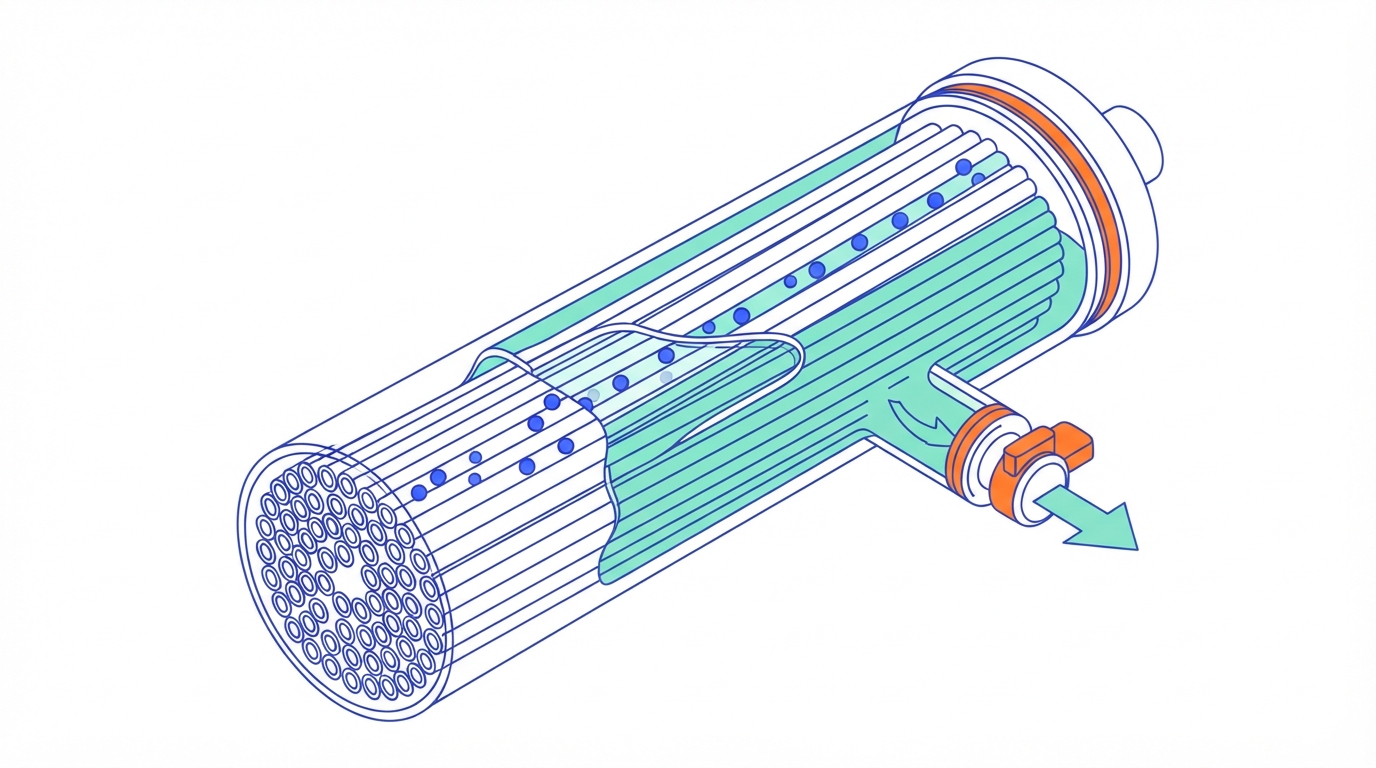
In perfusion the membrane is a bundle of hollow fibres inside a cartridge. The culture flows inside the fibres, in the lumen S01, and cell-free liquid, the permeate, leaves through the fibre wall. The 2013 KTH study, the earliest side-by-side comparison we read, used 50 polysulfone fibres with 0.2 µm pores and a 1 mm lumen, 60 cm long, with 850 cm² of area S01. An ATF2 cartridge described in a modelling paper had 75 fibres of 20 cm and 470 cm² S05. The vendor’s range for the ATF is polyethersulfone or polysulfone, at 0.2 µm, 0.5 µm or 50 kD, with a 1 mm inner diameter S21.
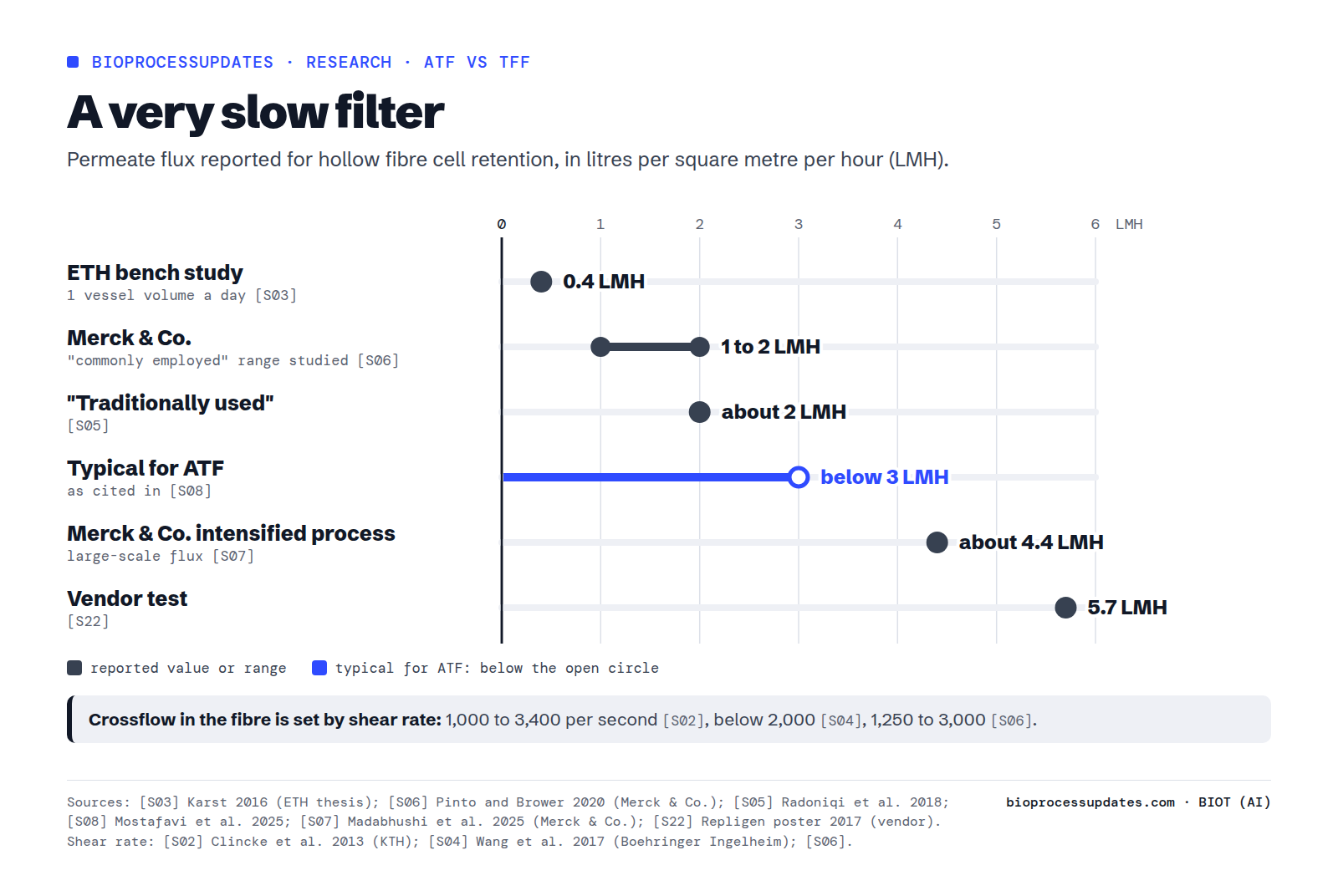
The flow through the wall is very small. It is quoted as about 2 litres per square metre per hour (LMH) “traditionally” S05, as 1 to 2 LMH in a Merck & Co. study S06 and, in a paper that cites earlier work for it, as typically below 3 LMH for ATF, which is why “large membrane areas are required” S08. Higher values appear in an intensified Merck & Co. process, about 4.4 LMH S07, and in a vendor test, 5.7 LMH S22. The crossflow along the fibre is set as a shear rate: 1,000 to 3,400 per second at KTH S02, below 2,000 at Boehringer Ingelheim S04, 1,250 to 3,000 at Merck & Co. S06.
One detail matters later. The pore rating on the label is not what the culture meets. Under the electron microscope, a membrane rated 0.2 µm had surface pores of 0.5 to 2 µm, and one rated 0.65 µm from the same maker had surface pores of 0.3 to 0.6 µm S06.
Same filter, two pumps
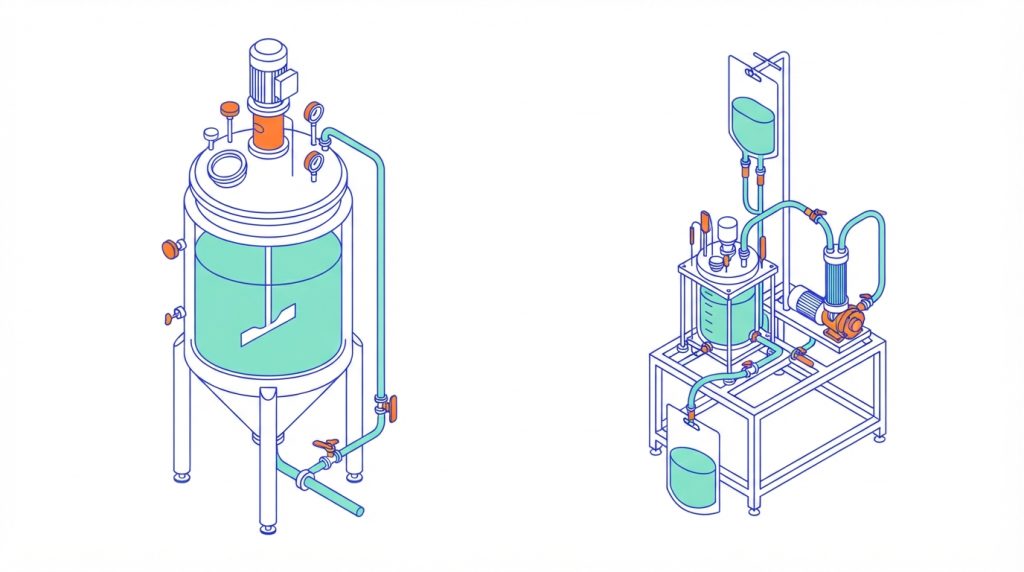
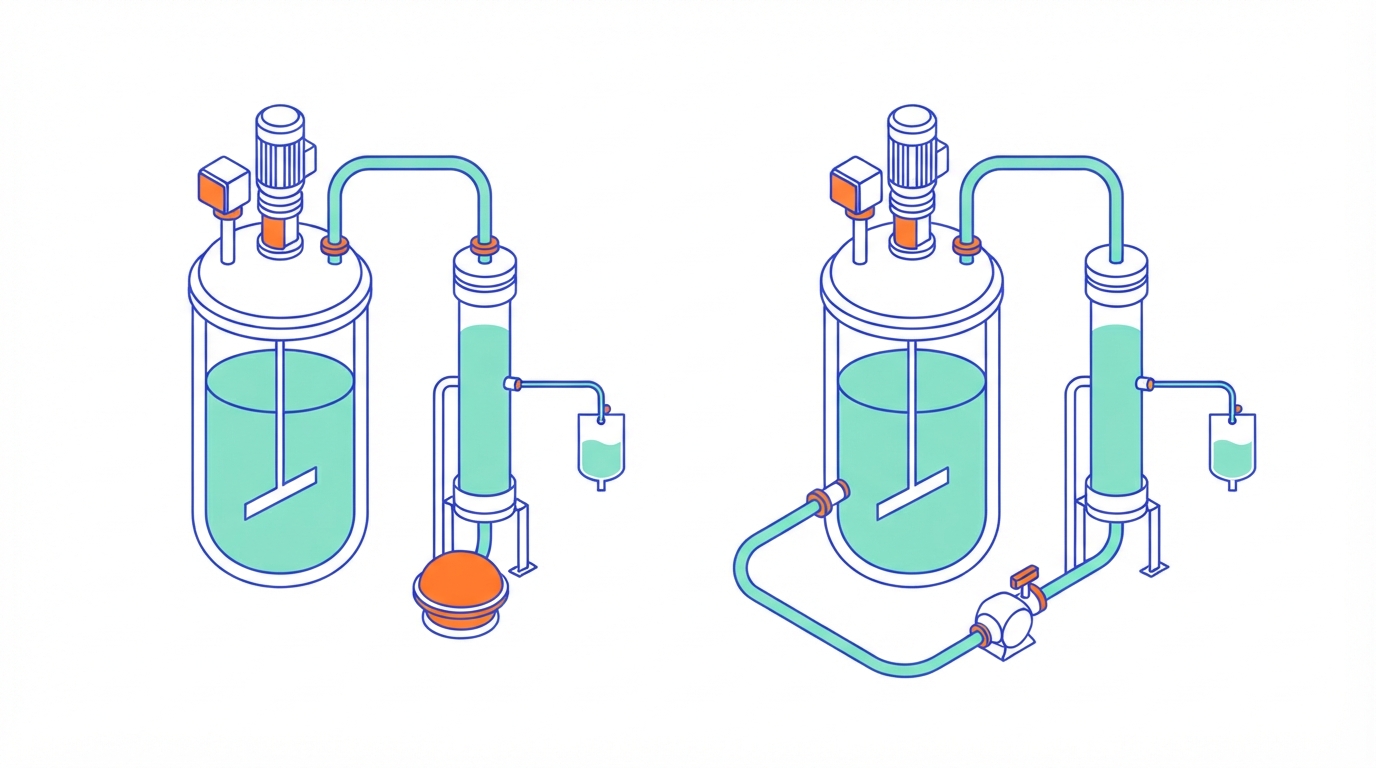
Much of the setup, hollow fibre included, is the same in both systems. The difference is the pump that drives the flow along the fibres S04.
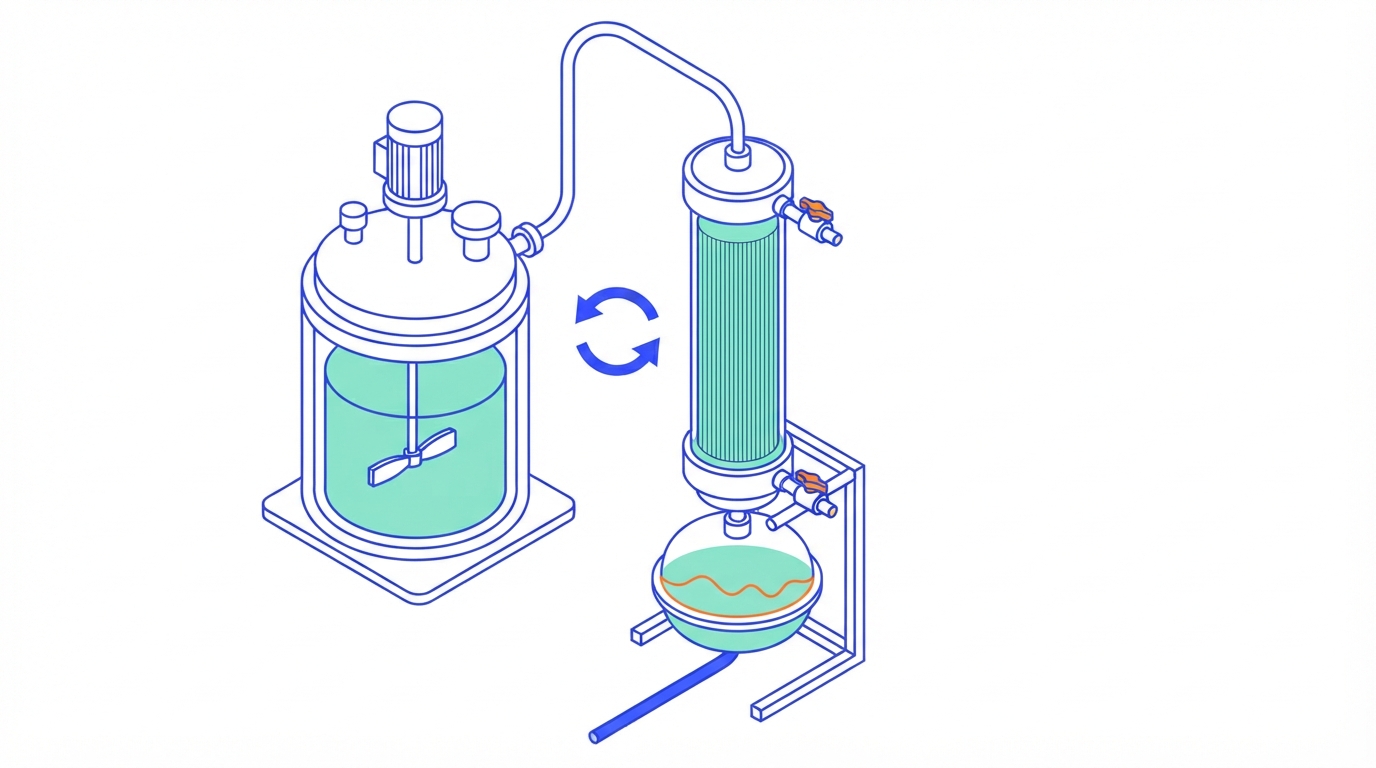
In an ATF, a diaphragm pump moves the culture in and out of the fibres through a single connection to the bioreactor S03. Air pressure pushes the diaphragm and sends liquid through the fibres back to the bioreactor. Vacuum pulls the diaphragm the other way and draws liquid from the bioreactor into the fibres. Two strokes make one cycle S21. The vacuum is not optional: the vendor’s guide says that pressure from the bioreactor is not enough to deflate the diaphragm completely S21. With a 100 mL pump, one cycle took 11 seconds at 1.0 L/min and 8 seconds at 1.5 L/min S03.
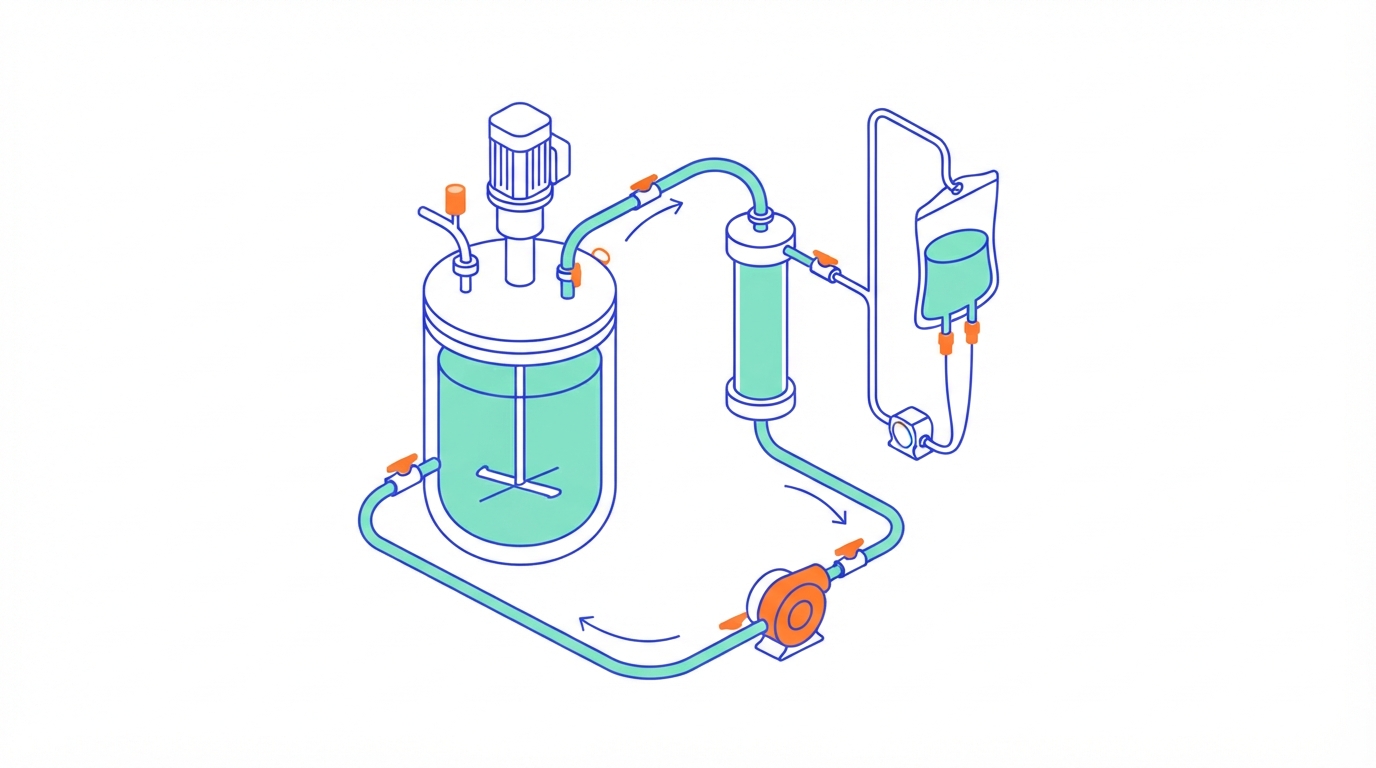
In a TFF, a pump circulates the culture one way around a loop, which takes two ports on the bioreactor instead of one S04. The loop pump was peristaltic in the early work S01 S04 and is a centrifugal pump made by Levitronix in later studies S03 S06, described as magnetically levitated S03 S04. In the fibre, the velocity is constant in a TFF and swings between a maximum and zero in an ATF S11. The cells spend a short time outside the bioreactor: under a minute in the 250 mL loop of the 2013 study S01, 8 seconds in the control runs of a Merck & Co. study S07, and 2 to 7 seconds in an industry design for 500 to 2,000 L, which notes that this is near the time to hypoxia S12.
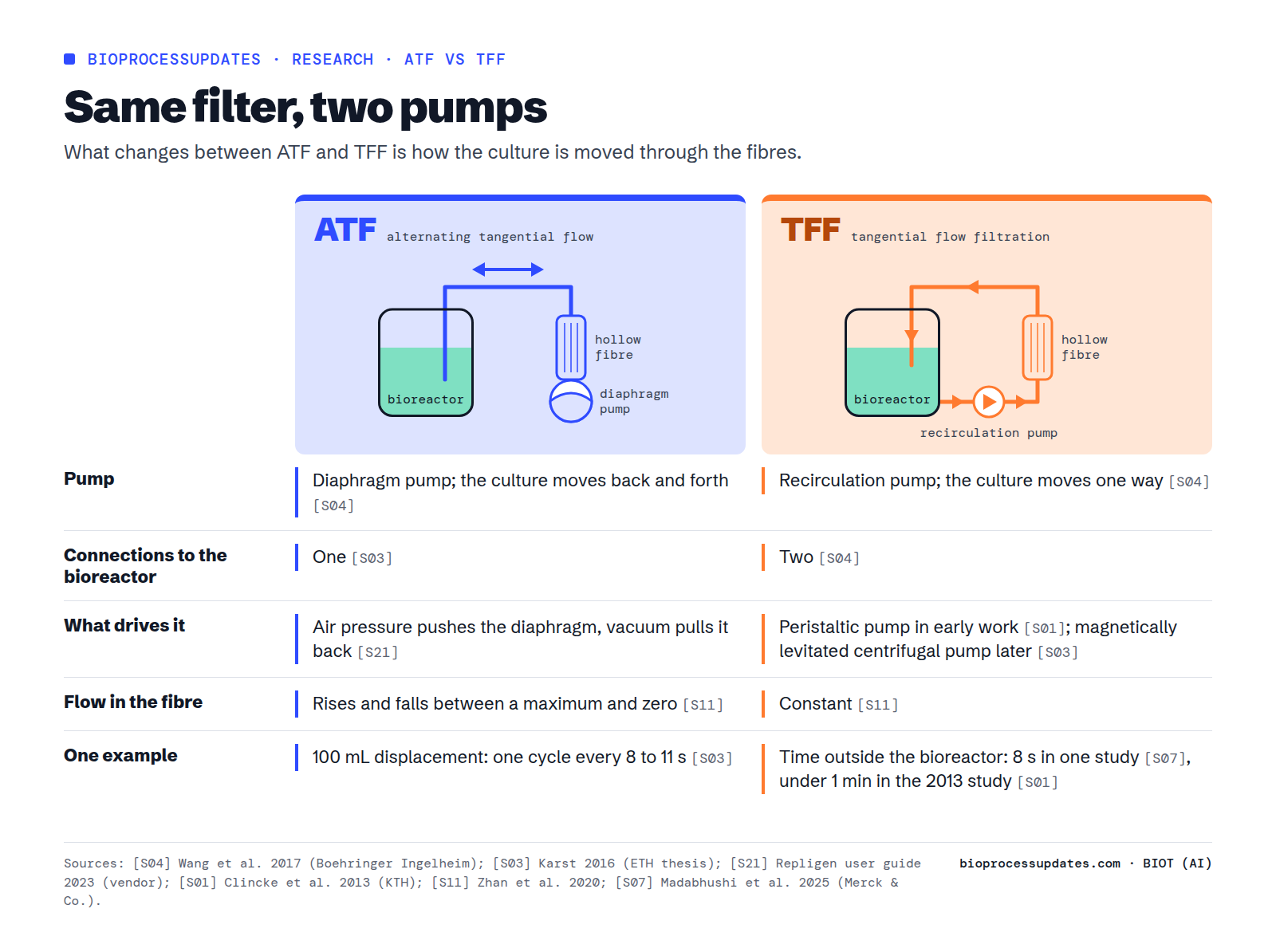
The claimed advantage of the ATF is the backflush. Each change of direction is said to push some permeate back through the pores and clean them S03 S31. The evidence for it is thin. The 2013 KTH paper noted that the effect “has not been quantified” S02. A computational model of one ATF fibre found that part of the permeate flows back into the fibre, which is known as Starling flow, with the direction of the flow through the wall changing about halfway along. It concluded that at 2 LMH a one-way flow would use half of the membrane while the alternating flow uses all of it over a cycle. In the same paper, Starling flow did not reduce fouling as the crossflow increased S05. For one-way TFF, a later model that we read as an abstract treats Starling flow as a major contributor to fouling and product retention, not as a cure S30.
Both hold back product, and more with time
The filter is there to stop cells. It also stops part of the product. Papers report this as sieving, the product concentration in the permeate divided by the concentration in the bioreactor S04, or as retention, its complement.
At KTH, with a 0.2 µm fibre and the culture held between 20 and 35 million cells/mL by daily bleeds S01, the ratio was 100% during the first days and then decreased rapidly S02. The harvest settled at 93 to 158 mg/L while the bioreactor held 176 to 243 mg/L S02. In a long TFF run of the same study, after day 20, when the cell density was raised to about 100 million cells/mL S01, the harvest was about 154 mg/L while the bioreactor reached 1,000 mg/L or more; the first cartridge of that run was in use for 30 days S02. WuXi Biologics, with a bispecific antibody on its own platform, saw retention rise gradually from 20% to 60% in a run harvested from day 7 to day 23 S10. An industry consortium writes that transmission “typically can reach as low as” 50 to 60% after only 20 days; that is a description of practice, not a measurement of its own S13. Boehringer Ingelheim tested commercial fibres from several hundred kilodaltons to 0.65 µm and reports moderate to severe retention with all of them (abstract) S26.
Three of the studies we read in full ran ATF and TFF side by side on the same fibre. They do not agree.
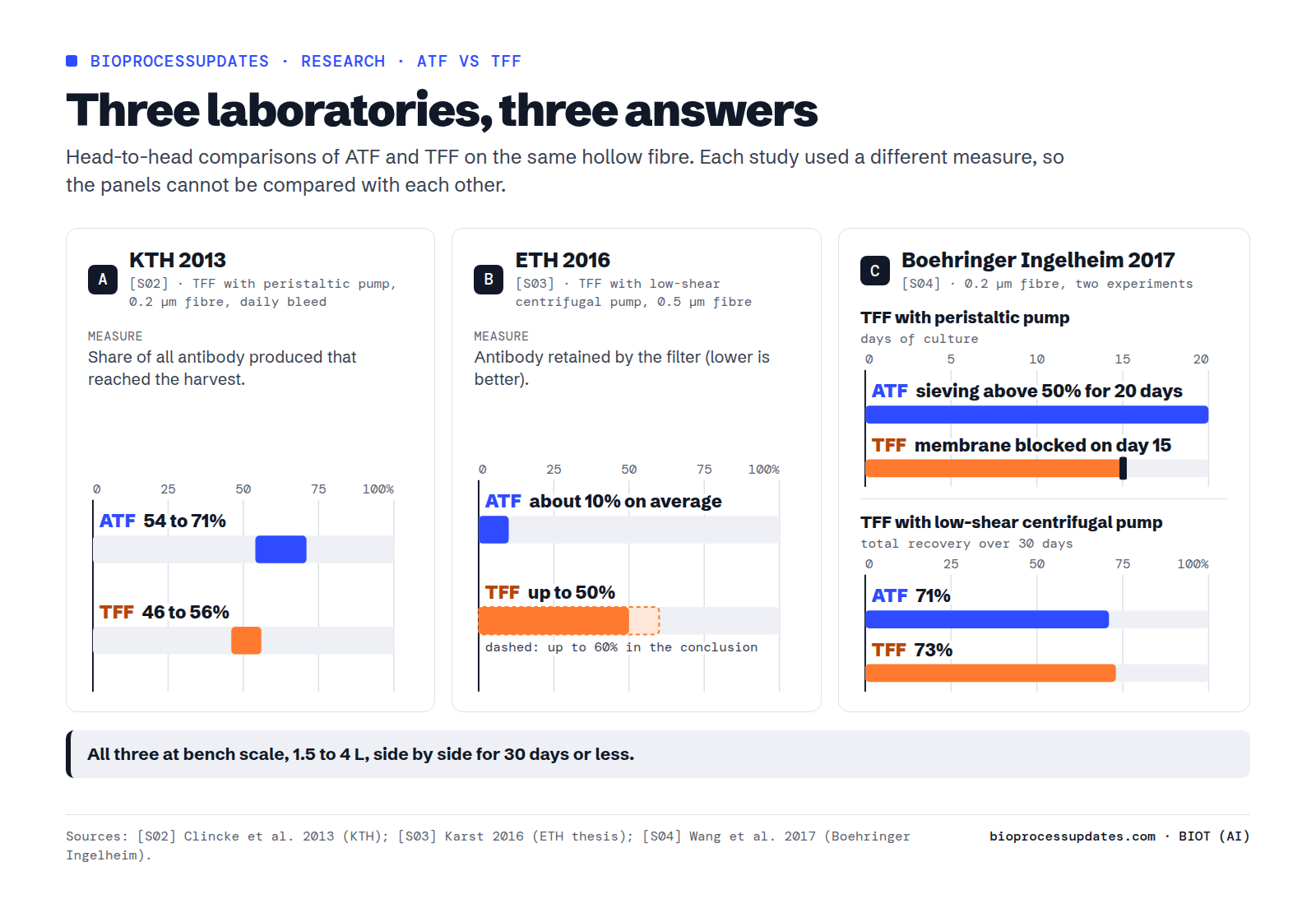
KTH, 2013. The TFF used a peristaltic pump. Antibody was partially retained by both systems “but more severely using TFF”. In the runs held at 25 million cells/mL, the share of all antibody produced that reached the harvest was 54 to 71% with ATF and 46 to 56% with TFF S02.
ETH Zurich, 2016. The TFF used a magnetically levitated centrifugal pump, the fibre had 0.5 µm pores and both loops ran at 1.5 L/min. The ATF retained 10% of the antibody on average (two runs). The TFF, in a single run, retained up to 50% when the cell density was raised from 20 to 60 million cells/mL; the conclusion of the same thesis chapter says up to 60%. The author’s explanation is the backflush of the ATF, which was not measured S03.
Boehringer Ingelheim, 2017. Two experiments on a 0.2 µm fibre. With a peristaltic pump, the TFF membrane blocked completely on day 15, while the ATF kept sieving above 50% for the 20 days of culture. With a low-shear centrifugal pump, the TFF ran the full 30 days and total recovery was 73% in the TFF against 71% in the ATF. The authors conclude that the ATF’s advantage came from its diaphragm pump, which puts less mechanical stress on the culture, and not from the back and forth flow. They add that sieving was “alleviated but not solved” in either system, and that their result is “in stark contrast” to the ETH one S04.
We cannot say which of the last two is right. The fibres differed (0.5 µm against 0.2 µm), the ETH study ran at a very low flux of 0.4 LMH S03, the cell lines were different, the ETH result rests on one TFF run, and we found no repeat of either study.
Held back is not lost, unless there is a bleed
What retention costs depends on what happens to the culture that stays behind. With no bleed, product that does not pass the filter today stays in the bioreactor, its concentration rises, and more of it passes later. In a KTH run without bleeds, the ratio of harvest to bioreactor concentration fell to 50% or less after 10 days, yet 86 to 92% of all the antibody made was harvested S02. A vendor poster makes the same point from its own data: even at 60% retention, more than 95% of the protein was recovered in the harvest S22. The poster does not say whether that culture was bled.
With a bleed it is different. Culture is removed every day to hold the cell density, and the product dissolved in it goes too. In the words of the KTH authors, the main loss caused by retention “was product discarded from the bioreactor in the daily bleeds” S02. That is where the 54 to 71% and 46 to 56% above come from. The authors count a second, smaller loss: the antibody still in the bioreactor when the run ends S02. The ETH thesis says the same: the yield in the harvest is directly linked to the loss of product in the bleed S03.
A steady-state mass balance shows the size of the effect. If s is the sieving, H the harvest flow and B the bleed flow, the share of product that reaches the harvest is s × H / (s × H + B). With a bleed of 20% of the outflow, that is 80% when the filter passes everything, 67% when sieving is 50% and 44% when it is 20%. With no bleed it tends to 100% whatever the sieving. This is our calculation, for a well-mixed bioreactor with constant sieving, and not a validated model: the KTH figures are consistent with it, but they are ranges over several runs and the bleed volumes were not reported, so they cannot confirm it. For scale, a pilot run at 100 million cells/mL bled 0.1 to 0.3 vessel volumes a day, 6.7 to 20% of the perfusion flow S09.
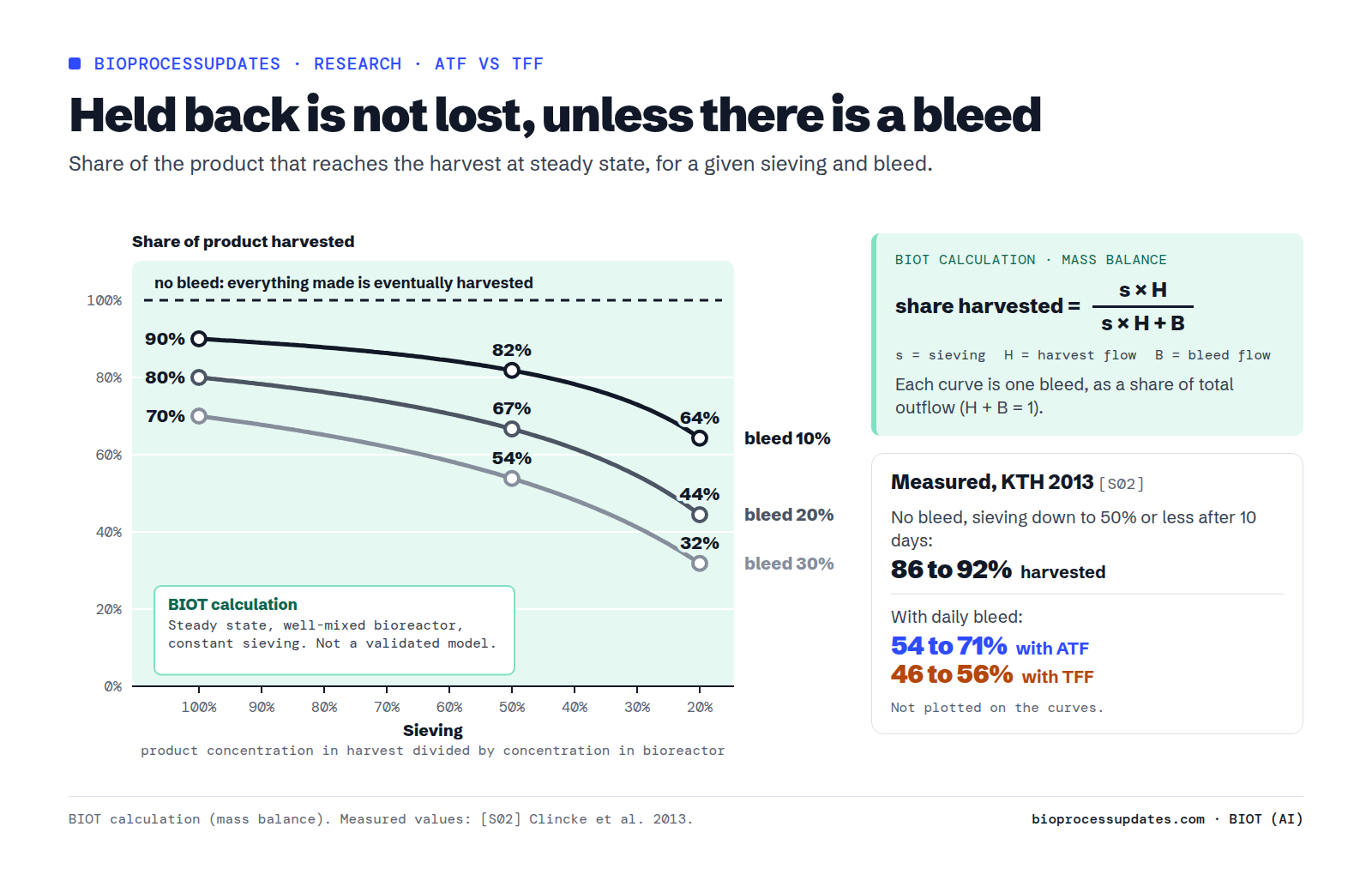
Two more consequences. Retained product stays longer in the bioreactor, which the KTH authors flag as an issue for sensitive glycoproteins S02. And the consortium’s design for a continuous plant simply assumes a 90% yield at the cell retention step S12 S13.
What fouls the fibre
Not the cells. In the Boehringer Ingelheim study most particles in the permeate were below 10 nm, while particles of about 100 nm accumulated in the bioreactor as the culture went on. The team then split a culture three ways and ran each fraction over a new 0.2 µm fibre. Permeate alone, and cells resuspended in permeate, caused no significant loss of transmission. The supernatant, with its 100 nm particles, caused a loss that was “severe and almost instantaneous”. Lysed cells produced far more of these particles than apoptosis alone S04. A later abstract from the same company gives about 20 to 200 nm S26, a range that a Merck & Co. paper takes up S06. The vendor’s poster gives 70 to 200 nm and also links retention to cell lysis S22.
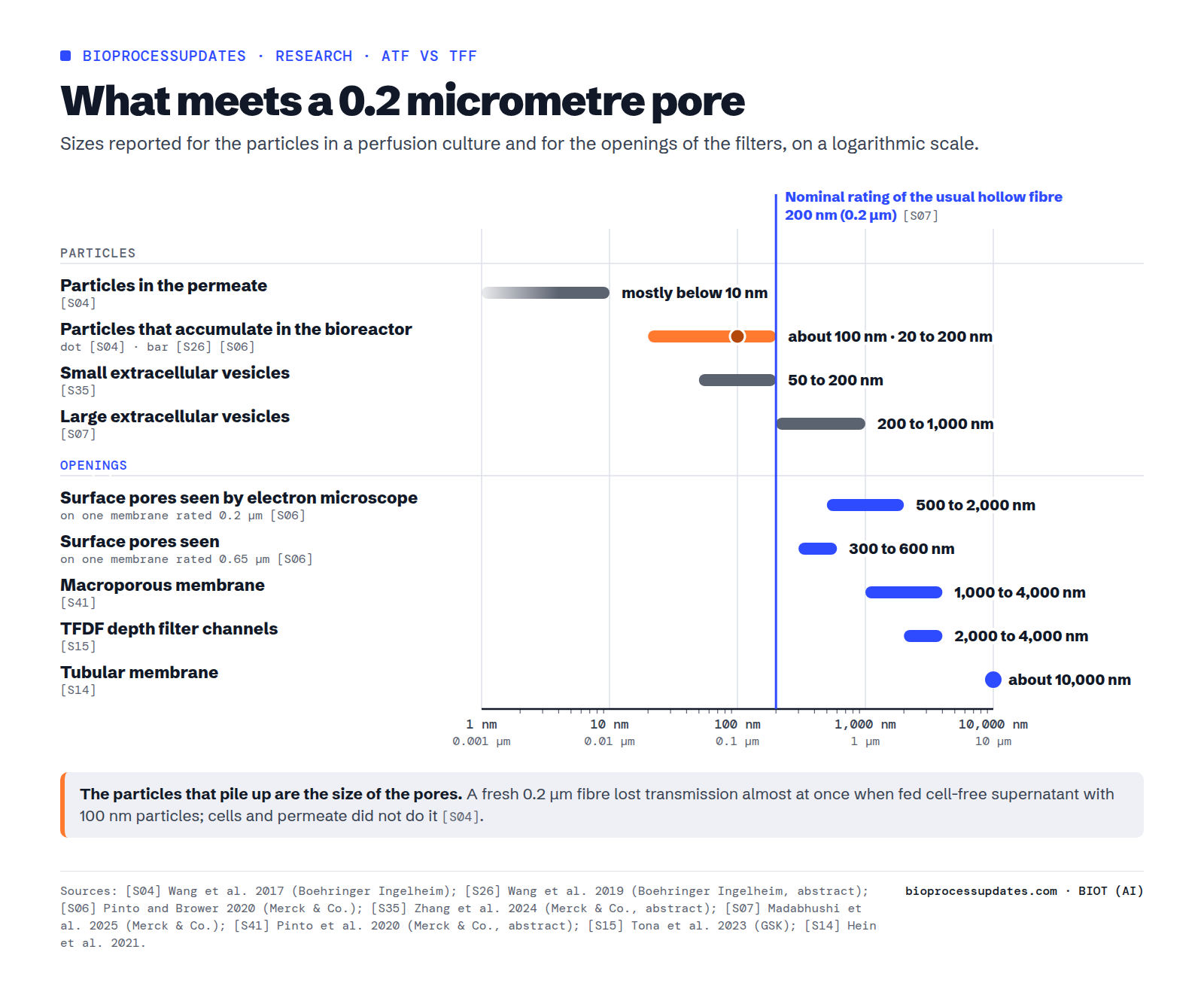
What the particles are made of is open. The candidates, and who puts them forward:
- Extracellular vesicles. At Merck & Co., the amount of vesicles of 50 to 200 nm in the permeate fell before the transmembrane pressure rose and sieving dropped. On used fibres, the foulant patches were rich in cellular material but not in antifoam (abstract) S35.
- Antifoam. A later Merck & Co. paper found that the antifoam does build up in the bioreactor, more than 10 fold between day 6 and day 24, to about 250 to 500 ppm. In a small-scale filter test, 75 to 250 ppm raised the pressure and cut sieving, and 500 ppm blocked the filter at once. A culture given twice the antifoam lasted 14 days S07. The vendor’s poster reports no effect of antifoam alone in a 30 day cell-free test S22.
- Host cell protein. On fibres from industrial ATF runs, the deposit was mostly host cell proteins with some antibody (abstract) S40.
- DNA. Named the main soluble foulant in a scale-down study (abstract) S43.
The authors say it themselves: the factors causing filter fouling “remain largely unknown” S07, and the mechanism “remains poorly understood” S13. The 2025 Merck & Co. paper adds that the causes of fouling may differ from those of sieving S07.
In one study, the pump did the damage
In the first Boehringer Ingelheim experiment, the death rate measured by LDH release was 0.22 per day in the TFF with a peristaltic pump and 0.09 per day in the ATF. The cells in the TFF appeared to grow more slowly, 0.32 against 0.49 per day, and the authors put that down solely to the higher rate of lysis. Viability by trypan blue showed a smaller gap, 81.1% against 91.5% on day 14. By day 8 the TFF bioreactor held about 4.5 times more particles than the ATF one S04.
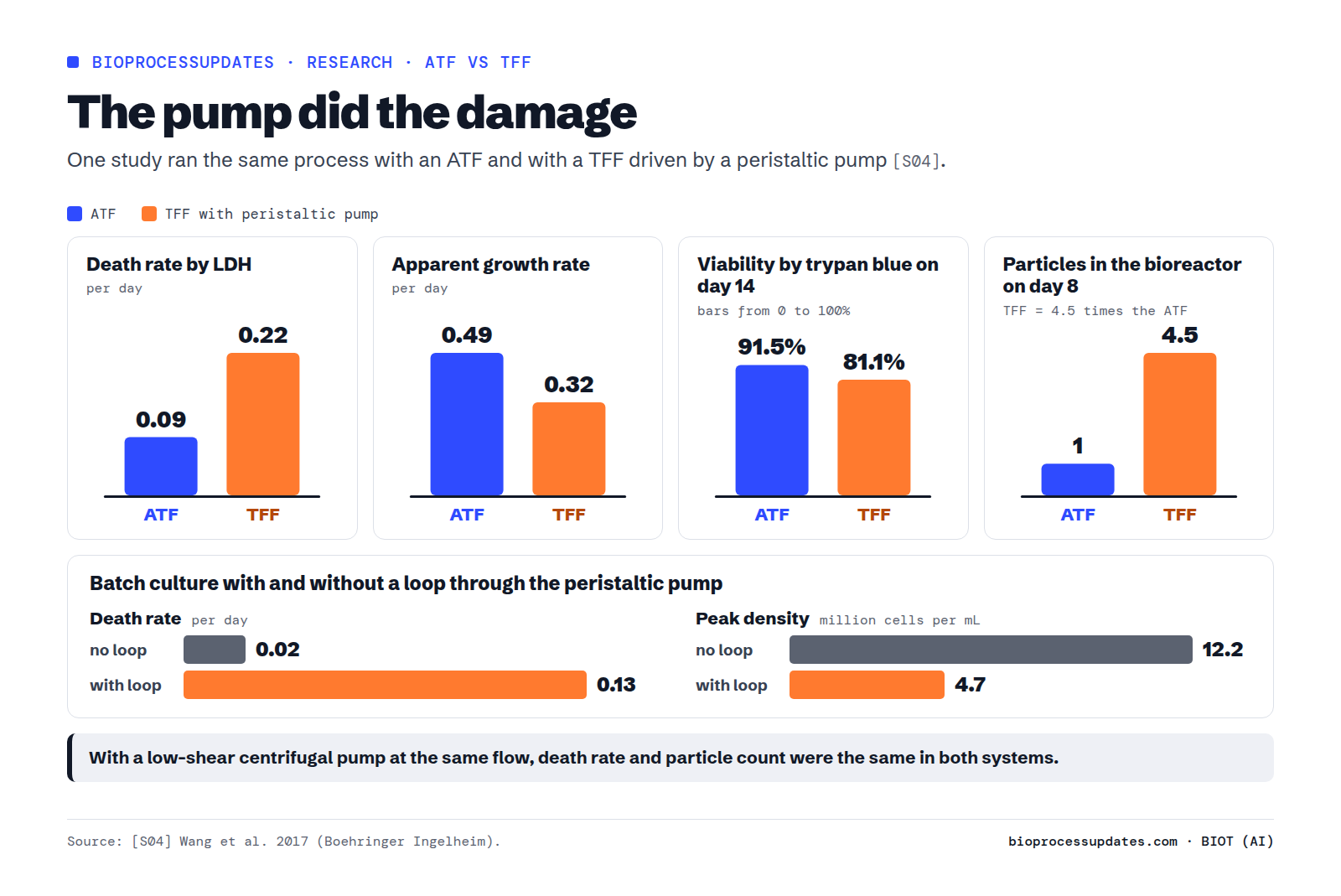
A batch culture looped through a peristaltic pump pointed to the cause: its death rate was 0.13 per day against 0.02 without the loop, and it peaked at 4.7 million cells/mL against 12.2 million. With a centrifugal pump in the TFF, death rates and particle counts were the same in both systems S04.
Not every study agrees on the pump. KTH saw no cell damage from its peristaltic pump at up to 2.75 L/min with the fibre bypassed, in tests of up to three days S02. At ETH Zurich, a stress probe made of particle aggregates, run in water without cells, showed a much lower maximum stress in the ATF than in the TFF with a centrifugal pump at comparable flow; the stress was dominated by the pump, and the TFF had to be limited in flow to stay under the 32 Pa that this cell line tolerated S03. A pump report co-authored by Levitronix, not peer reviewed, gives death rate constants, from 12 hour tests, of 0.023 per hour for its levitated pump against 0.03 for a peristaltic pump and 0.036 for a four-piston diaphragm pump S25, which is not the air-driven diaphragm of an ATF S21.
The ATF has its own stress routes. Sanofi links estimated residence times above 75 seconds with lower growth and productivity (abstract) S32. Inside the fibre it is gentler on average: by a calculation in a KTH paper, the time-averaged shear in an ATF is 2/π, about 0.64, of that in a TFF with the same peak S11.
What helped and what did not
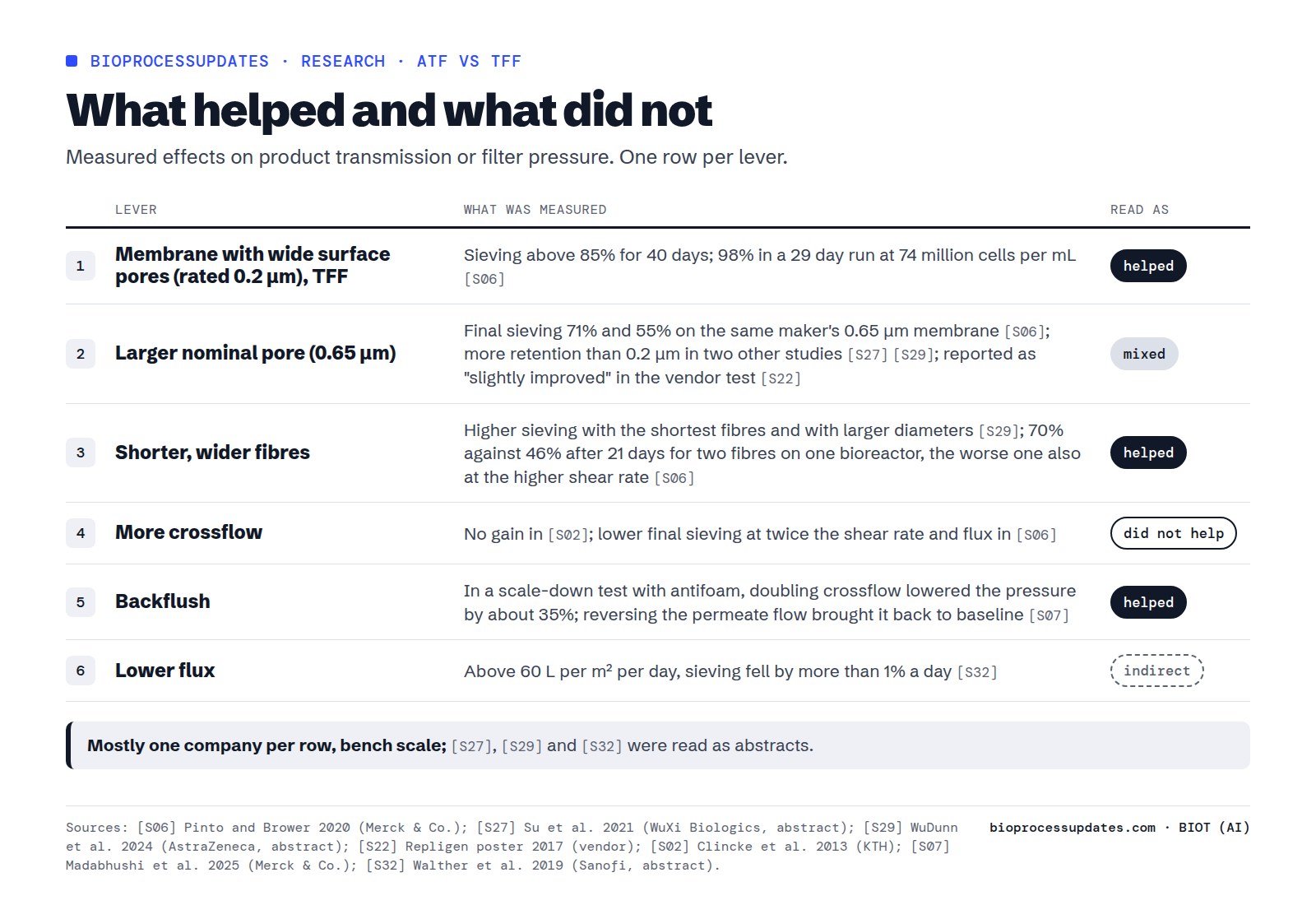
Membrane structure. At Merck & Co., a 0.2 µm membrane with wide surface pores kept antibody sieving above 85% throughout 40 days, whatever the shear rate and flux studied, and averaged 98% in a 29 day run at 74 million cells/mL. A 0.65 µm membrane from the same maker ended at 71% and 55%, and those cultures were stopped after three weeks S06. This is the pair described earlier: the membrane rated 0.2 µm was the one with the wider surface pores.
A larger pore rating is not a reliable fix. At WuXi Biologics, product retention was 38% higher with 0.65 µm fibres than with 0.2 µm ones (abstract) S27. At AstraZeneca, 0.2 µm filters kept higher sieving than 0.65 µm ones (abstract) S29. The vendor’s poster reports “slightly improved protein retention” with 0.65 µm S22, which we read as slightly less retention. WuXi’s reading is that it depends on the debris: larger pores may help when particles of about 0.01 to 0.2 µm dominate, and 0.2 µm pores when most particles are larger than that S27. Boehringer Ingelheim, after finding retention with every commercial fibre up to 0.65 µm, reports that a fibre with an “unconventionally larger” pore size reduced it drastically; the abstract does not give the size (abstract) S26. Going much larger changes the trade: a macroporous membrane of 1 to 4 µm delivered 13,000 L/m² of throughput, but its permeate was turbid and needed a depth filter before chromatography (abstract) S41.
Shorter and wider fibres. AstraZeneca found higher sieving with the shortest fibres and with larger inner diameters (abstract) S29. At Merck & Co., two fibres fed by the same bioreactor gave 70% and 46% transmission after 21 days; the worse one had longer, narrower lumens and ran at the higher shear rate S06.
More crossflow did not help. At KTH a higher recirculation rate did not improve the ratio S02. At Merck & Co. it led to a lower final sieving on the 0.65 µm membrane, in a run that also had twice the flux S06.
Backflush and flux. In a scale-down test with antifoam at Merck & Co., doubling the crossflow lowered the transmembrane pressure by about 35%, and reversing the permeate flow brought the pressure back to baseline S07. Sanofi reports that above 60 L/m² per day, about 2.5 LMH by our conversion, sieving fell by more than 1% a day (abstract) S32.
The forms of TFF
“TFF” now covers several designs. What has been measured for each is uneven.
| Form | What changes | What has been measured |
|---|---|---|
| One-way TFF, peristaltic pump | Baseline | Membrane blocked on day 15 in one study S04; more retention than ATF in another S02 |
| One-way TFF, low-shear centrifugal pump | The pump | Equal to ATF in one study S04, worse in another S03; above 85% sieving for 40 days with a wide-surface-pore membrane S06 |
| ATF | Flow reverses every few seconds, one port | Sieving above 50% for 20 days S04; retention rising from 20% to 60% in one run S10 |
| Reverse-flow TFF | Two levitated pumps reverse the loop flow | Sieving improved by 30% with a dynamic flow, at 200 mL scale; no absolute values in the abstract S42 |
| Co-current filtrate flow | A flow on the filtrate side reduces or removes Starling recirculation | Up to 40% higher sieving than standard TFF; abstract, pump vendor among the authors S39 |
| Stacked short filters | Permeate taken from short sections | Higher sieving at 3 L and 50 L; abstract S28 |
| Macroporous membrane plus depth filter | Pores of 1 to 4 µm | 13,000 L/m² of throughput, turbid permeate; abstract S41 |
| Tangential flow depth filtration (TFDF) | Tubular depth filter of 2 to 5 µm S23 with a wall of about 5 mm S15 | Viral vectors only: near full passage of lentivirus and more than 5,000 L/m² in one harvest S15; similar titres in bioreactor and permeate for another virus S16 |
The last row needs a caution. The vendor’s data sheet claims “negligible product retention” for TFDF and sizes it for antibodies at 3 cm² per litre of process volume, but shows no antibody data S23, and we found no peer-reviewed data for a long antibody perfusion run. The published work we read is on viral vectors S15 S16 S17.
Open-pore designs also change what goes downstream. With a tubular membrane of about 10 µm, protein and DNA concentrations were more or less the same in the vessel and in the permeate, while the hollow fibre held most of them back S14. The macroporous membrane above needed a depth filter for the same reason S41.
Scaling up
The vendor’s data sheet lists three production ATF sizes: ATF 4 for 10 to 50 L of working volume with 0.77 m² of filter, ATF 6 for 50 to 200 L with 2.5 m², and ATF 10 for 200 to 1,000 L with 11 m². Their nominal maximum perfusion rates are 50, 200 and 1,000 L a day S20. Dividing one by the other gives 2.7, 3.3 and 3.8 LMH (our calculation): the flux changes far less than the area, which grows with the volume.
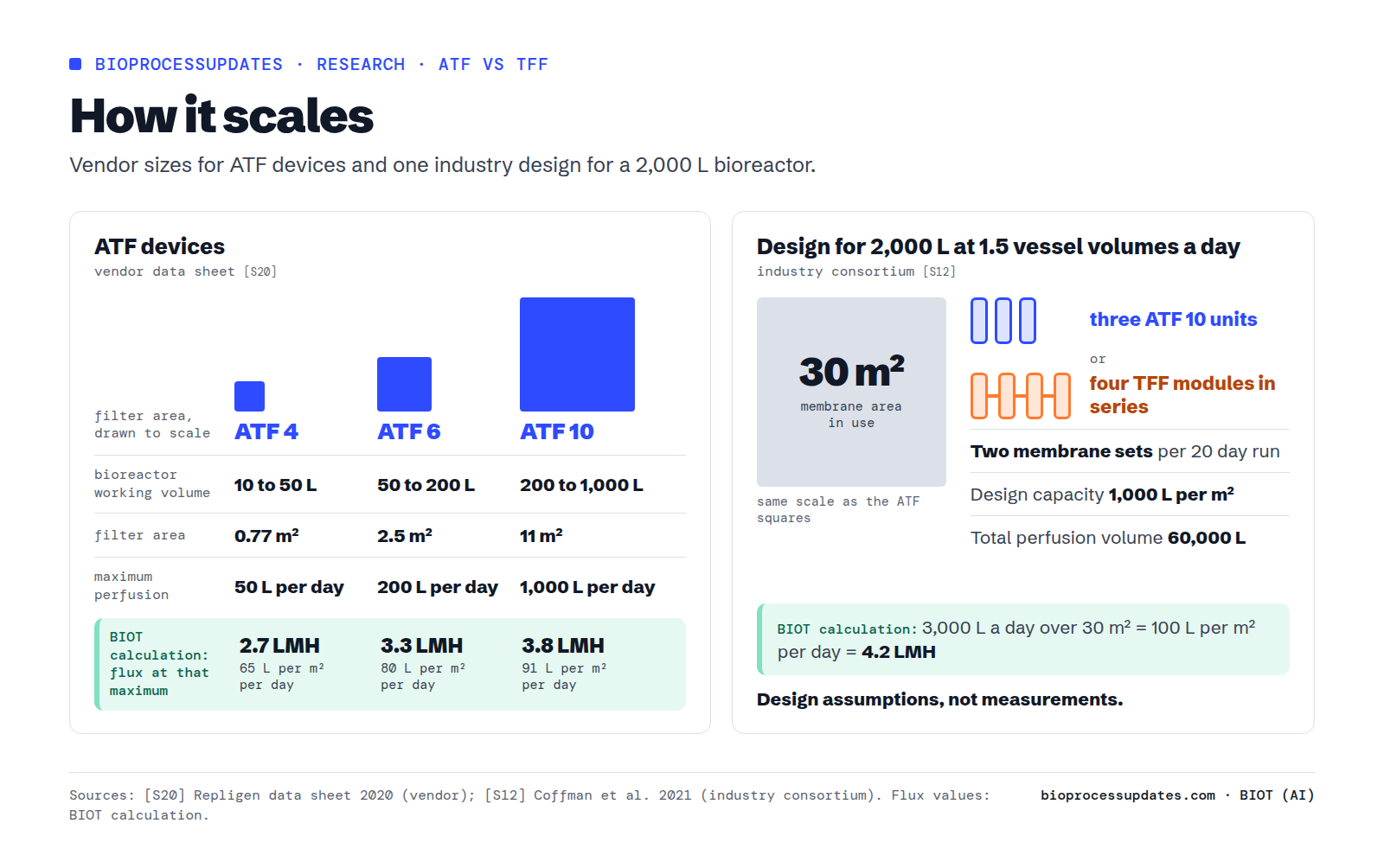
In practice, the consortium reports that ATF systems are often used for 500 L bioreactors and below, that two or more may support 1,000 L, “but TFF is the preferred choice”, and that some of its authors have used as many as four on a 2,000 L bioreactor S13. Its design basis for 2,000 L at 1.5 vessel volumes a day calls for 30 m² of membrane, as three ATF 10 units or as TFF modules four in series. The modules go in series to limit Starling flow; in parallel, the loop would need 500 to 1,000 L/min S12. That design works out at 100 L/m² per day, about 4.2 LMH (our calculation), above the 60 L/m² per day at which Sanofi saw sieving decline in one ATF process (abstract) S32.
Each system has its own ceiling. For the ATF it is the pump: AstraZeneca writes that the few diaphragm pumps on the market prevent the use of vertical space when scaling beyond 500 L, and that stacked filters with viscous culture demand more vacuum than a facility supplies (abstract) S28. KTH saw the mechanism at bench scale: at 132 million cells/mL the alternating flow stopped, possibly because the vacuum could no longer pull the viscous broth S01. For the TFF it is the fibre: longer filters at scale worsen the retention caused by Starling flow (abstract) S28, and a 2026 paper with authors from several companies, a pump vendor among them, says that scaling TFF perfusion still “often requires time-consuming trial-and-error efforts” (abstract) S38.
On filter life there is little. At bench scale in 2013, single cartridges were in use for 30, 14, 22 and 27 days, and only the first is reported as replaced because of probable fouling; the authors say the data do not support a general conclusion S01. Merck & Co. measured 900 to 1,200 L/m² of throughput for its 0.2 µm membrane S06. The consortium assumes 1,000 L/m² and two sets of membranes per 20 day run S12. For an intensified process at 85 to 100 million cells/mL, Merck & Co. writes that filters can be swapped once during a run at large scale, and that the swap only extends the culture by a couple of days S07. The one manufacturing-scale case we found is a 3,000 L seed culture at Biogen: pressure rose on the last day, and a 30% lower permeate flow cut it by 75% (abstract) S37.
Cost: not resolved
No source we read gives the price of a perfusion hollow fibre, the filter cost per run or the value of the product lost to retention. What exists are the design assumptions above: 1,000 L/m², two membrane sets per run and a 90% yield at the retention step S12. For one 2,000 L bioreactor that is 60 m² of membrane per 20 day run (our calculation). The only price we found is a vendor’s assumption of 5,000 dollars per square metre in a cost model for lentivirus filters S24, which is not a quote for hollow fibres, and we do not build a figure on it. A 2013 model from University College London estimated that ATF perfusion could save 20% of the cost of goods against fed-batch if it reached five times the cell density (abstract) S46; it does not compare ATF with TFF. We cannot say which of the two is cheaper to run.
A hollow fiber bioreactor is something else
The term is easy to confuse with the filter. In a hollow fiber bioreactor the cells live inside the cartridge. In the two examples we read they sit outside the fibres, in what is called the extracapillary space. Medium flows through the fibre lumens, and nutrients and oxygen reach the cells through the fibre wall S19. The cartridge is the bioreactor, and it is small: one used for T cells had six fibres and 20 cm² S19; in another, used to produce a virus, about 20 mL was harvested from the extracapillary space every second day S18. In the perfusion systems of this article it is the other way round. The cells pass through the fibre lumens and go back to a separate bioreactor S01.
What it means for a plant
- Ask for sieving over time, not for the pore rating. Two membranes with the “wrong” order of ratings gave 98% and 55 to 71% S06. A sieving curve over the full run length, at the intended cell density, is the number to request.
- If you choose TFF, the pump and the loop are the design. A peristaltic pump cost a run on day 15 in one study; a low-shear pump on the same type of fibre matched the ATF S04.
- Measure lysis directly. The damage showed in LDH release and in particle counts; the viability gap by trypan blue was smaller S04.
- The bleed sets what retention costs. With no bleed, retained product comes out later. With a bleed, part of it is discarded every day S02.
- Watch the antifoam. It did not leave through the filter and built up more than 10 fold in one process S07.
- Plan for filter changes. The consortium design carries two membrane sets per 20 day run S12, and Merck & Co. writes that a swap extends an intensified culture by only a couple of days S07.
- Expect a different problem at scale. Several ATF units and their vacuum demand past 500 to 1,000 L S13 S28; modules in series and loop design for TFF S12.
Questions
What is tangential flow filtration?
A way of filtering in which the liquid flows along the membrane instead of straight at it, so that the flow itself sweeps the surface S01 S04. In perfusion cell culture the membrane is a cartridge of hollow fibres: the culture flows inside the fibres and cell-free liquid leaves through their walls at a very low flux, from about 1 to 4.4 LMH in two Merck & Co. processes S06 S07.
How does alternating tangential flow work?
A diaphragm pump moves the culture in and out of the hollow fibres through one connection to the bioreactor S03. Air pressure pushes the liquid back to the bioreactor and vacuum draws it into the fibres; two strokes make a cycle, which took 8 to 11 seconds in one bench setup S21 S03.
ATF vs TFF: which holds back more product?
With a peristaltic pump, the TFF held back more in two studies S02 S04. With a low-shear pump the evidence is split: equal recovery, 73% and 71%, in one study S04, and up to 50% retention in the TFF against about 10% in the ATF in another S03. Both retain more as the filter ages.
What is a sieving coefficient?
The product concentration in the permeate divided by the concentration in the bioreactor. At 100% all the product passes; at 0% none does S04. Retention is 100% minus sieving.
Is a larger pore size better for product transmission?
Not reliably. A 0.65 µm rating did worse than 0.2 µm in three of the four comparisons we read S06 S27 S29 and was reported as slightly improved in one, the vendor’s S22. In one Merck & Co. study, the structure of the membrane surface explained more than the rating S06.
What is a hollow fiber bioreactor?
A cartridge that is itself the culture vessel: the cells grow in it, outside the fibres in the two examples we read, while medium flows through the fibres S19 S18. It is not the same as a hollow fibre filter on a perfusion bioreactor, where the cells only pass through the fibres and return to the vessel S01.
What we could not verify
- No head-to-head comparison of ATF and TFF beyond 4 L, none with the two systems side by side for more than 30 days, and no repeat of the two studies that disagree. One more comparison, at 200 mL, was read only as an abstract S42.
- No sieving curve printed as numbers: every time course is a figure, so we quote start and end values only.
- The ETH comparison was read in the author’s thesis, which gives 50% in its results and 60% in its conclusion for the same TFF run S03.
- Reverse-flow, co-current and stacked-filter TFF were read as abstracts; their gains are relative and the baselines are not given S42 S39 S28.
- No peer-reviewed antibody perfusion data for TFDF.
- No measured filter life for a production bioreactor of 500 L or more, and no filter prices.
- We did not build a model of sieving over time. No source prints the numbers needed to test one, so the only calculation of ours in this article is the steady-state balance, labelled as such.
Sources
- S01 Clincke MF et al., Very high density of CHO cells in perfusion by ATF or TFF in WAVE bioreactor. Part I. Effect of the cell density on the process. Biotechnol Prog 29:754-767, 2013. Affiliations: KTH Stockholm (academic); GE Healthcare Bio-Sciences (vendor of the WAVE bioreactor and of the hollow fibre used). Seminal, pre-2015. Published before 2015.
- S02 Clincke MF et al., Very high density of Chinese hamster ovary cells in perfusion by alternating tangential flow or tangential flow filtration in WAVE Bioreactor. Part II: Applications for antibody production and cryopreservation. Biotechnol Prog 29:768-777, 2013. Affiliations: KTH Stockholm (academic); GE Healthcare Bio-Sciences (vendor). Seminal, pre-2015. Published before 2015.
- S03 Karst DJ, Mammalian cell perfusion culture development for integrated continuous biomanufacturing (doctoral thesis, ETH Zurich, Diss. ETH No. 23955). Chapter 3 is the thesis version of Karst DJ, Serra E, Villiger TK, Soos M, Morbidelli M (2016) Biochem Eng J 110:17-26. ETH Zurich Research Collection (doctoral thesis), 2016 (doctoral thesis). Affiliations: ETH Zurich, Morbidelli group (academic). Industrial CHO cell line from Merck Serono; ATF from Repligen and centrifugal pump from Levitronix used as purchased equipment (no vendor authors).
- S04 Wang S et al., Shear contributions to cell culture performance and product recovery in ATF and TFF perfusion systems. J Biotechnol 246:52-60, 2017. Affiliations: Boehringer Ingelheim, Fremont CA (manufacturer, end user). No vendor authors. The open-access article PDF was read from a copy hosted on the website of Levitronix, the vendor of the low-shear pump that the paper favours.
- S05 Radoniqi F et al., Computational fluid dynamic modeling of alternating tangential flow filtration for perfusion cell culture. Biotechnol Bioeng 115:2751-2759, 2018. Affiliations: Keck Graduate Institute, Amgen Bioprocessing Center (academic); Boehringer Ingelheim (manufacturer). CFD model with experimental validation.
- S06 Pinto NDS et al., Wide-surface pore microfiltration membrane drastically improves sieving decay in TFF-based perfusion cell culture and streamline chromatography integration for continuous bioprocessing. Biotechnol Bioeng 117:3336-3344, 2020. Affiliations: Merck & Co., Kenilworth NJ (manufacturer, end user). Membranes by Asahi Kasei, TFF system by Repligen/Spectrum, pump by Levitronix; no vendor authors.
- S07 Madabhushi SR et al., Systematic Investigation of Impact of Antifoam and Extracellular Vesicles on Fouling of Hollow Fiber Filters in Intensified Perfusion Processes Highlights the Key Impact of Antifoam. Biotechnol Bioeng 122:1684-1695, 2025. Affiliations: Merck & Co., Rahway NJ (manufacturer, end user).
- S08 Mostafavi AH et al., Enhancing the Performance of Tangential Flow Microfiltration for Bioreactor Clarification. Membranes (Basel) 15:78, 2025. Affiliations: University of Arkansas and Penn State (academic); Biogen (manufacturer). Membrane modules custom made by Asahi Kasei Bioprocess (no vendor authors).
- S09 Schwarz H et al., Integrated continuous biomanufacturing on pilot scale for acid-sensitive monoclonal antibodies. Biotechnol Bioeng 119:2152-2166, 2022. Affiliations: KTH and Lund University (academic), AdBIOPRO; Cytiva BioProcess R&D (vendor of the XDR bioreactor, the APS TFF system and the hollow fibres used).
- S10 Qin Y et al., Productivity and quality improvement for a symmetric bispecific antibody through the application of intensified perfusion cell culture. Antib Ther 5:111-120, 2022. Affiliations: WuXi Biologics (CDMO reporting on its own proprietary platform).
- S11 Zhan C et al., Low Shear Stress Increases Recombinant Protein Production and High Shear Stress Increases Apoptosis in Human Cells. iScience 23:101653, 2020. Affiliations: KTH Stockholm (academic) with AstraZeneca co-authors (manufacturer). HEK293 cells, not CHO.
- S12 Coffman J et al., The design basis for the integrated and continuous biomanufacturing framework. Biotechnol Bioeng 118:3323-3333, 2021. Affiliations: Industry consortium: AstraZeneca, Merck & Co., Novartis (manufacturers) and Wood PLC (engineering firm). A DESIGN basis: its numbers are engineering assumptions, not measurements.
- S13 Coffman J et al., A common framework for integrated and continuous biomanufacturing. Biotechnol Bioeng 118:1721-1735, 2021. Affiliations: Industry consortium: AstraZeneca, Merck & Co., Just Biotherapeutics, Eli Lilly, Janssen, Novartis (manufacturers), UCL (academic), Sartorius Stedim (vendor). Consensus and literature statements, not own measurements.
- S14 Hein MD et al., Cell culture-based production of defective interfering influenza A virus particles in perfusion mode using an alternating tangential flow filtration system. Appl Microbiol Biotechnol 105:7251-7264, 2021. Affiliations: Max Planck Institute Magdeburg, OvGU Magdeburg, University of Halle (academic) with a co-author from Artemis Biosystems (vendor of the tubular membrane tested). MDCK cells and virus particles, not CHO and antibody.
- S15 Tona RM et al., Process intensification for lentiviral vector manufacturing using tangential flow depth filtration. Mol Ther Methods Clin Dev 29:93-107, 2023. Affiliations: GSK Cell and Gene Therapy (manufacturer, end user of the Repligen TFDF). Lentiviral vector, HEK-derived producer cells.
- S16 Göbel S et al., Production of recombinant vesicular stomatitis virus-based vectors by tangential flow depth filtration. Appl Microbiol Biotechnol 108:240, 2024. Affiliations: Max Planck Institute Magdeburg, Polytechnique Montreal, McGill, TU Munich (academic) with a Repligen co-author (vendor of the TFDF device).
- S17 Mendes JP et al., AAV process intensification by perfusion bioreaction and integrated clarification. Front Bioeng Biotechnol 10:1020174, 2022. Affiliations: iBET and ITQB NOVA, Portugal (academic) with Repligen co-authors (vendor of both the ATF and the TFDF devices compared).
- S18 Pihl AF et al., High density Huh7.5 cell hollow fiber bioreactor culture for high-yield production of hepatitis C virus and studies of antivirals. Sci Rep 8:17505, 2018. Affiliations: Copenhagen Hepatitis C Program at Hvidovre Hospital and Aalborg University Hospital (academic). Cartridge by FiberCell Systems, whose staff is thanked for advice.
- S19 Yoo SM et al., Manufacturing T cells in hollow fiber membrane bioreactors changes their programming and enhances their potency. Oncoimmunology 10:1995168, 2021. Affiliations: McMaster University (academic); Triumvira Immunologics (company) among the affiliations.
- S20 Repligen Corporation, XCell C410 Controller data sheet: specifications for XCell ATF 4, 6 and 10. Vendor data sheet, revised 12-14-2020, 2020 (vendor document). Affiliations: Repligen (vendor and manufacturer of the ATF). Specifications and recommendations of the vendor, not experimental data.
- S21 Repligen Corporation, XCell ATF Stainless Steel Housings User Guide (XCell ATF 4, 6 and 10), UG-4847 rev. 1. Vendor user guide, effective 9/22/2023, 2023 (vendor document). Affiliations: Repligen (vendor and manufacturer of the ATF). Product description, not experimental data.
- S22 Kudugunti S et al., Mitigation of Protein Retention in Perfusion Process and Effect of Filter Pore Size (scientific poster). Repligen scientific poster, 2017 (vendor document). Affiliations: Repligen (vendor of the ATF) reporting its OWN experiments. Not peer reviewed. Chart values are not in the text.
- S23 Repligen Corporation, TFDF (Tangential Flow Depth Filtration) Technology data sheet. Vendor data sheet, revised 10-19-2022, 2022 (vendor document). Affiliations: Repligen (vendor of TFDF). Product claims and specifications, not experimental data.
- S24 Repligen Corporation, Optimizing Lentiviral Manufacturing Economics with TFDF Technology (application note). Vendor application note, 28 Jun 2021, 2021 (vendor document). Affiliations: Repligen (vendor of TFDF). A vendor COST MODEL built on a Repligen and Oxford Biomedica study; lentivirus, not antibodies.
- S25 Löffelholz C et al., Investigations into Mechanical Stress Caused to CHO Suspension Cells by Single-use Magnetically Levitated, Bearingless Centrifugal Pumps (technical report). Technical report hosted by Levitronix (undated; year taken from its reference list), 2013 (vendor document). Affiliations: Zurich University of Applied Sciences (academic) with two Levitronix co-authors (vendor of the pump tested). Not peer reviewed in this form; year is approximate. Baseline, pre-2015. Published before 2015.
- S26 Wang SB et al., Larger Pore Size Hollow Fiber Membranes as a Solution to the Product Retention Issue in Filtration-Based Perfusion Bioreactors. Biotechnol J 14:e1800137, 2019. Affiliations: Boehringer Ingelheim, Fremont CA (manufacturer). Abstract only. Abstract read.
- S27 Su Y et al., Optimized process operations reduce product retention and column clogging in ATF-based perfusion cell cultures. Appl Microbiol Biotechnol 105:9125-9136, 2021. Affiliations: WuXi Biologics (CDMO). Abstract only. Abstract read.
- S28 Vu J et al., Improved sieving coefficient in perfusion cell culture with reduced effective filtration length of hollow fibers. Biotechnol Prog 40:e3472, 2024. Affiliations: AstraZeneca, Gaithersburg (manufacturer). Abstract only. Abstract read.
- S29 WuDunn D et al., Effect of inner diameter, filter length, and pore size on hollow fiber filter fouling during perfusion cell culture. Biotechnol Prog 40:e3440, 2024. Affiliations: AstraZeneca, Gaithersburg (manufacturer). Abstract only. Abstract read.
- S30 Dhingra A et al., Mechanistic Modeling of Hollow Fiber Fouling and Sieving Predictions for Continuous Bioprocessing. Biotechnol Bioeng 123:1364-1379, 2026. Affiliations: AstraZeneca (manufacturer); MIT (academic). A model. Abstract only. Abstract read.
- S31 Kelly W et al., Understanding and modeling alternating tangential flow filtration for perfusion cell culture. Biotechnol Prog 30:1291-1300, 2014. Affiliations: Villanova University (academic; only affiliation in the record). PER.C6 cells. Baseline, pre-2015. Abstract only. Abstract read. Published before 2015.
- S32 Walther J et al., The effects of alternating tangential flow (ATF) residence time, hydrodynamic stress, and filtration flux on high-density perfusion cell culture. Biotechnol Bioeng 116:320-332, 2019. Affiliations: Sanofi, Framingham (manufacturer). Abstract only. Abstract read.
- S35 Zhang Y et al., Contributions of Chinese hamster ovary cell derived extracellular vesicles and other cellular materials to hollow fiber filter fouling during perfusion manufacturing of monoclonal antibodies. Biotechnol Bioeng 121:1674-1687, 2024. Affiliations: Merck & Co., Rahway NJ (manufacturer). Abstract only. Abstract read.
- S37 Karst DJ et al., Modulation of transmembrane pressure in manufacturing scale tangential flow filtration N-1 perfusion seed culture. Biotechnol Prog 36:e3040, 2020. Affiliations: Biogen, Solothurn and Research Triangle Park (manufacturer reporting its own manufacturing-scale data). Abstract only. Abstract read.
- S38 Romann P et al., A General Workflow for Tangential Flow Filtration Perfusion Scale-Up. Biotechnol Bioeng (2026, volume and pages not in the record), 2026. Affiliations: Multi-company author list (Amgen, AstraZeneca, Biogen, Boehringer Ingelheim, Eli Lilly, Genentech, Lonza, Merck and others) including Levitronix (pump vendor). Abstract only. Abstract read.
- S39 Romann P et al., Co-current filtrate flow in TFF perfusion processes: Decoupling transmembrane pressure from crossflow to improve product sieving. Biotechnol Bioeng 121:640-654, 2024. Affiliations: Merck Serono (manufacturer); FHNW, TU Wien and Penn State (academic); Levitronix (pump vendor) among the affiliations. Abstract only. Abstract read.
- S40 Sundar V et al., Use of scanning electron microscopy and energy dispersive X-ray spectroscopy to identify key fouling species during alternating tangential filtration. Biotechnol Prog 39:e3336, 2023. Affiliations: Penn State and University of Arkansas (academic); Biogen and Amgen (manufacturers); MilliporeSigma (vendor). Abstract only. Abstract read.
- S41 Pinto NDS et al., Impact of micro and macroporous TFF membranes on product sieving and chromatography loading for perfusion cell culture. Biotechnol Bioeng 117:117-124, 2020. Affiliations: Merck & Co., Kenilworth NJ (manufacturer). Abstract only. Abstract read.
- S42 Pappenreiter M et al., Product sieving of mAb and its high molecular weight species in different modes of ATF and TFF perfusion cell cultures. J Chem Technol Biotechnol 98:1658-1672, 2023. Affiliations: Bilfinger Life Science (engineering firm); BOKU Vienna and KTH Stockholm (academic). Abstract only (publisher abstract from Crossref). Abstract read.
- S43 Tavernier D et al., Scale-Down Analysis of Fouling in Cell Retention Devices for the Continuous Production of Monoclonal Antibodies. J Adv Manuf Process 7:e70019, 2025. Affiliations: UCL Biochemical Engineering (academic); Cytiva (vendor of hollow fibre filters). Abstract only (publisher abstract from Crossref). Abstract read.
- S46 Pollock J et al., Fed-batch and perfusion culture processes: economic, environmental, and operational feasibility under uncertainty. Biotechnol Bioeng 110:206-219, 2013. Affiliations: University College London (academic; only affiliation in the record). A cost MODEL. Baseline, pre-2015. Abstract only. Abstract read. Published before 2015.