Primary source Cadena-Herrera et al.: Validation of three viable-cell counting methods: Manual, semi-automated, and automated
Viable cell density (VCD) is the number of living cells in each millilitre of culture, and percent viability is the share of counted cells that are alive. Together they say how many living cells are in the tank and how healthy the culture looks, but both numbers depend on how they were measured.
How cultures are counted
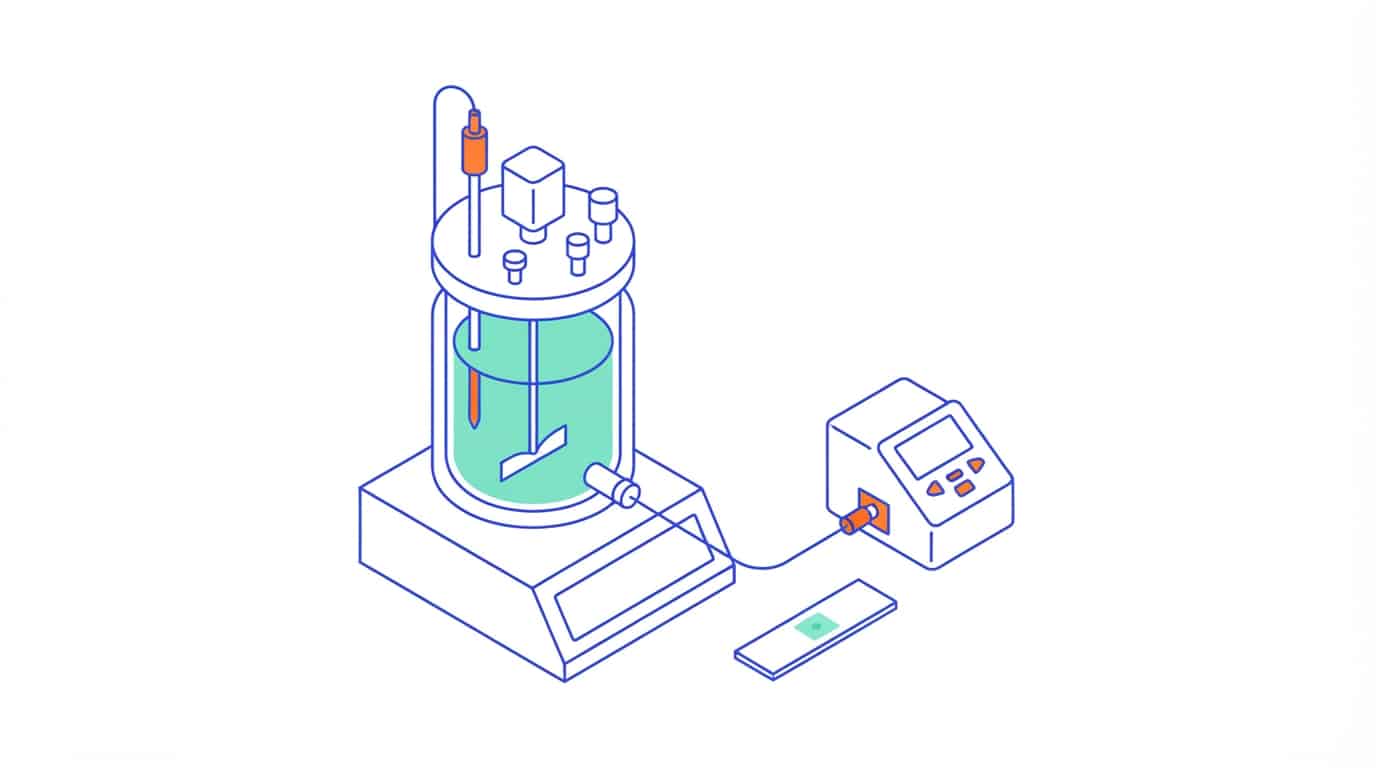
Manual. An analyst mixes a sample with trypan blue, a dye that enters cells with a damaged membrane and turns them blue. The mix goes onto a hemocytometer, a slide with a ruled grid, and the analyst counts under a microscope. Blue cells count as non-viable. Unstained cells are assumed to be intact and count as viable. It is cheap and versatile, but slow, and results vary between analysts. The source estimates about 4 USD per manually counted sample.
Automated. An instrument photographs the stained sample and software does the counting. Some instruments mix the dye themselves. This handles many samples quickly and reduces the variability that comes from human error.
Capacitance probe. A probe sits inside the vessel. Intact cells act as small capacitors in an electric field, so the capacitance of the culture is proportional to viable cell volume. It measures continuously without taking a sample. In CHO (Chinese hamster ovary) perfusion seed cultures, the probe signal tracked offline VCD linearly up to 130 million cells/mL. Each of six antibody-producing cell lines needed its own correction factor to convert the probe reading into VCD, and those factors ranged from 1.26 to 1.73.
Why a good number can still hide a problem
- Viability is a membrane test. The stain only flags cells with damaged membranes. Cells that look intact are assumed to be viable.
- The counter needs tuning. In one validation, a semi-automated image-based counter counted 75.8 to 82.7% of the expected number of CHO-K1 cells at 2 to 8 million cells/mL. The manual count was close to 100% of expected. The authors suggest this may come from cells clumping at higher densities: the instrument cannot recognise the clusters as separate cells and excludes them.
- Daily sampling is too infrequent. A once-a-day offline count is too infrequent for dense cultures, where the cells can grow significantly within hours.
- One number is not enough. In a perfusion seed culture (fresh medium fed in, spent medium drawn off), one run reached 53.3 million cells/mL at 96.8% viability. A second run reached 46.0 million cells/mL at 98.9% viability while perfusing 39% less medium than the first. Neither number alone says which run is better.
Sources
- Cadena-Herrera et al., Validation of three viable-cell counting methods: Manual, semi-automated, and automated, Biotechnology Reports, 2015.
- Rittershaus et al., N-1 Perfusion Platform Development Using a Capacitance Probe for Biomanufacturing, Bioengineering, April 2022.