Primary source Esmonde-White et al.: The role of Raman spectroscopy in biopharmaceuticals from development to manufacturing

Process analytical technology (PAT) means measuring a process while it is running, with sensors in or next to the vessel, so the process can be controlled as it goes. The alternative is to make the whole batch and only then test the product, and regulators encourage PAT because it builds quality in during production.
How it works in a plant
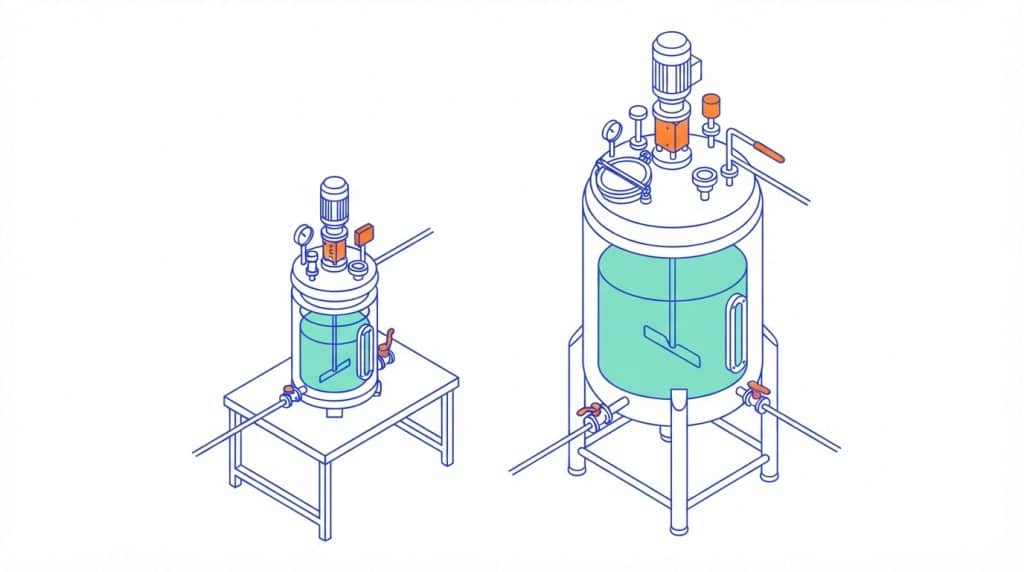
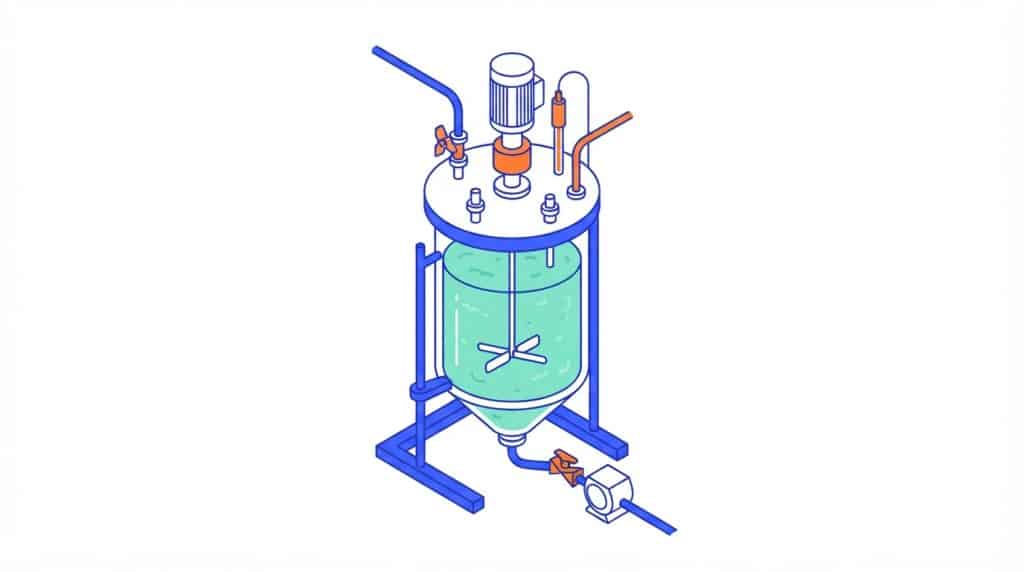
Some measurements are old routine: pH, temperature and dissolved oxygen (how much oxygen is in the liquid) are read by probes inside the tank. PAT extends this to the chemistry of the broth, such as nutrients, waste products (metabolites), amino acids, cell viability and biomass. These can be measured by spectroscopy (analysis based on how light interacts with the liquid), electrochemical sensors, assays or chromatography.
Where the sensor sits matters. In-line (also called in situ) means the probe is inside the vessel. At-line means an automated sampler pulls liquid out for a nearby instrument. Off-line means a sample goes to the lab.
Example: Raman in a bioreactor
Raman spectroscopy shines laser light into the broth and reads the light that scatters back. Each molecule scatters in a characteristic way, so the result works like a molecular fingerprint. It can often be taken in water without sample preparation, which suits a cell culture. Because many signals overlap in a culture, software models (multivariate analysis, such as partial least squares) convert the spectrum into concentrations. For Chinese hamster ovary (CHO) cell cultures, Raman measurements use near-infrared lasers because the cells’ own fluorescence at visible wavelengths is strong. The review calls Raman a first-choice PAT for monitoring and controlling upstream (cell growth) steps.
The trade-offs are real. The Raman effect is very weak and competes with fluorescence. Models need calibration and validation, and have to stay robust when transferred. Connecting the instrument to control systems takes extra software work, including data integrity.
Why regulators encourage it
In 2002 the US Food and Drug Administration (FDA) launched an initiative to encourage innovation in manufacturing technology. Its 2004 PAT framework shifted the emphasis from quality that is tested in after production to quality built in throughout production. The European Medicines Agency (EMA) set up a PAT team in 2003. The ICH Q8(R2) guideline defines real-time release testing as the ability to evaluate and ensure the quality of in-process and/or final product based on process data. The guidance is strategic, not prescriptive: it asks manufacturers to understand and manage risks to critical quality attributes.
Sources
- Esmonde-White K.A., Cuellar M., Lewis I.R., The role of Raman spectroscopy in biopharmaceuticals from development to manufacturing, Anal Bioanal Chem, 2022 (accepted 8 Oct 2021).
- Esmonde-White K.A. et al., Raman spectroscopy as a process analytical technology for pharmaceutical manufacturing and bioprocessing, Anal Bioanal Chem, 2017 (accepted 21 Jul 2016).