A peer-reviewed paper in the Journal of Pharmaceutical Sciences (volume 115, issue 11, article 104511, first published online 23 September 2026) tests whether small computational fluid dynamics-based devices (CFD, numerical simulation of fluid flow and heat transfer) can stand in for large freeze-thaw containers. The authors are from Ludwig-Maximilians-Universität München, Novartis and SmartFreez. This brief is based on the abstract only, because the full text was not read.
What was compared
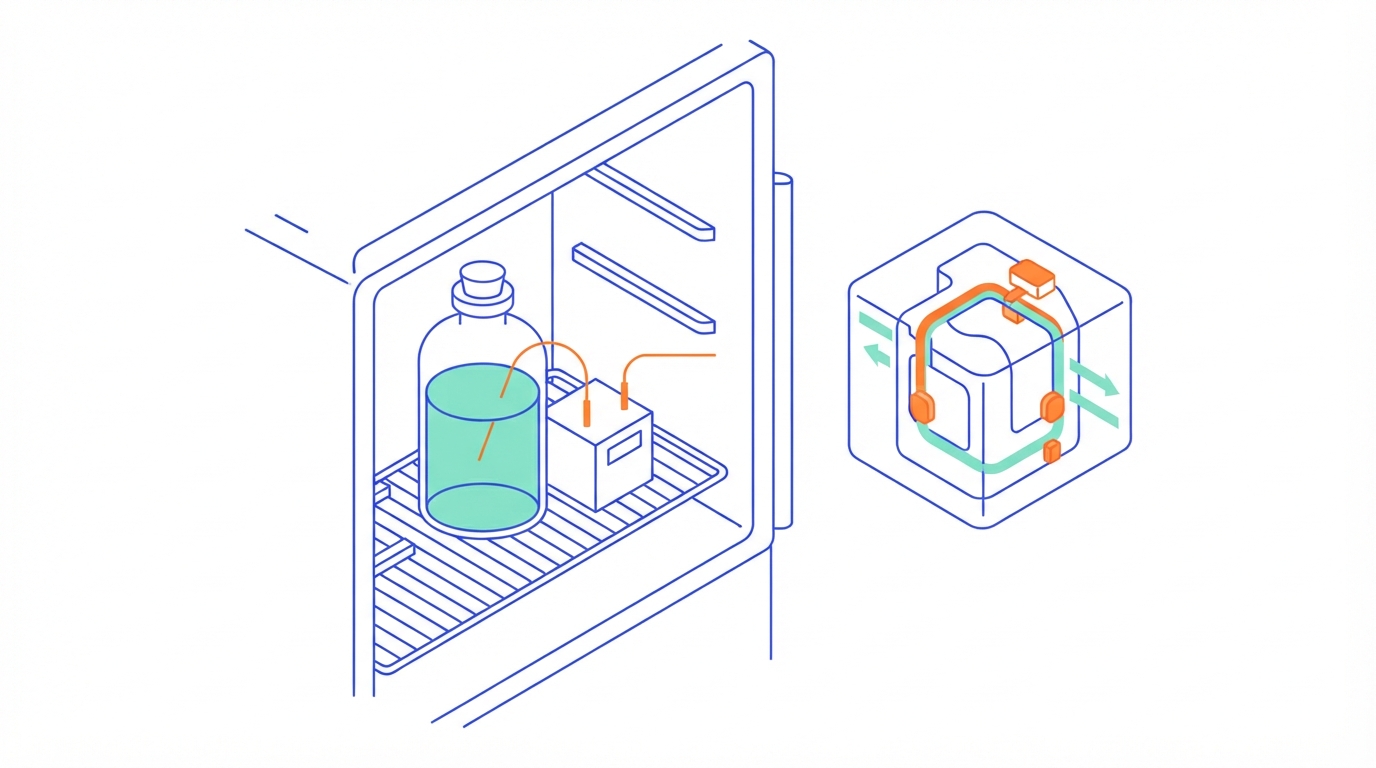
The abstract says large-scale freezing and thawing of biopharmaceutical drug substance creates spatially heterogeneous stresses, meaning the stress differs from place to place inside the container. These are hard to replicate and predict with traditional scale-down methods. The study assessed two CFD-based scale-down devices (SDDs) against the 5 L PharmaTainer bottle, the at-scale counterpart.
The comparison was multimodal. It included 3D temperature mapping, quantification of cryoconcentration (solutes concentrating in the liquid that freezes last) during freezing, and stratification (layering of concentration) during thawing. It also included predictions of protein aggregation after freeze-thaw cycling, measured as high molecular weight species, subvisible particles and turbidity.
Stress at the ice-liquid interface was assessed through spatially resolved specific surface area analysis (ice-liquid surface per unit volume) in both the devices and the 5 L bottle. The abstract states that, for the first time, this was directly supported by spatially resolved in-ice micro-computed tomography (μCT) imaging.
Results as stated
- A box SDD most accurately reproduced the spatial patterns and parameter magnitudes observed at scale in the 5 L PharmaTainer.
- A wedge SDD captured qualitative trends but had limitations in quantitative accuracy.
- The authors conclude that CFD-based SDDs provide a predictive, mechanistically supported approach for scaling down large-scale freeze-thaw processes.
The abstract gives no numerical results, so this brief reports none. It does not say how many cycles, formulations or proteins were tested.