A paper published on 28 October 2026 in the open-access journal Bioresources and Bioprocessing combines two ways of easing oxygen limits in high-cell-density Komagataella phaffii fermentation: changing headspace pressure during the run, and redesigning the agitator with computational fluid dynamics (CFD). The process makes recombinant xylanase.
Pressure as a stage-dependent variable
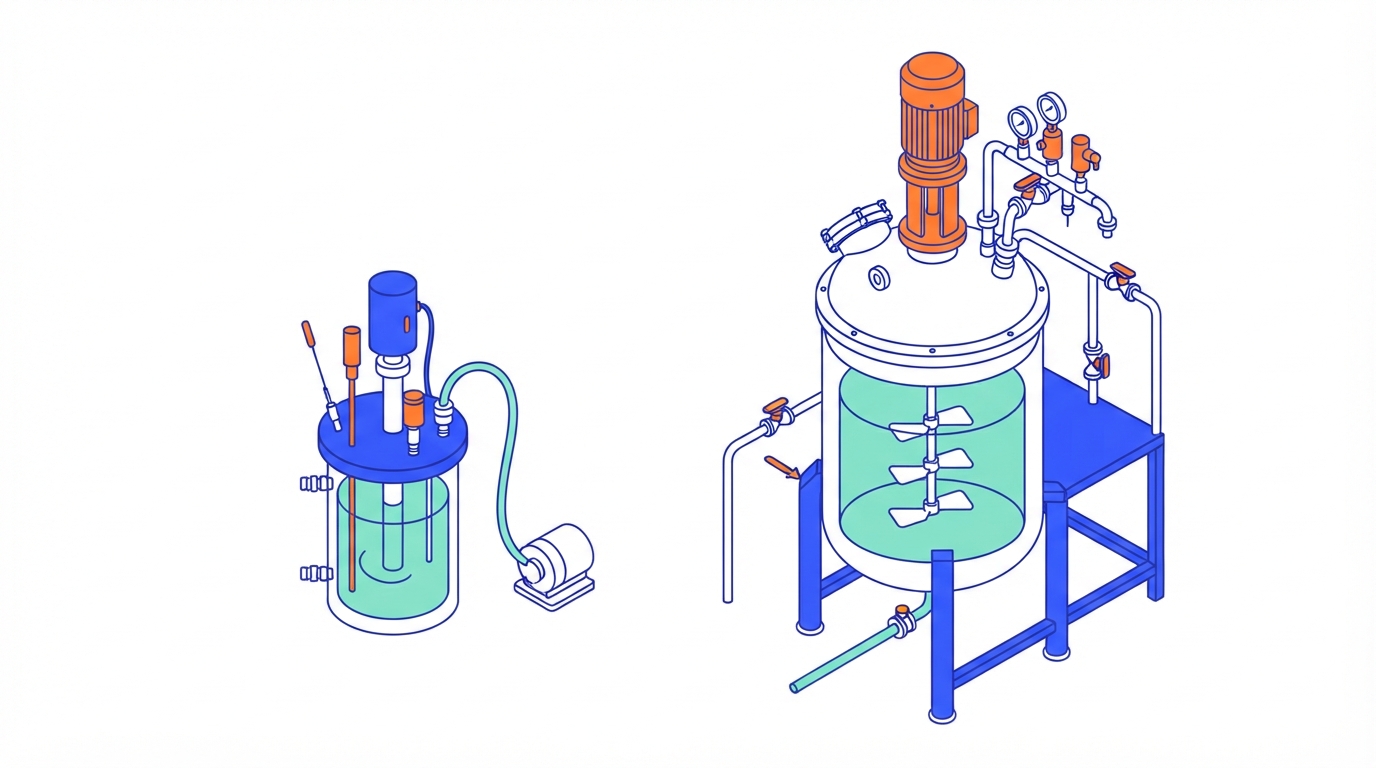
The authors note that agitation and aeration increases can bring high shear stress, foaming and higher energy demand. At 5 L, they compared three headspace pressure strategies with identical feeding, agitation and aeration profiles. The control held 0.5 bar (gauge) throughout. In the two-stage dynamic pressure (TSP) strategy, 0.5 bar was kept during growth and early methanol induction, then pressure was gradually raised to 1.0 bar in the mid-to-late induction phase, when oxygen demand rises.
Compared with the conventional-pressure condition, TSP increased final dry cell weight (DCW, the biomass concentration) by 11.2%, to 120.25 g/L. Maximum xylanase activity rose by 19.8%, to 213.23 KU/mL.
Pilot and industrial scale
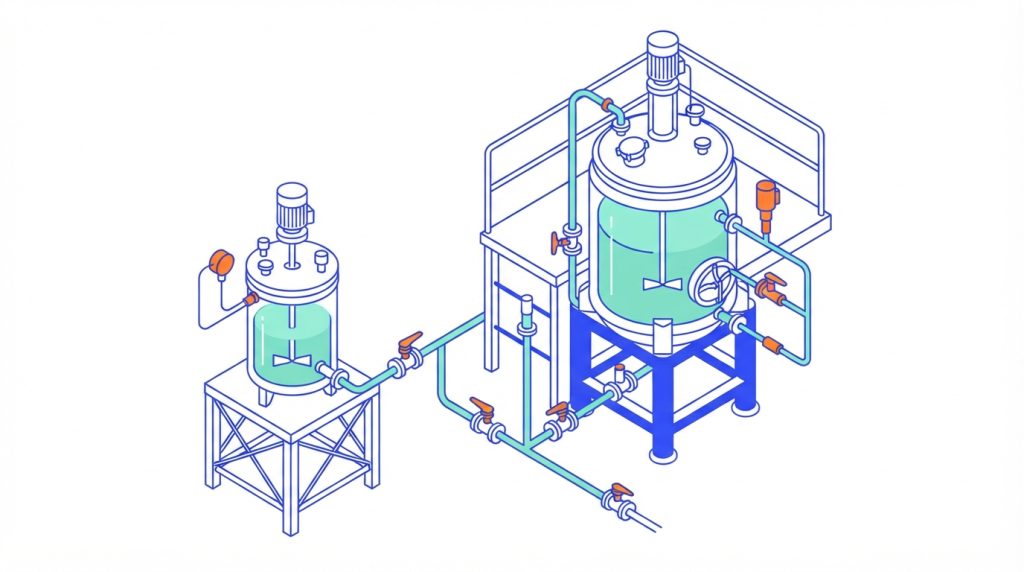
With the strategy implemented at 1,000 L, peak oxygen uptake rate (the rate at which the culture consumes oxygen) reached 185.23 mmol/L/h, with a final DCW of 124.08 g/L and xylanase activity of 225.07 KU/mL.
At 30 m3, CFD identified hydrodynamic limitations in the original agitation system. The authors replaced 0.7 m Rushton turbines with a 0.8 m CD-6/3KSX hybrid impeller system. Under identical simulation conditions, the redesign raised the predicted average kLa (the volumetric oxygen transfer coefficient, a measure of how fast oxygen moves into the broth) by 46.4% and cut the predicted mixing time by 43.3%. After the redesign was implemented, final DCW reached 134.01 g/L and xylanase activity 242.02 KU/mL.
Limits stated by the source
The kLa screening by response surface methodology (agitation 500 to 900 rpm, aeration 1.5 to 2.5 vvm, pressure 0.5 to 1.5 bar) was done in pure water at 5 L, as a relative comparison and not as an estimate of absolute kLa in a fermentation. The authors describe the work as a case-based approach for this one recombinant K. phaffii process. The abstract does not give a like-for-like pressure comparison at 1,000 L or the 30 m3 results before the redesign, so from the abstract alone the scale-up gains cannot be separated from other changes between scales.