Primary source Microorganisms (MDPI): Bioprocess Intensification Using Perfusion Culture for Recombinant Protein Production from Lactococcus lactis
Researchers at the Bioprocessing Technology Institute (BTI) of A*STAR in Singapore, with a colleague at the National University of Singapore, report a perfusion strategy for high-cell-density culture of Lactococcus lactis, published in Microorganisms on 1 October 2026. They used basic fibroblast growth factor 2 (FGF2) as a model recombinant protein. The authors note that secretion from microbial cell factories simplifies downstream processing.
What was done
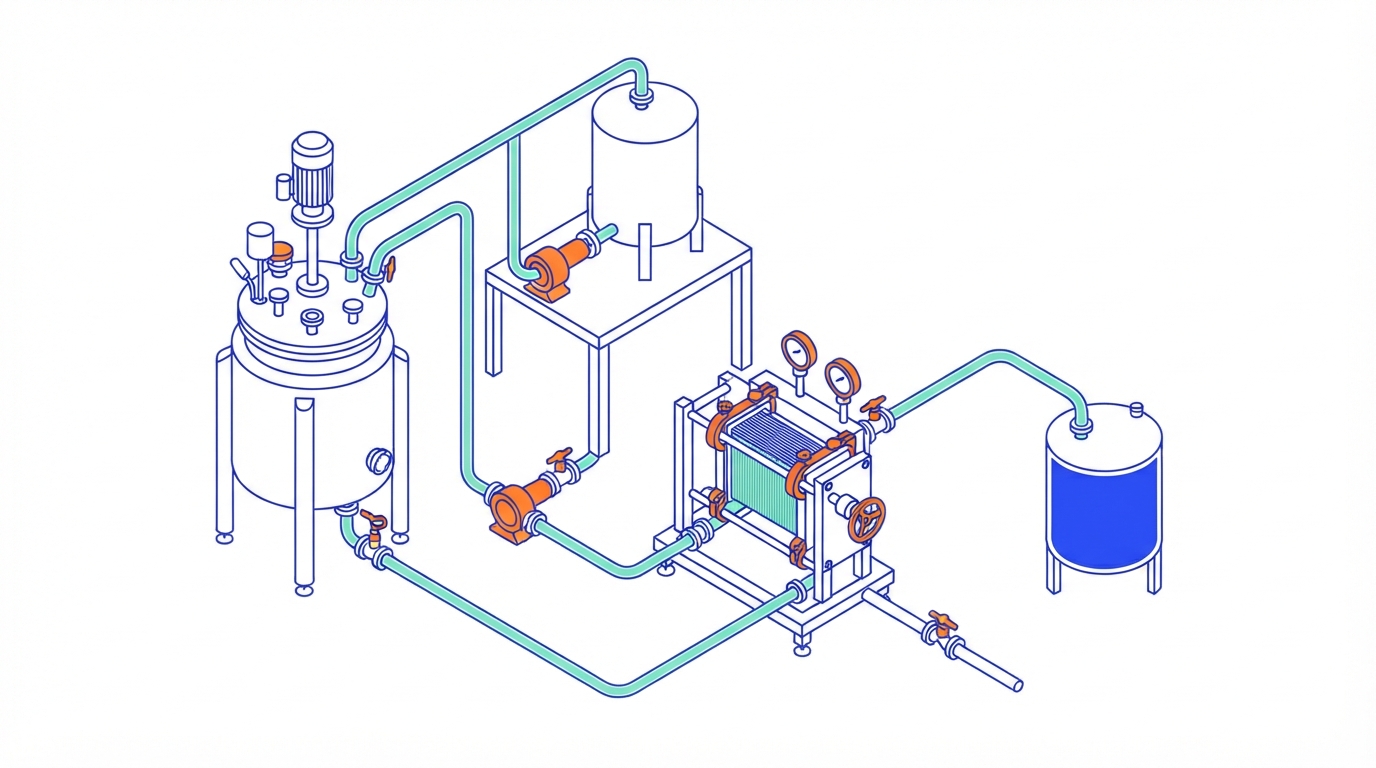
The team used tangential flow filtration (TFF) to retain cells, which allows continuous removal of inhibitory metabolites while fresh nutrients are replenished. With conventional 2 × GM17 medium, perfusion outperformed batch cultivation: biomass rose 4.7-fold and secreted FGF2 rose 3-fold over batch, reaching a titer of 10,416 ± 892 µg/L.
A model for media use
The group also built a bioprocess model for L. lactis grown in a fortified spent cell culture medium, to explore operating conditions systematically. It generated a Pareto front (the set of best trade-offs) of FGF2 titer against media usage, and identified perfusion profiles that balance the two competing objectives.
One experimentally selected operating point was used to test the model. It gave a final OD600 (optical density at 600 nm, a measure of cell density) of 49.2 ± 0.3 and an FGF2 titer of 2,166 ± 161 µg/L. Those values are 7.9 times the OD600 and 5 times the FGF2 titer of the batch process. The authors conclude that model-guided decisions can raise productivity while reducing waste.
Limits of this note
The full text could not be read in this review; this piece rests on the published abstract and bibliographic record. The abstract does not state the culture scale, the run length or the batch reference titer, so those are not reported here.