A paper published on 16 October 2026 in Bioprocess and Biosystems Engineering tests a combined feeding strategy for Chinese hamster ovary (CHO) cells producing an IgG1 monoclonal antibody (mAb). The aim is to limit lactate and ammonia build-up, which the authors call persistent bottlenecks for cell viability, productivity and product quality. Only the abstract was available to us (the full text is behind a subscription), so this summary is limited to what the abstract states.
Four conditions, compared head to head
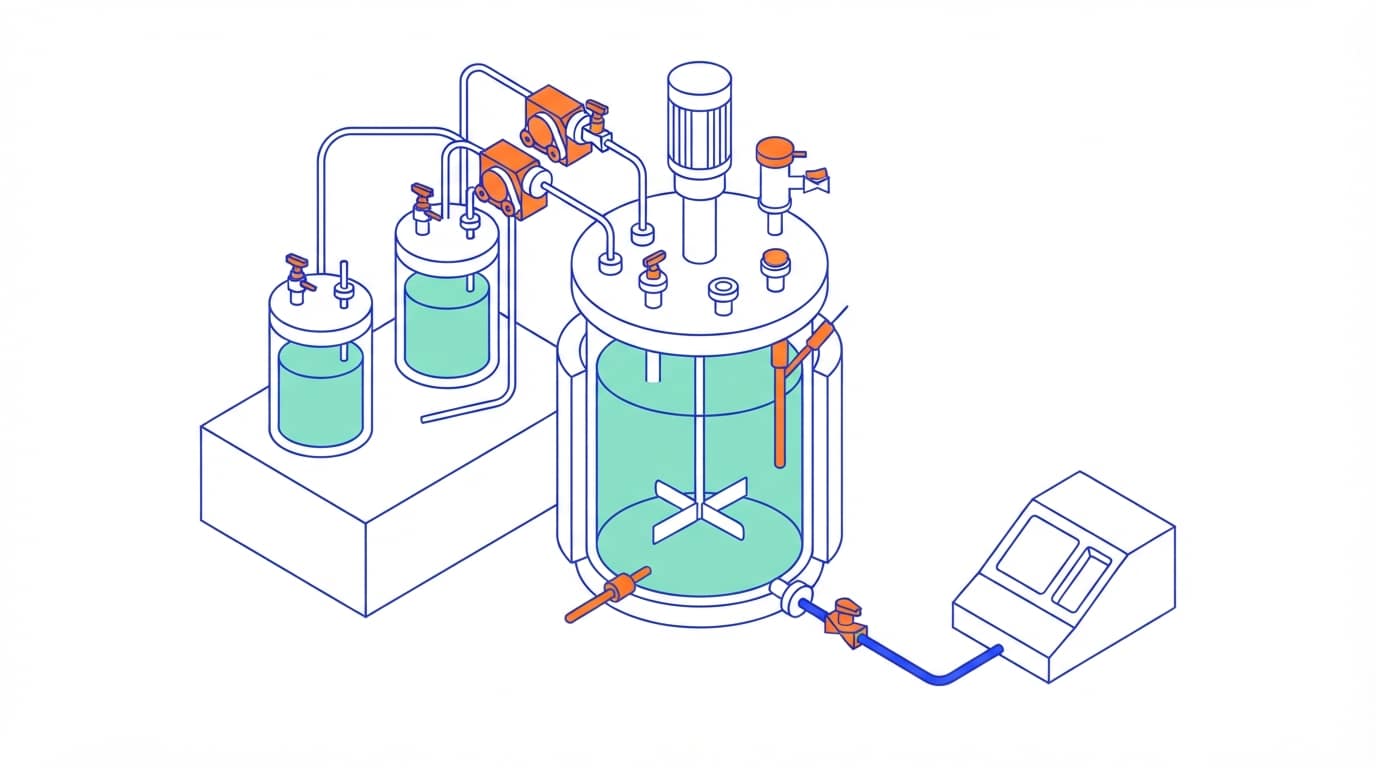
The authors replaced conventional L-glutamine with L-alanyl-glutamine (Ala-Gln) to curb spontaneous ammonia release. They also used a customized “efficient feed mix” enriched with TCA (tricarboxylic acid, the cell’s central energy cycle) intermediates and branched-chain amino acids, together with a glucose-galactose co-feed (2 mM glucose plus 30 mM galactose) introduced upon glucose depletion. Four fed-batch conditions were run:
- FB-01: glutamine control.
- FB-02: Ala-Gln alone.
- FB-03: Ala-Gln with TCA intermediates.
- FB-04: the complete integrated strategy.
Reported results for FB-04
- Peak lactate: a reduction of more than 83%, to 4.0 mM.
- Ammonia: an 80% reduction, to below 2.0 mM.
- Cell viability (the share of living cells): sustained above 85% through day 11.
- Titre: 1.72 g/L, which the abstract describes as 93% higher.
- Peak viable cell density (VCD, the number of living cells per millilitre of culture): 39 x 10^6 cells/mL, or 39 million.
- Glycosylation: 19.0% galactosylation (the share of the antibody’s sugar chains carrying galactose), which the abstract says remained aligned with innovator benchmarks.
The authors state that this is the first direct head-to-head benchmarking of Ala-Gln substitution, TCA intermediate supplementation and galactose co-feeding in a single CHO fed-batch platform. The abstract does not state explicitly which condition the percentages are measured against; its closing sentence describes the combined benefits as shown against a glutamine control. It does not give the control values, the culture scale, the number of replicates or the cell line, so those cannot be assessed from the source we read.