Researchers at the Indian Institute of Technology in New Delhi report a feeding strategy for producing human papillomavirus (HPV) virus-like particles (VLPs) in the yeast Komagataella phaffii. The paper was published online on 9 October 2026 in Biotechnology Progress. We could read only the abstract, so this brief is limited to what the abstract states.
The problem and the test
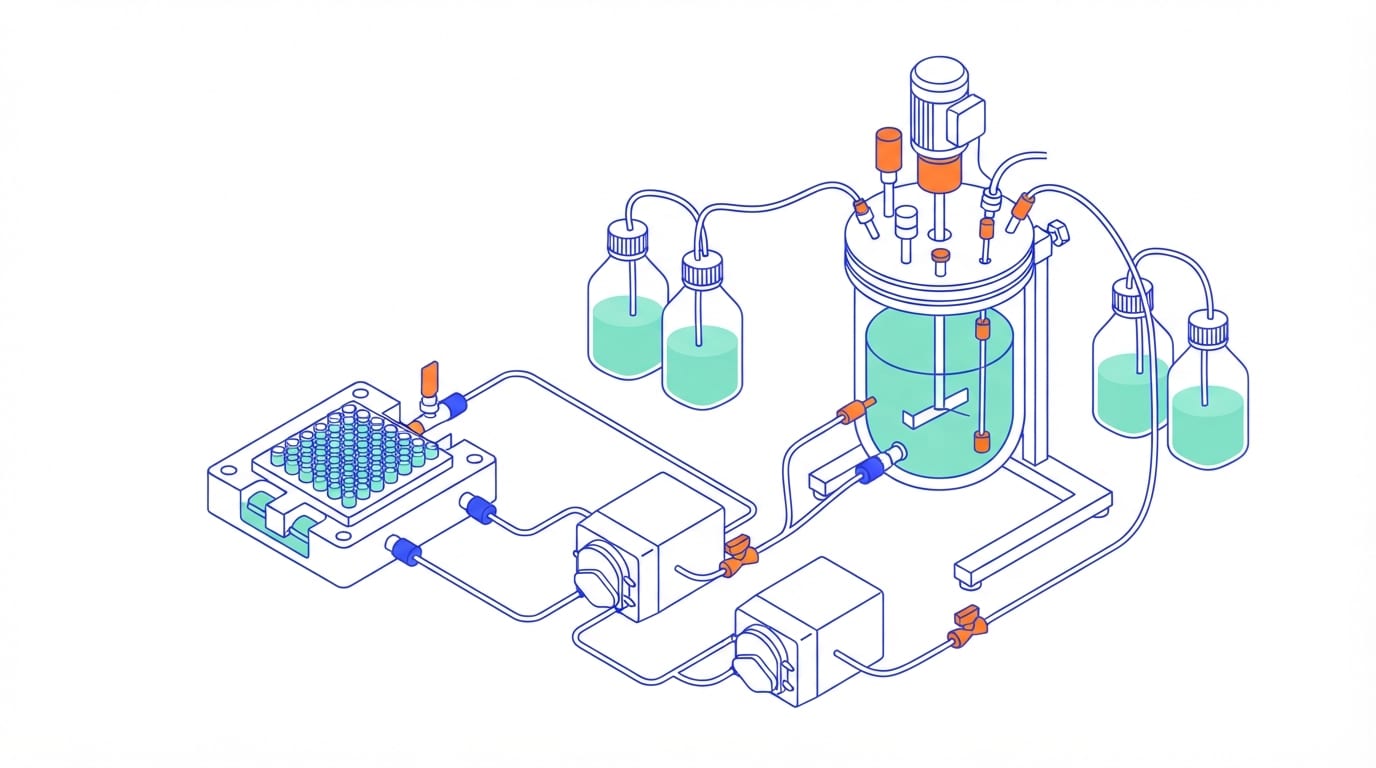
The authors say production of HPV VLPs in K. phaffii is often constrained by methanol-associated toxicity and suboptimal feeding strategies during induction. They used a microbioreactor-based approach to design and compare mixed-substrate fed-batch strategies for HPV16 L1 VLP production. Four methanol-based feed compositions were tested: methanol only, and combinations with glycerol and sorbitol. Each was run under pulse feeding and linear feeding.
Results
A linear feed of 70% methanol and 30% glycerol gave the highest biomass and VLP titer in the microbioreactor. Biomass reached 90.36 g/L, measured as dry cell weight (DCW, the mass of dried cells per litre of culture). VLP titer, the VLP concentration in the culture, reached 42 mg/L. The abstract describes this as a two-fold improvement over methanol-only feeding.
The authors attribute the gain to reduced methanol-induced metabolic stress and improved substrate utilization. They link this to more stable dissolved oxygen (DO) profiles and sustained cellular activity. Pulse feeding produced significant DO fluctuations, which the authors read as transient metabolic imbalances, and lower overall productivity.
Scale-up
The optimized feed was transferred to a 1 L stirred-tank bioreactor. There it reached a DCW of 120 g/L and a VLP titer of 49 mg/L, a roughly 2.3-fold increase compared to the control. The authors say the agreement between microscale and bench-scale results shows that microbioreactors can predict fed-batch behavior. They also state that the strategy reduces methanol usage.
The abstract does not give the microbioreactor volume, the number of replicates, or the exact definition of the control at 1 L. It does not report any data above 1 L.
What it means for a plant
For a team running methanol-induced K. phaffii, the paper suggests that feed composition and feed mode (linear rather than pulse) are worth screening early, and that DO stability can serve as a readout of metabolic stress. It also supports using a microbioreactor as the screening step before bench scale. Whether the result holds at pilot or production scale is not addressed in the abstract. The full text would be needed to check feed rates, strain details and the control condition.