Researchers at Daiichi Sankyo and Gunma University report a feasibility study of a monoclonal antibody (mAb) polishing block that runs at one pH, about 5.0, after Protein A capture. The paper was published online on 18 October 2026 in Biotechnology and Bioengineering. We could open only the abstract, so this note is limited to what the abstract states.
The problem it targets
The authors say mAb downstream processing often requires multiple pH adjustments between Protein A capture and polishing steps. They state that these adjustments increase process complexity and make direct connection of unit operations more difficult.
What was tested
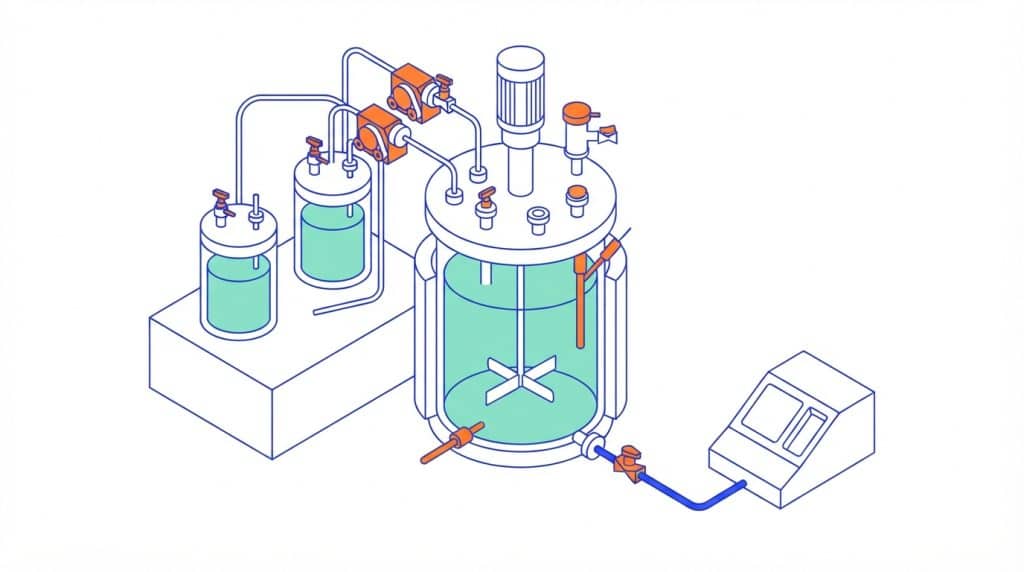
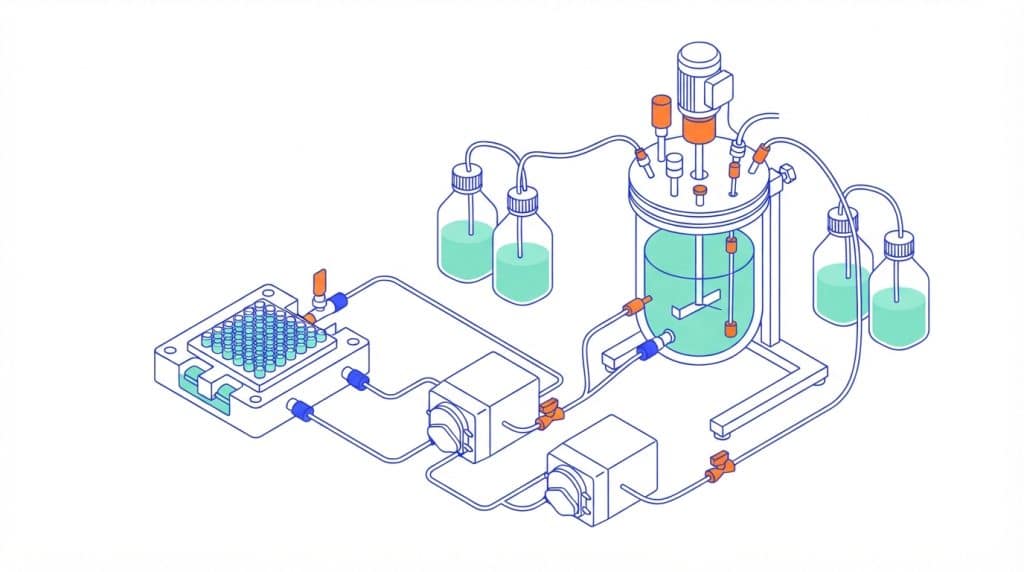
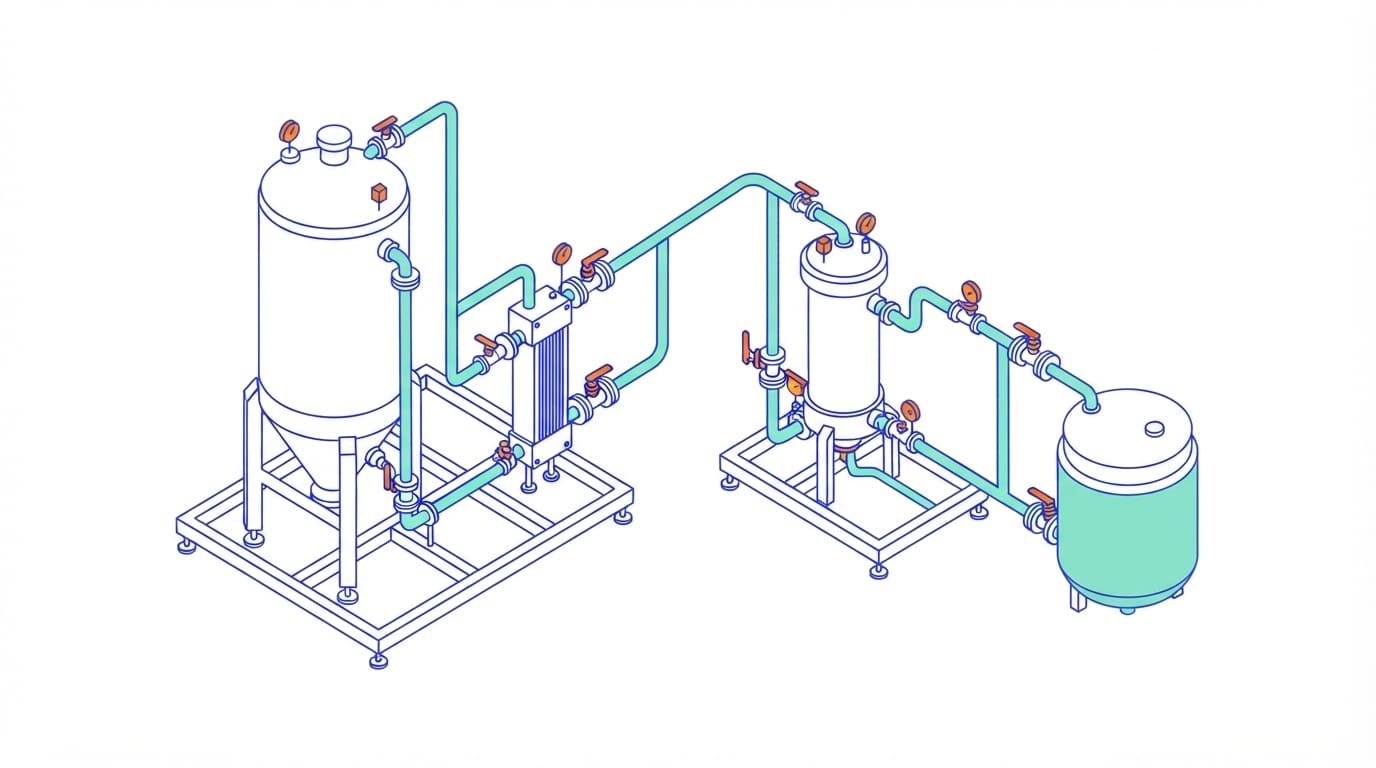
The connected block combined mild-pH Protein A elution, an acidic-window anion exchange (AEX) membrane, and cation exchange (CEX) chromatography. Praesto Jetted A50 HipH produced IgG1 eluates near pH 5.0 with a conductivity suitable for loading directly onto the AEX step.
Results reported in the abstract
- Virus clearance: under the standard condition (pH 5.0 and a conductivity, a measure of the salt level, of 5.0 mS/cm), the AEX membrane reduced xenotropic murine leukemia virus to the assay limit (at least 3 log10, a thousand-fold) and minute virus of mice by approximately 2 to 3 log10 (roughly 100- to 1,000-fold).
- Host cell proteins: in a connected proof-of-concept run without intermediate pH adjustment, the AEX-CEX block lowered host cell protein content from more than 25 to less than 10 ng per mg of IgG.
- Aggregates: high-molecular-weight species fell from 1.3% to below 1% in the final product pool, and low-molecular-weight species (fragments) stayed below 1%.
- Recovery: the connected AEX-CEX run recovered 97.6% of the product. The abstract gives no baseline for comparison.
Other antibodies and the comparison
For two additional IgGs, the authors relied on archived strong-AEX flow-through records at pH 7.5 and sequence-derived charge descriptors. They say these supported the plausibility of product flow-through at pH 5.0. The abstract does not report connected runs with those two molecules.
In a retrospective comparison using the same IgG1, the connected configuration used fewer vessels and conditioning operations. It also had a shorter recipe-derived programmed chromatography time. The abstract gives no numbers for these differences.
What it means for a plant
If the approach holds up, removing the pH adjustment steps between Protein A and polishing would mean fewer vessels and conditioning operations, and would remove the obstacle to connecting unit operations directly that the authors set out to address. The evidence here is one IgG1 in a proof-of-concept run, plus a plausibility argument for two other antibodies. Plants would need to confirm flow-through behavior and viral clearance for their own molecule. The abstract does not report scale, resin lifetime or cost.
Sources
- Aiso T, Muto H, Suzuki K, Masuda Y, Kakihara H, Sonoyama M, Biotechnology and Bioengineering, Feasibility Assessment of a Single-pH Connected Polishing Train for Monoclonal Antibody Purification, 18 Oct 2026 (abstract via Europe PMC record, PMID 42894435).