Primary source Applied Microbiology and Biotechnology (PMC): Benchmarking of commercially available CHO cell culture media for antibody production
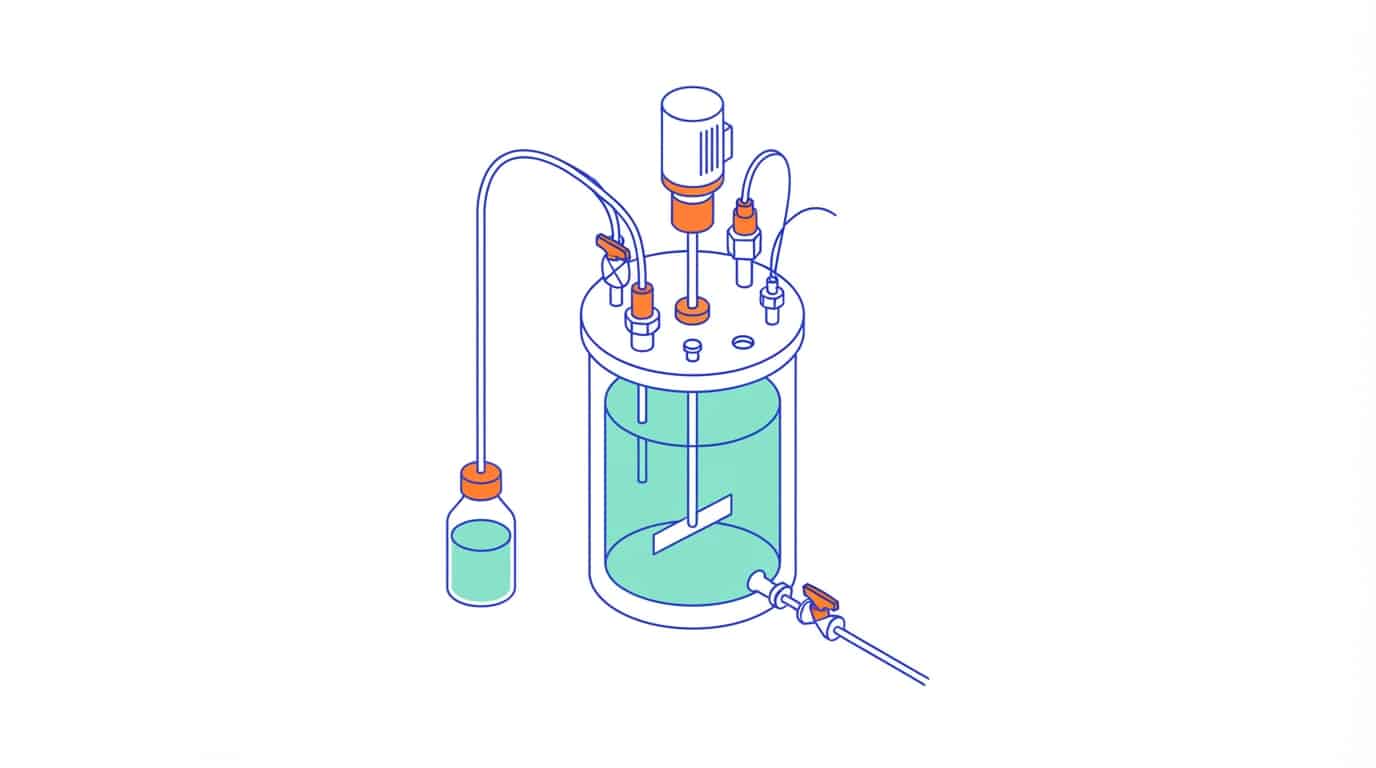
Cell culture medium is the liquid that feeds the cells in a bioreactor: sugar for energy, amino acids to build protein, vitamins and trace metals for the cell’s machinery. A batch holds only so much food, so plants add concentrated feeds during the run to keep the cells alive and making product.
What is in the tank before the cells arrive
The workhorse host for antibodies is the CHO cell (Chinese hamster ovary), which a 2015 paper calls the standard mammalian host for more than 70% of recombinant protein pharmaceuticals on the market. The starting liquid is called the basal medium. Chemically defined CHO media are widely used: every ingredient is a known compound, with no animal serum added.
Four groups of ingredients matter most to a newcomer:
- Sugar. Glucose is the main energy source for the cells.
- Amino acids. These are the building blocks of the antibody and of the cells themselves.
- Vitamins and trace metals. Cells need a balanced supply of these micronutrients to grow properly and to make well-formed glycoproteins (proteins carrying sugar chains).
- Dissolved compounds in total. The overall concentration of dissolved material is measured as osmolality, the number of dissolved particles per kilogram of water. Cells tolerate only a limited range.
There is no single best recipe. Media differ in design: some are built for high cell density, others to extend cell life or to raise the output per cell. The choice depends on the cell line, the clone and the product, so each process needs its medium screened and tuned.
Why a batch runs out
In a plain batch culture, everything is added at the start and nothing more goes in. The cells eat, grow and change the liquid around them.
Some nutrients vanish early. In one benchmark of eight commercial media, the amino acid glutamine was used up in every medium by the end of the exponential growth phase (the stretch where cell numbers climb fastest). Tyrosine, serine, aspartic acid and asparagine were also among the amino acids most often running low. Glucose was handled separately: in the study’s fed-batch runs, a concentrated glucose solution kept it above 3 g/L.
At the same time, waste builds up. Lactate (from sugar metabolism) reached 1.0 to 1.8 g/L in most media in that benchmark, and ammonium (from amino acid breakdown) rose steadily to 80 to 180 mg/L. Lactate and ammonia affect growth above a certain threshold, and an unbalanced mix of glucose and amino acids drove cells to produce more of both.
Having more food is not automatically better. High amino acid concentrations alone did not guarantee good growth or antibody production. Excess nutrients can also harm cells through concentration-dependent toxicity and high osmolality.
A worked example: what feeds add
A feed is a concentrated nutrient mixture added at intervals during the run. In the 2015 benchmark, feeding began on day 3. One regimen added Feed A daily at 3% of the culture volume and Feed B daily at 0.3%.
The effect was large. Concentrated feed supplements raised cell concentrations almost threefold and antibody titres (grams of antibody per litre of culture) up to sevenfold. With the best medium and feed pair, peak cell concentration reached 2.39 x 10⁷ cells/mL and the antibody titre 5.5 g/L. In the same medium without feeds, a batch peaked at 8.5 x 10⁶ cells/mL and 863 mg/L of antibody.
The choice of feed also matters. In a second basal medium, CD OptiCHO, a single feed (EfficientFeed A) reached only 0.7 to 0.8 g/L. Adding a titre enhancer supplement raised it to 1.7 g/L, and a different two-feed combination gave 1.5 g/L in a culture 4 days shorter.
A later study (2025) used a Trastuzumab biosimilar CHO-K1 line, fourteen basal media and seven feeds, with 6% feed by volume added on days 4, 6, 8, 10 and 12. Results depended on the pair. One control medium reached about 10 million cells/mL in batch and 13.0 million cells/mL with one feed, but showed only a marginal increase with three others. One feed pushed osmolality above 400 mOsm/kg on day 13.
The trade-offs
Feeding raises output but adds complexity. The feed also changes the by-products: one feed in the 2025 study raised ammonia accumulation in every basal medium tested, probably because of its high glutamate content. The 2015 study also reports that medium and feed choice shifted the glycosylation of the antibody, the sugar chains attached to it that are part of product quality.
A third route is to keep supplying fresh medium continuously, as in perfusion. With better cell lines, media and feeds, titres of up to 5 g/L are routinely reached within 2 weeks, the 2015 paper notes.
Sources
- Reinhart et al., Benchmarking of commercially available CHO cell culture media for antibody production, Applied Microbiology and Biotechnology (PMC), 2015.
- Gyorgypal et al., Evaluating the impact of media and feed combinations on CHO cell culture performance and monoclonal antibody (trastuzumab) production, Cytotechnology (PMC), 2025.