Primary source Yang, Qadan and Ierapetritou, Economic Analysis of Batch and Continuous Biopharmaceutical Antibody Production: A Review (J Pharm Innov)
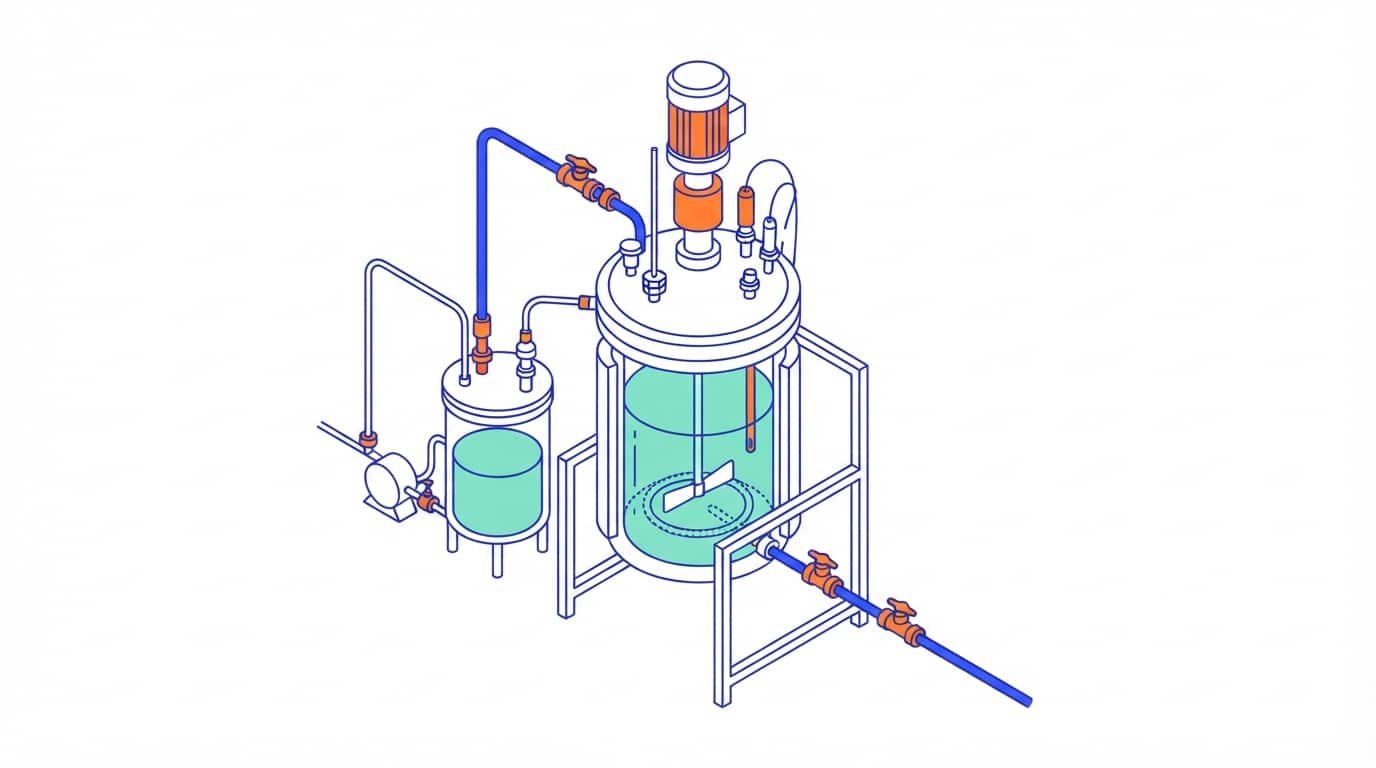
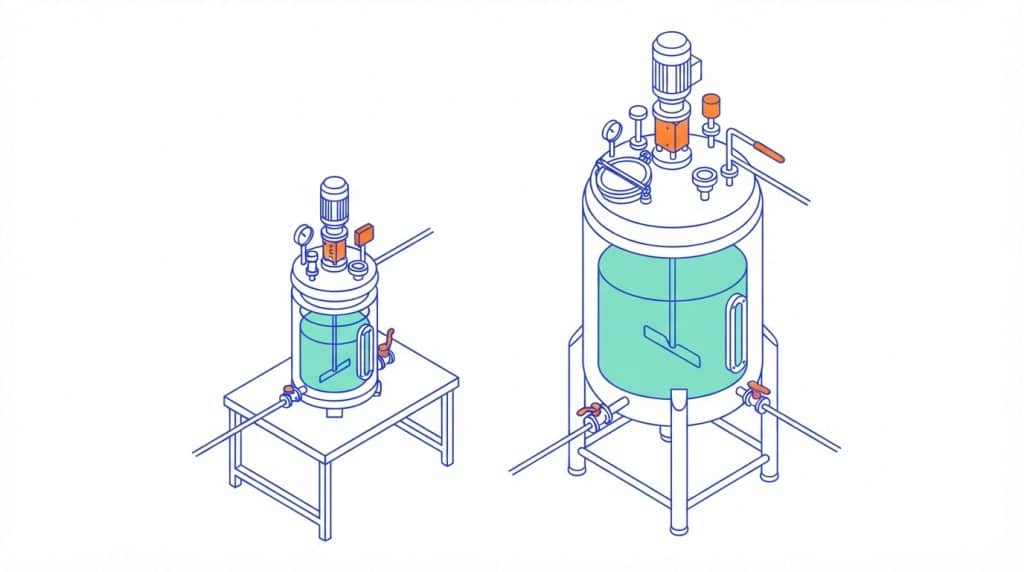
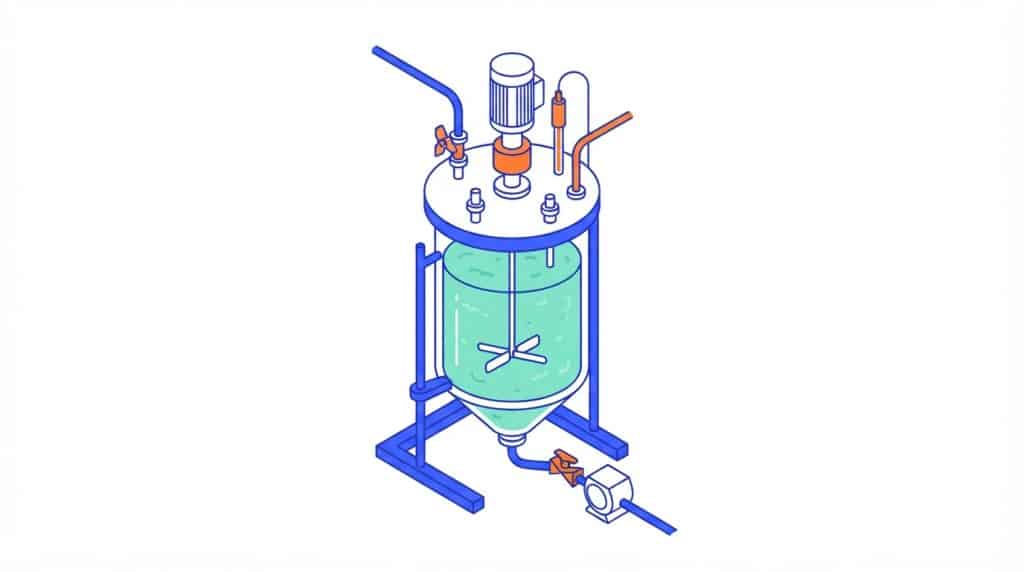
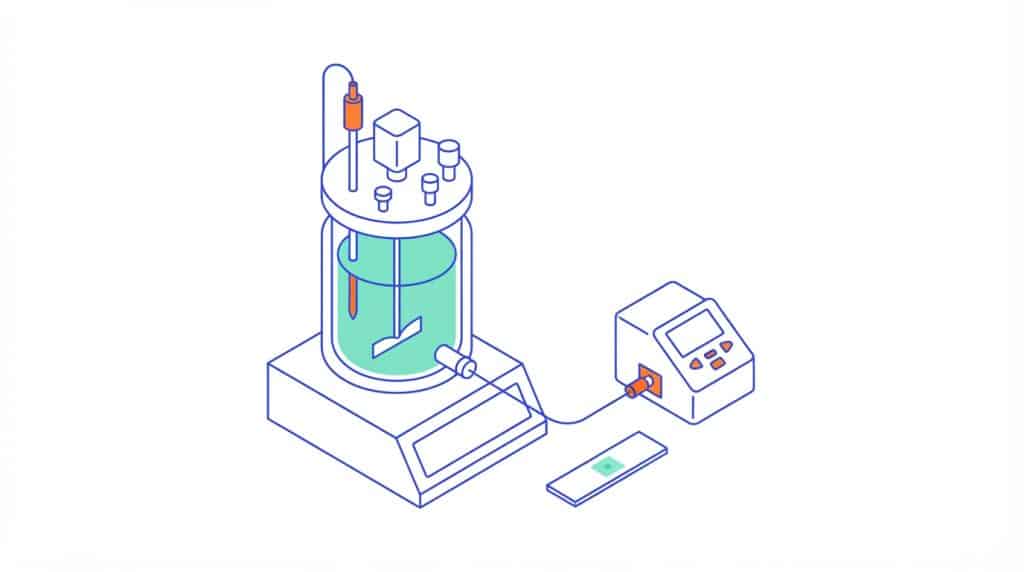
The three modes differ in when material goes into the bioreactor and when product comes out. In batch everything goes in at the start and comes out at the end, in fed-batch nutrients are added during the run and everything comes out at the end, and in continuous culture material goes in and comes out at the same time.
Batch: fill, wait, empty
A batch culture is the simplest case. The FDA definitions quoted in the review describe batch as a mode where materials are charged before the start and discharged at the end of the process. The tank holds the cells, the growth medium (the liquid with sugars, amino acids and salts the cells live on) and nothing else is added later. The cells grow, use up nutrients and release waste, and when the nutrients run low or the waste builds up, the run ends and the tank is harvested.
The limit is built in: the cells only have what you put in on day zero.
Fed-batch: keep feeding, harvest once
In fed-batch the tank starts like a batch, but concentrated nutrients are added during the run. The harvest still happens once, at the end. The FDA semi-batch definition the review quotes fits this: materials are added during processing and discharged at the end.
The feed is deliberately small. Fed-batch protocols supply only the minimal quantities of carbon and nitrogen sources, such as glucose and glutamine, needed to sustain the cells. That keeps their metabolism efficient and limits the by-products lactate and ammonia, so the cell population stays at a high percentage of viability (the share of living cells) for longer (Butler and Meneses-Acosta, 2012).
Antibody production in CHO cells is the usual example. Companies typically use batch or fed-batch bioreactors of 5,000 to 25,000 L with a duration of 10 to 17 days, according to the review. Microbial runs are typically significantly shorter than mammalian ones.
Continuous: feed in and harvest out at the same time
In continuous mode materials are simultaneously charged and discharged. In cell culture the usual form is perfusion: fresh medium is added and spent medium is removed continuously, while a cell retention device (a filter or settler) keeps the cells inside. The product leaves with the spent medium. Perfusion can run as a long-term steady state at small scale. Our lesson on perfusion covers the mechanics.
The review also notes that continuous processing is not widely used and is not well defined, even in many research studies, so check what a supplier means by the word.
A worked example: what feeding buys
Butler and Meneses-Acosta give the clearest numbers for what feeding does. A process that previously reached a maximum of around 1 million cells per milliliter over 7 days can now run for around 21 days, with a maximum density of 10 million cells per milliliter.
Titer, the concentration of product in the tank at harvest, is the product of two factors: specific productivity (how much each cell makes per day) and the integral of viable cell density (how many living cells there were, summed over the whole run). Typical titers of 100 mg/L before have risen to 1 to 5 g/L with improved cell lines in efficient fed-batch processes. The review gives the same range of 1 to 5 g/L for batch and fed-batch, with some reports of 10 to 13 g/L. See our lessons on viable cell density and titer versus specific productivity for those terms.
Now the continuous side. Many researchers indicate that the titer of perfusion bioreactors is lower than that of fed-batch bioreactors. In one economic analysis (Pollock et al.), the perfusion product concentration was taken as 20% and 45% of the fed-batch concentration. The stream leaving a perfusion tank is more dilute, so downstream steps handle more liquid per gram of product. The gain is that perfusion can hold cells at high density: in one perfusion setup with alternating tangential flow filtration, the cell density reached as high as 130 million cells per milliliter at steady state.