Gas is bubbled into many bioreactors to feed the cells oxygen and to control pH, and the bubbles can pile up at the surface as foam. Antifoams are chemicals that break that foam, but they can lower oxygen transfer, and the wrong type or amount can slow cell growth and foul filters.
Why sparged cultures foam
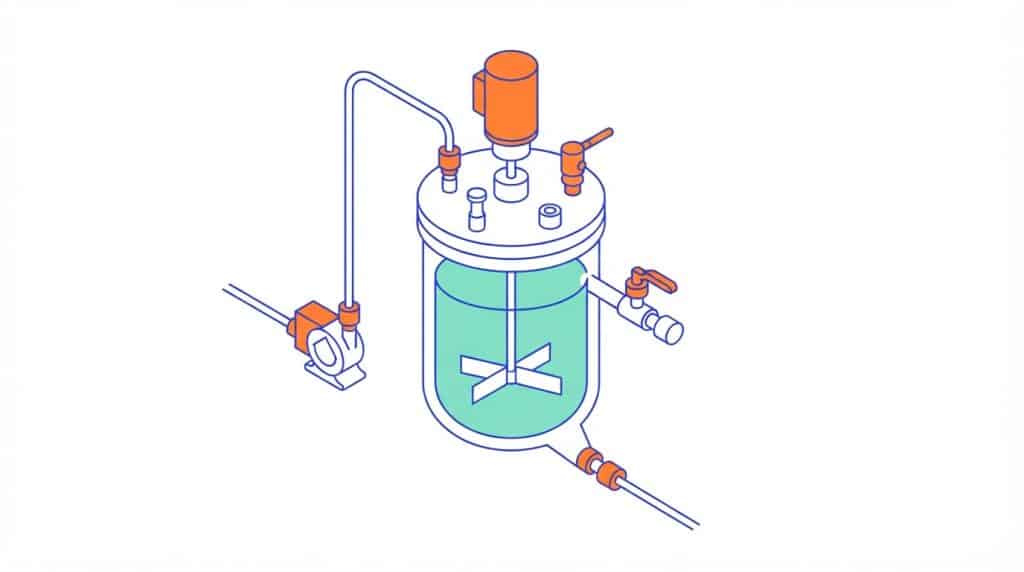
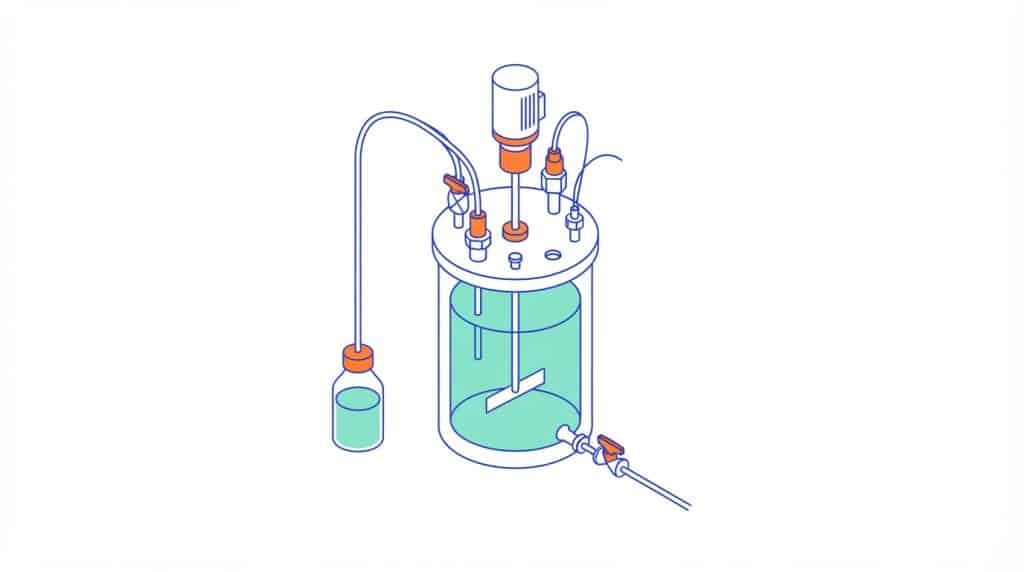
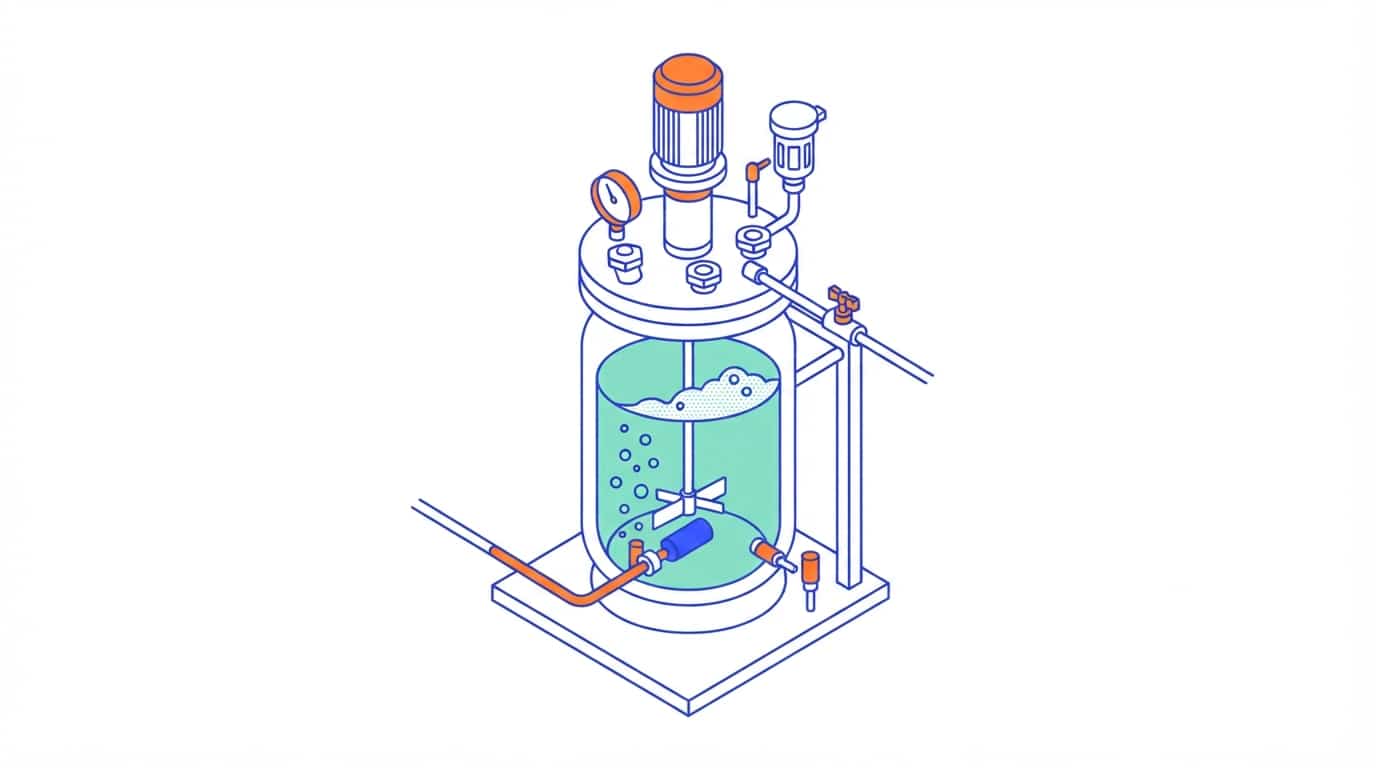
Many bioreactors are sparged: gas (air, oxygen, nitrogen or carbon dioxide) is pushed into the liquid through a sparger, a ring or a porous frit with small holes. The gas supplies oxygen and also helps set pH, as described in how a bioreactor controls pH and dissolved oxygen. The bubbles rise through the culture and collect at the top as foam.
Excessive foam can damage proteins when bubbles burst, let sterility control slip when foam escapes, and put pressure on equipment when it blocks the exit filter. A blocked vent filter is a real event: in a 5 L run, a clogged venting filter was picked up overnight from the off-gas oxygen trace (the paper does not say what clogged it), and the culture recovered once the filter was replaced under aseptic conditions.
What antifoams are
Antifoams are generally made of solid hydrophobic (water-repelling) particles, an oil, or a mixture of both. A hydrophobic particle makes holes in the thin liquid film around a bubble, so the foam ruptures. An oil forms bridges across the film that stretch until it breaks.
Commercial products fall into a few chemical families. In the main study, Antifoams C, SE-15 and Y-30 were silicone emulsions, Antifoam EX-Cell was a simethicone emulsion (a silicone-based type), and Antifoam 204 was a non-silicone polypropylene-based polyether dispersion.
In the main study, antifoam was added when foam was seen, but the dissolved oxygen signal also hinted at it: foaming was flagged when the local variability of the oxygen reading exceeded 250% of the variability over all earlier data.
Cost 1: oxygen transfer
Oxygen transfer is measured by kLa, a measure of how fast oxygen moves from the gas into the liquid (see what kLa is and why it limits a bioreactor). In CHO fed-batch runs at 5 L and 50 L, adding antifoam (a 1% v/v Antifoam C solution) lowered kLa, so the culture needed an inlet gas with a higher share of oxygen.
The effect was easy to miss early on. While cells were multiplying fast, their growing oxygen demand probably masked the oxygen spikes after antifoam additions. Later, when cell density was falling and demand was lower, the spikes were much more obvious.
Cost 2: cell growth, a worked example
Researchers at the US Food and Drug Administration screened five antifoams with a CHO cell line making an IgG1 antibody, in 15 mL micro-bioreactors. Each antifoam was dosed at the same 30 parts per million (ppm) of active ingredient at the start, and each later addition was also 30 ppm.
- Antifoams C, EX-Cell and SE-15 gave adequate foam control.
- Antifoams 204 and Y-30 noticeably stunted cell growth.
- For the three usable antifoams, specific productivity (the antibody made per cell per day) was between 1.5 and 2.3 pg/cell-d, where pg is a picogram, a millionth of a millionth of a gram.
The paper notes that antifoams can interact with cell membranes and alter their permeability, so cell contents leak out. Massive cell death from antifoam toxicity is considered a worst case. The result comes from one cell line in small batch cultures, so it shows why screening is needed, not which product to buy.
Cost 3: downstream filters
Silicone-based antifoams have been reported to travel downstream, where they can clog filters and complicate purification (see upstream vs downstream processing).
It matters in perfusion, where a hollow fiber filter holds the cells back while product passes through. A 2025 study from Merck in CHO perfusion cultures found that simethicone-based antifoam accumulates over time and significantly affects fouling. In its tests, antifoam was not found in the permeate (the liquid that passes through the filter), and runs with minimal antifoam showed better cell health. An antifoam that does not rely on simethicone gave better filter performance in the offline model.
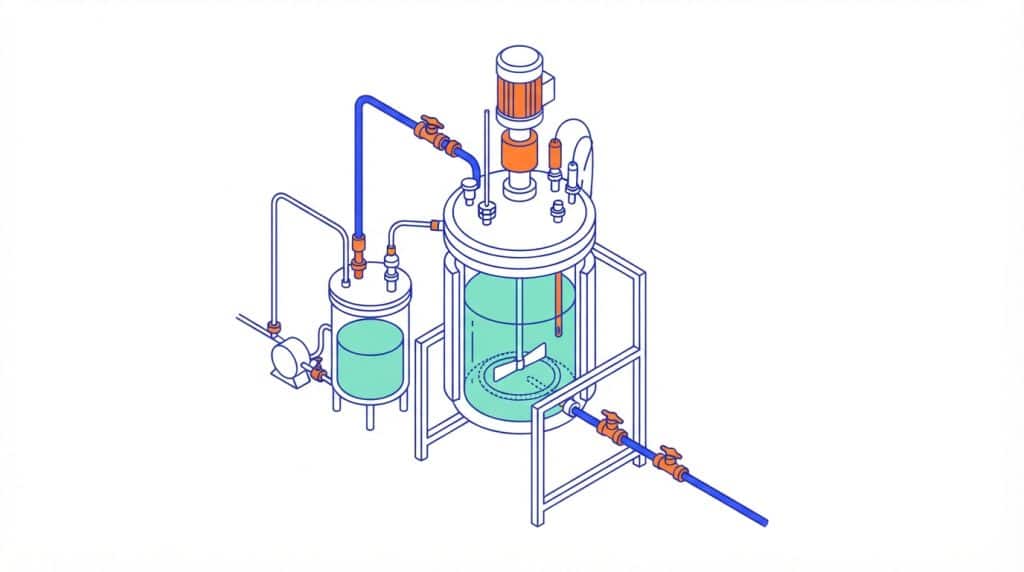
Running with almost no antifoam is not simple. In that study, the minimal-antifoam run needed a custom setup: a line that let foam escape into a carboy, an exhaust filter moved to a bottle mounted higher than the vessel, and a second impeller above the liquid as a partial foam breaker. The reason is that uncontrolled foam can wet the exhaust filter and compromise sterility. Even so, the run still received some antifoam, at least 24-fold less than the control runs.
Sources
- Biotechnology Progress, Impact of media and antifoam selection on monoclonal antibody production and quality using a high throughput micro-bioreactor system, Jan-Feb 2018.
- Bioprocess and Biosystems Engineering, Applications of off-gas mass spectrometry in fed-batch mammalian cell culture, 2020.
- Biotechnology and Bioengineering, Systematic Investigation of Impact of Antifoam and Extracellular Vesicles on Fouling of Hollow Fiber Filters in Intensified Perfusion Processes Highlights the Key Impact of Antifoam, July 2025.