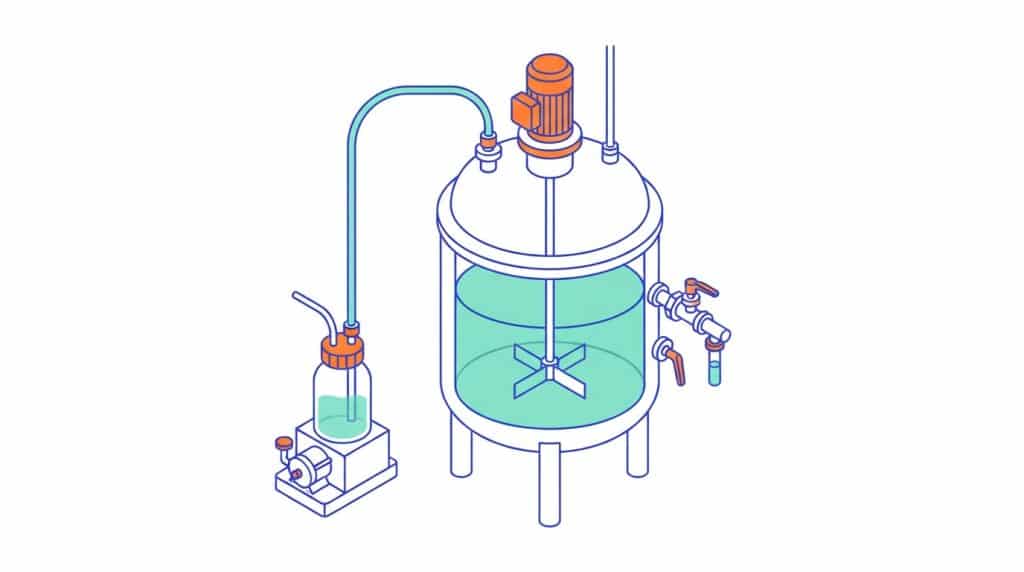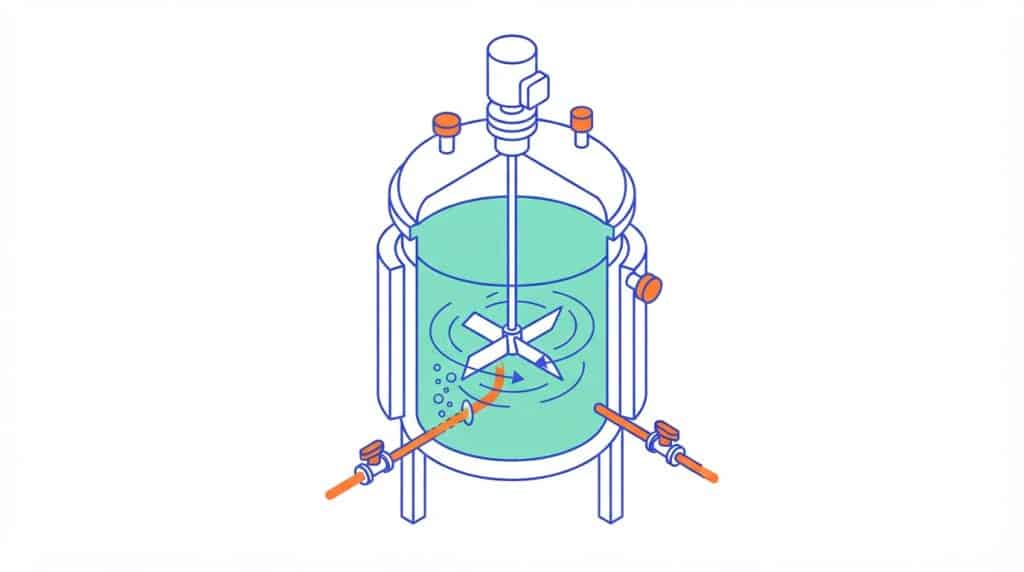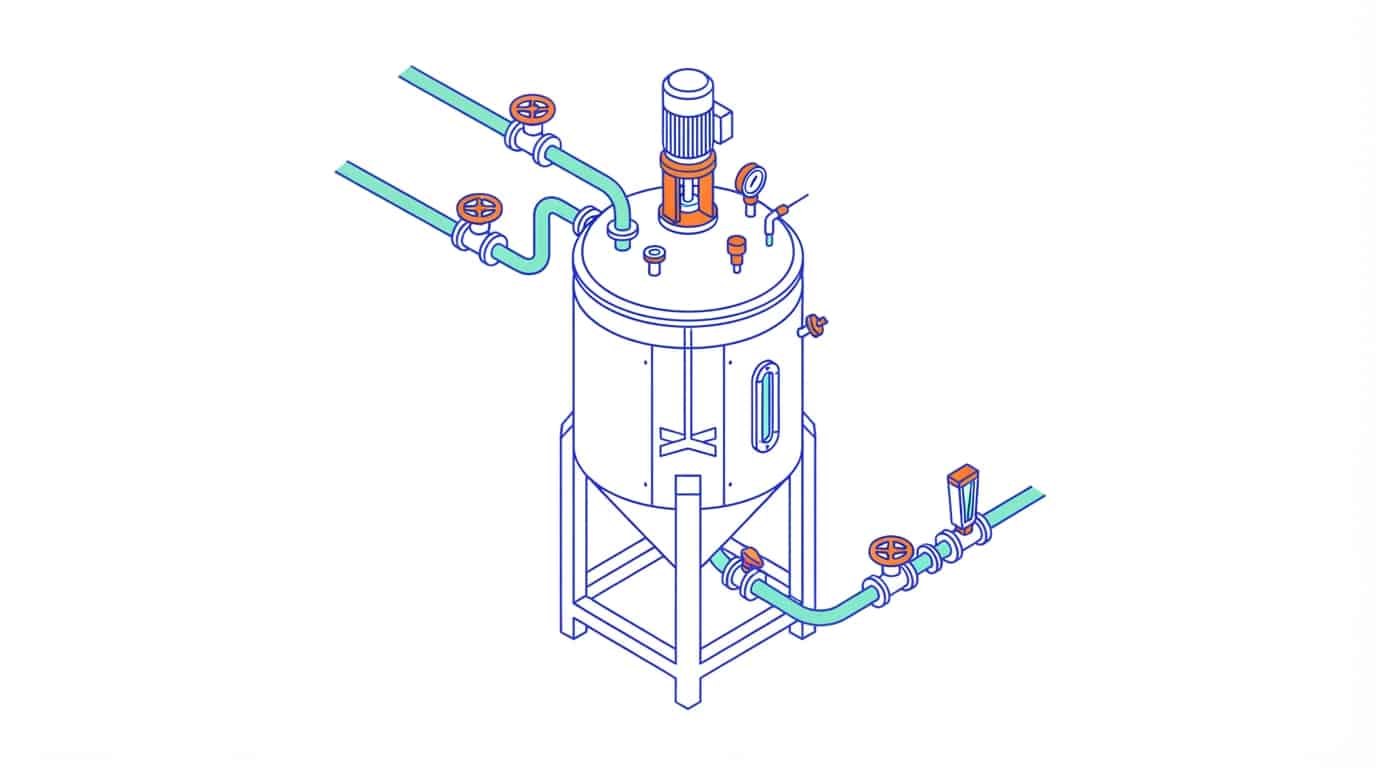
Pichia pastoris is a yeast that grows to very high cell densities and can release gram amounts of a foreign protein per litre of culture into the liquid around it. Production is switched on by adding methanol, which lets the plant first grow cells and then make product.
What kind of organism is it?
P. pastoris (now reclassified as Komagataella pastoris) is a methylotrophic yeast, meaning it can use methanol as its carbon source. It was first used more than 40 years ago to make single cell protein, a biomass sold as animal feed, in a high cell density fermentation on methanol. When the 1973 oil crisis made methanol expensive, that business stopped being economical. In the 1980s the same fermentation process was reused to make foreign (heterologous) proteins. Like E. coli, it is a microbe grown in a fermenter, and yeasts grow vigorously on inexpensive media. Unlike E. coli, it is a eukaryote (its cells have a nucleus and internal compartments), so it can add the chemical modifications to proteins that eukaryotic cells add.
How does it secrete protein into the medium?
The gene for the target protein is fused to a short signal sequence. The most common one is borrowed from baker’s yeast (the alpha-mating factor signal). The signal steers the new protein into the cell’s secretory pathway, the internal route that folds proteins and sends them out of the cell. Along the way the signal is cut off, and the finished protein ends up in the culture medium.
This matters for the plant because the product is already outside the cells. Yeast secretes only a small number of its own proteins, so the medium starts out relatively clean. The authors describe the main advantage as the ability to secrete high titres (the amount of product per litre of culture) of properly folded, processed and active protein.
What titres are we talking about?
The numbers depend heavily on the protein. One of the first large-scale processes, in the 1990s, made a plant enzyme, hydroxynitrile lyase, at more than 20 g of protein per litre of culture. A second review reports that P. pastoris made up to 15 g/L of secreted (extracellular) protein under the methanol-inducible promoter. Its table lists an insulin precursor at 3 g/L and a hepatitis B antigen at 7 g/L, but human serum albumin at 92.29 mg/L, which is about 0.09 g/L, and a human growth factor (GM-CSF) at 285 mg/L. The same host gives very different yields for different proteins.
How does methanol induction work?
A promoter is the stretch of DNA that switches a gene on. The one most used in Pichia, the AOX1 promoter, normally drives the yeast’s own methanol-digesting enzyme, alcohol oxidase. The product gene is placed under it. The promoter is strongly repressed (held off) while the cells grow on glucose, glycerol or ethanol. When those carbon sources run out it is released, but it is fully induced only when methanol is added.
In practice this gives two stages. First the cells grow on a repressing feed such as glycerol until the culture is dense. Then methanol is fed and the product is made. Because growth and production are uncoupled, cells are not stressed by product during growth, and even proteins that are toxic to the yeast can be made. The feed strategy in the second stage is the same idea as in a fed-batch culture, where nutrient is added over time.
The cost is methanol itself. It is highly flammable and hazardous, which makes it undesirable for large-scale fermentations. The alternative is a constitutive promoter, one that is always on. The GAP promoter, used on glucose, reaches almost the same expression level as methanol-induced AOX1, but its output falls to about one half on glycerol and about one third on methanol.
Where does it fall short of mammalian cells?
Not every protein is produced or secreted at high titre. Yields are frequently clearly lower for complex proteins: those built from several different chains (hetero-oligomers), those attached to a membrane, and those that the cell’s own enzymes chop up (proteolytic degradation).
Sugar chains are the other gap. Many therapeutic proteins carry N-glycans, sugar chains attached to the protein, and the pattern depends on the host. To get mammalian-type N-glycan structures in P. pastoris, strains must be engineered, for example by disrupting the OCH1 gene and adding human glycosylation enzymes. Mammalian cells such as CHO cells are the usual choice when the product needs that pattern without such engineering. In the other direction, a second review notes that yeast can resolve low-yield problems seen in mammalian systems.
Sources
- Ahmad M, Hirz M, Pichler H, Schwab H, Applied Microbiology and Biotechnology, Protein expression in Pichia pastoris: recent achievements and perspectives for heterologous protein production, 2014.
- Madhavan A et al., Microbial Cell Factories, Customized yeast cell factories for biopharmaceuticals: from cell engineering to process scale up, 2021.