Impeller tip speed is how fast the outer edge of the stirrer blade moves through the liquid, and hydrodynamic stress is the force that the moving liquid puts on the cells. Animal cells were once thought too fragile for hard stirring, but under normal production conditions shear damage is no longer considered a major problem, so the real task in scale-up is to keep the stress similar from one vessel to the next.
What tip speed and shear stress are
An impeller is the rotating blade that mixes a bioreactor. Its tip speed is the circumference of the circle the blade tip draws, pi times the impeller diameter, multiplied by the rotations per second. Take the 1,000 L vessel in a BHK-21 cell study (a hamster kidney cell line): its impeller is 429.7 mm across and turned at 50 rpm, which gives a tip speed of about 1.1 m/s. The 42 L vessel in the same study had a 108.0 mm impeller at 80 rpm, which gives about 0.45 m/s. A bigger vessel can run at fewer rpm and still have the faster blade tip.
Shear stress is the force per unit area that acts along the direction of flow, measured in pascals (Pa). It is not the same everywhere in the tank. High stress appears at the vessel wall and near internal structures such as impellers, and the liquid moves faster in the impeller zone than in the rest of the tank. Engineers map this with computational fluid dynamics (CFD), a computer simulation of the flow. In one study of seven vessels, simulated stress rose predictably with tip speed in each vessel.
Why animal cells were thought fragile
Mammalian cells have no cell wall, so researchers long assumed they were shear-sensitive. Damage was traced to three mechanisms: the physical action of the impeller, bursting gas bubbles, and the speed of gas as it enters the culture through the sparger (the device that bubbles gas in).
That worry has eased. Because CHO cells (the workhorse for antibody production) are used successfully in manufacturing-scale suspension culture, shear sensitivity under current normal conditions is no longer considered a major problem. Several studies found that agitation up to 600 rpm in a 2 L bioreactor has little impact on suspension cultures. In one experiment the maximum tolerable stress was 32.4 Pa for CHO cells and 25.2 Pa for mouse hybridoma cells. The average stress simulated in manufacturing-scale vessels was up to about 6 Pa: 3.02 Pa in a 1,800 L steel vessel at a tip speed of 0.86 m/s, and 5.85 Pa in a 5,000 L vessel at 1.47 m/s. Culture media commonly contain poloxamer to protect cells from bubble rupture at the liquid surface.
The quieter problem: lost productivity
Stress can hurt without killing. Cells may survive but make less product. In the CHO study, average shear stress correlated well with a drop in titer (the product concentration in the culture), and cell lines differed in how they responded. A lower titer raises the cost per unit of product, so shear sensitivity is worth testing for each cell line before scale-up.
Cell growth can also respond to stress. In the BHK-21 study, early growth rate and maximum cell density peaked when the average shear rate (the velocity gradient in the flow) in the impeller zone was 8.5 to 11.0 per second, and both fell as the rate rose further.
How engineers match stress when scaling up
Stirring has other jobs. Raising agitation helps to mix the liquid, supply oxygen and remove CO2 (see kLa and oxygen transfer), so it cannot simply be turned down. The usual scale-up rules keep one number constant: power input per unit volume, tip speed, mixing time, gas flow or oxygen transfer. These rules work within one type of vessel, but across different vessel designs they are hard to apply. Even the choice of rule matters. In a stem-cell study, seven scale-up parameters called for very different agitation rates, and holding the average energy dissipation rate (how fast the stirring power is turned into heat in the liquid) constant worked best.
The BHK-21 team used CFD to keep the whole flow environment similar, not one number. They scaled from 5 L to 42, 350 and 1,000 L by setting the agitation to 80, 65 and 50 rpm. The larger vessels reached a maximum cell density of 4.6 to 4.8 million cells/mL, against 4.8 million cells/mL in the 5 L vessel.
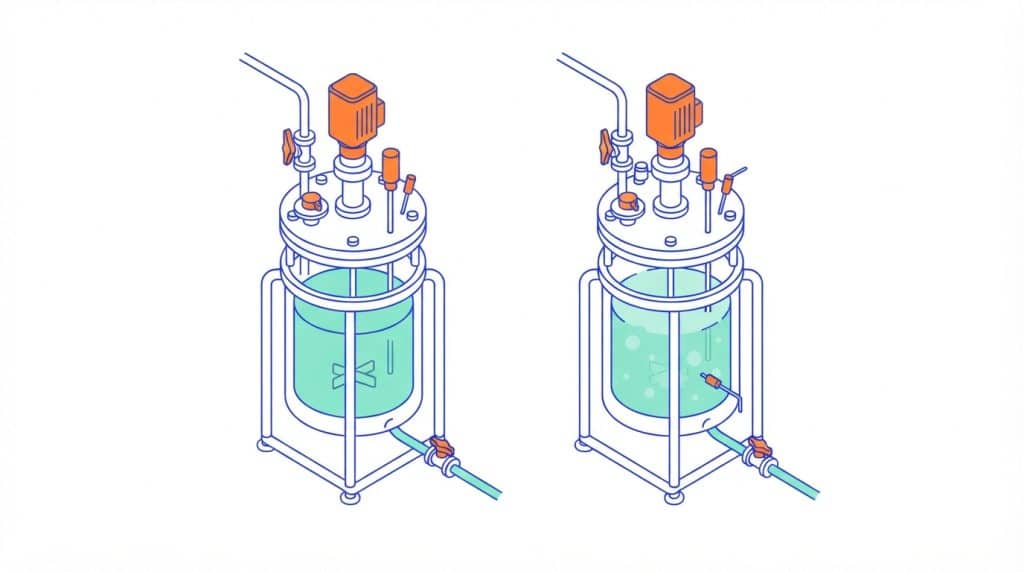
The CHO team built a small test vessel to check cells ahead of time. A 3 L glass vessel with extra impellers and fixed blades reproduced the high average stress of large vessels at a lower tip speed, without a vortex (a whirlpool that disrupts oxygen and CO2 control). See also why scale-up is hard.
Sources
- Kenmoku et al., Engineering in Life Sciences, Scale-Up Strategy Focused on Hydrodynamic Stress for Mammalian Cell Culture Established by a Dry-Wet Approach, Nov 2025.
- Teng et al., Bioresources and Bioprocessing, A novel scale-up strategy for cultivation of BHK-21 cells based on similar hydrodynamic environments in the bioreactors, Dec 2021.